
Why European Retailers Are Replacing SAP Forecasting Layers With Custom AI Models
TL;DR: European retailers do not need another forecasting module welded onto a SAP-shaped workflow. They need a forecasting system they can inspect, govern, and change. Eurostat reported retail trade volume in January 2026 up 1.5% year on year in the euro area and 2.0% in the EU,

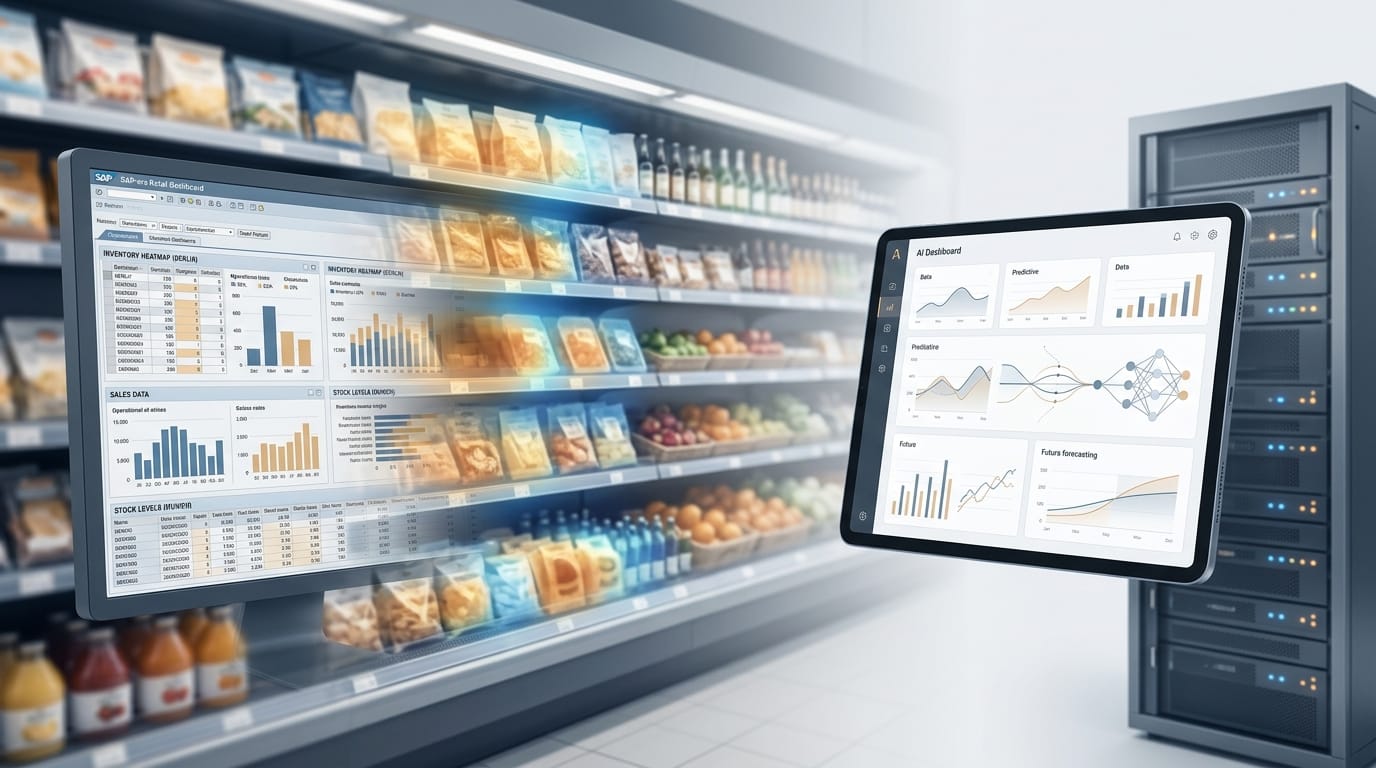
TL;DR: European retailers do not need another forecasting module welded onto a SAP-shaped workflow. They need a forecasting system they can inspect, govern, and change. Eurostat reported retail trade volume in January 2026 up 1.5% year on year in the euro area and 2.0% in the EU, which means demand is still moving while margins stay tight. At the same time, SAP says mainstream maintenance for SAP ERP 6.0 ends at the end of 2027, with an extended maintenance option until the end of 2030. That combination matters. If a retailer is already rethinking core architecture, this is the moment to stop renting forecasting logic and start owning the decision layer behind inventory, promotions, and replenishment.
The old promise was simple: put planning close to ERP, standardize the workflow, and trust the suite. That worked when the main problem was reporting discipline. It breaks when the actual problem is fast-moving demand, channel fragmentation, promotion volatility, and governance pressure around how AI systems behave. European retail forecasting is becoming a systems-design problem, not a module-selection exercise.
Retailers do not win by moving from one black box to another. They win when the judgment system behind margin lives inside a boundary they control.
Why are European retailers replacing SAP forecasting layers now?
Because the economics and the architecture are both pushing in the same direction.
Start with timing. SAP's published maintenance timeline means many retailers are already forced to make infrastructure decisions they would prefer to postpone. Mainstream maintenance for SAP ERP 6.0 ends at the end of 2027, and the extended option only carries some customers to 2030. That does not mean every retailer must rip out SAP tomorrow. It does mean the comfortable argument for leaving planning logic untouched is getting weaker by the quarter. Once a business is spending real money on migration, integration, and operating-model redesign, the obvious question appears: why keep the forecasting brain trapped in the old shape?
Now layer on market pressure. Eurostat's March 2026 release showed January retail trade volume up year on year across both the euro area and the wider EU. Growth is welcome, but it does not simplify planning. Uneven category performance, private-label pressure, promotion intensity, and cross-channel fulfillment complexity all make bad forecasts more expensive. Forecasting errors no longer show up as a harmless spreadsheet nuisance. They show up as stock-outs, excess inventory, panicked markdowns, and planners burning hours on overrides.
The usual response is to buy one more planning add-on, one more dashboard, one more vendor connector. That is how retailers accumulate software instead of capability. What they actually need is a system that can absorb current signals, explain its output, and write decisions back into the operating stack under explicit rules.
Direct answer: European retailers are replacing SAP forecasting layers now because maintenance deadlines are forcing architectural change at the same time that market volatility is making opaque planning logic too expensive to tolerate.
What is actually wrong with a SAP-centered forecasting stack?
The problem is not that SAP is useless. The problem is that ERP-centered planning logic was designed for process consistency, not for fast judgment across messy signals.
AWS defines demand forecasting as the process of predicting future customer demand over a defined period using historical and current data. That is accurate, but incomplete for real retail operations. A retailer does not just need a number for next week. It needs a governed answer to questions like these: which signals count by category, how do promotions distort the baseline, when should local store behavior override central patterns, and what downstream actions are safe to automate? Those are operating questions. They do not fit neatly inside a monolithic vendor workflow.
In practice, a SAP-centered stack often treats forecasting as a handoff problem. Data comes from POS, ecommerce, OMS, WMS, supplier systems, and product master tables. Someone spends weeks cleaning and reconciling it so the planning layer can consume it. The model runs. People export the output. Then they manually reconcile exceptions and push a version of the forecast back into replenishment or purchasing logic. That is not an intelligent system. It is a slow relay race.
Three costs follow. First, connector debt. Every source system change becomes a mini-project. Second, override culture. Because the planner cannot fully inspect or trust the logic, spreadsheets quietly reappear and become the real system of record for judgment. Third, write-back fragility. Once the business wants to use the forecast operationally, the final step into allocation, ordering, or store replenishment is brittle enough that teams avoid automation unless the stakes are low.
European retailers also face a governance wrinkle that many vendor pitches glide past. When AI-supported decision systems influence stock availability, pricing assumptions, or human workflow, the business increasingly needs traceability, role clarity, and documented controls. That pressure aligns badly with opaque forecasting layers and very well with systems the retailer can actually inspect.
Direct answer: A SAP-centered forecasting stack fails because it turns a live decision system into a chain of rigid handoffs. The result is connector debt, spreadsheet overrides, and weak operational trust.
What does a custom AI forecasting system look like instead?
It looks less like a module and more like a retailer-owned operating layer.
The first design choice is the deployment boundary. That does not have to mean literal hardware in a basement. It means the retailer decides where the models run, where sensitive data lives, how model changes are approved, and what telemetry is retained. For some operators that will mean private cloud. For others it will mean tightly controlled public-cloud environments with clear data boundaries. The key point is ownership. Mistral's enterprise deployment menu, which includes self-hosted, public-cloud, private-cloud, and vendor-hosted options, is a useful signal here. Deployment flexibility is no longer a luxury request from paranoid buyers. It is a normal enterprise requirement.
The second layer is connectors. A serious retail forecasting system needs clean access to POS events, product attributes, promotion calendars, inventory position, lead times, returns, ecommerce behavior, and planner overrides. Those connectors should be reusable product infrastructure, not a bag of one-off integrations. That is why reusable connector architecture for enterprise systems matters more than another synthetic AI demo. If you cannot move the right signals reliably, the model quality discussion is mostly theater.
Above the connectors sits the model and reasoning layer. This is where the system becomes useful. One model may handle short-horizon store replenishment. Another may forecast promotion lift by category. Another may detect when stock-outs are poisoning the training signal and need to be corrected before the next run. A policy layer then decides what the output can do: surface a recommendation, require planner approval, or write directly into a constrained replenishment queue.
This architecture also aligns better with European governance pressure. Regulation (EU) 2024/1689, the EU AI Act, creates a phased governance regime for AI systems. Not every retail forecasting workflow is automatically high-risk in the legal sense, but the operational lesson is still obvious: document what the system does, keep the decision path inspectable, and avoid magical black boxes that nobody in the business can defend. That is one reason deployment control and data security design should be treated as product requirements rather than late-stage compliance decoration.
The migration logic is deliberately practical. SAP can remain a system of record for transactions, finance alignment, and certain master-data responsibilities while the custom AI layer replaces the judgment loop around forecasting. That keeps the business moving while shifting the part that actually creates advantage: the reasoning between signals and action.
Direct answer: A custom AI forecasting system combines retailer-controlled deployment, reusable connectors, fit-for-purpose models, and explicit action policies so the forecast becomes a governed operational layer rather than a rented feature.
What does implementation look like in practice?
Usually six to ten weeks for the first workflow if the team is disciplined and the scope is honest.
The right starting point is not “replace all planning.” That is the sort of sentence consultants like because it keeps the invoice growing. A better first target is one forecast-driven workflow with visible economic pain: store replenishment for a volatile category, promotion-aware SKU forecasting, markdown planning support, or cross-channel inventory rebalancing. If the business cannot point to the pain in margin, availability, or planner time, the scope is too vague.
Weeks one and two are about process truth. Which systems actually matter? Which overrides happen in spreadsheets today? Which constraints are legal, commercial, or operational? Retailers often discover that the nominal process in SAP and the real process in the business are different species. That is useful. It tells you what the system needs to replace rather than what the org chart says should exist.
Weeks three and four are about connectors and control points. Stand up the smallest reliable data paths from POS, promotions, inventory, lead times, and product metadata. Decide where the forecast lands. Is it advisory? Does it route into a replenishment work queue? Does a planner approve exceptions above a threshold? If the write-back path is vague, the project will drift into dashboardware and die politely.
Weeks five and six are about behavior and trust. This is where a forward-deployed engineer earns their keep. Somebody has to translate category nuance, commercial pressure, and system behavior into concrete product decisions. That person sits with planners, merchants, and engineers long enough to turn local reality into deployable logic. Without that bridge, teams often build a model that looks clean in a notebook and gets ignored in production because the explanation layer is weak or the workflow fit is wrong.
The objections are predictable. “Our data is messy.” Yes, which is why connector design is the real work. “Our categories behave differently.” Good, then stop forcing them through one generic model. “We cannot allow automated actions yet.” Fine, start with ranked recommendations and approval thresholds. “We have already invested in SAP.” Also fine. Keep what still earns its place, but stop confusing sunk cost with future architecture.
If the first workflow works, the economics improve quickly. The same connectors, policy framework, and deployment boundary can support adjacent use cases: inventory balancing, supplier-risk planning, promotion planning, and assortment support. That is a much better compounding pattern than purchasing yet another sealed planning component.
Direct answer: Real implementation starts narrow, builds reliable connectors first, defines clear approval and write-back rules, and uses a forward-deployed engineer to make the system fit actual retail operations.
What results should a retailer expect from replacing the forecasting layer?
Expect better operational control before you expect magic. That is the healthy order.
The first gain is speed. When the model layer sits closer to live retail signals, planners can respond faster to demand shifts, promotion effects, and local inventory constraints. The second gain is cleaner working-capital judgment. If the business can inspect why a forecast changed and tie action rules to explicit thresholds, it can reduce avoidable buffer stock and markdown noise. The third gain is compounding infrastructure. Once the retailer owns the connectors, policies, and deployment model, the next workflow is cheaper than the first.
This is the part many market articles miss. The advantage is not only forecast accuracy. Accuracy matters, but a slightly better number inside an opaque system is often less valuable than a transparent system the business can trust, tune, and expand. That is why InfraHive's approach makes sense in retail just as it does in finance: build the client-owned system, then replace the brittle legacy logic around it. The same instinct behind MetricFlow's client-owned finance operating model applies here too. Put the judgment layer where the company can inspect it.
If you want proof of the pattern rather than another maturity matrix, look at customer stories and deployment outcomes. The recurring theme is not “AI did everything.” It is that teams regained control over the systems making important decisions.
Direct answer: Replacing the forecasting layer improves reaction speed, planner trust, and the economics of future AI deployments. The strategic gain is owned operational control, not just a higher model score.
What does this mean for European retail over the next two years?
It means forecasting is becoming a sovereignty issue as much as a planning issue.
European retailers are being pushed by both business pressure and governance pressure. Margin remains fragile. Channel behavior is uneven. At the same time, the regulatory climate rewards systems that can be documented, constrained, and audited. That does not mean every retailer needs a dramatic “rip and replace” story. It means the winners will separate systems of record from systems of judgment and treat the second category as core infrastructure.
The laggards will keep buying packaged comfort. The leaders will keep the data boundary under their control, move faster on workflow-specific AI, and build reusable foundations that survive vendor churn. In a market where timing, inventory, and pricing mistakes show up quickly, that is not a philosophical difference. It is a margin difference.
Direct answer: Over the next two years, European retailers that own their forecasting infrastructure will move faster, govern better, and protect margin more effectively than retailers still trapped inside generic planning logic.
So what should a retailer do next?
Pick one forecast-driven workflow where the current stack is obviously too slow, too manual, or too opaque. Keep the deployment boundary and data policy under your control. Build connectors like product infrastructure, not afterthoughts. Then prove value in one loop before expanding.
If that sounds more sensible than buying another planning wrapper, start at https://infrahive.ai and explore what a client-owned AI system looks like for your stack. The point is not to “modernize forecasting.” The point is to own the reasoning system behind retail margin.
Direct answer: Start with one painful workflow, own the boundary, and replace forecasting logic with a governed system you can inspect and improve.
Frequently Asked Questions
Do retailers need to remove SAP completely to use custom AI forecasting?
No. Many teams keep SAP as a system of record while a custom AI layer replaces the forecasting judgment loop around inventory, promotions, and replenishment.
Why is SAP maintenance timing relevant to forecasting decisions?
Because once a retailer is already reassessing architecture due to end-of-maintenance pressure, it becomes rational to question whether forecasting logic should stay trapped inside the old vendor-shaped stack.
What makes a custom AI model better than a planning-suite module?
The value is control. Retailers can decide where the model runs, what data it uses, how output is explained, and when actions require human approval.
Does the EU AI Act force retailers to build on-prem AI?
No. But it does strengthen the case for traceable, well-governed AI systems with clear deployment boundaries and documented controls.
What is the safest first workflow to replace?
A narrow, high-friction workflow such as promotion-aware demand forecasting, category-level replenishment support, or inventory rebalancing usually offers the clearest path to measurable value.