
Why Mid-Market Ecommerce Finance Teams Are Replacing RPA with AI-Native AP Automation
TL;DR: AI-native AP automation is replacing RPA in mid-market ecommerce finance because payable work is no longer a stable set of rules. McKinsey's State of AI research keeps making the same point in different ways: adoption is rising, but value capture is uneven. Gartner added a

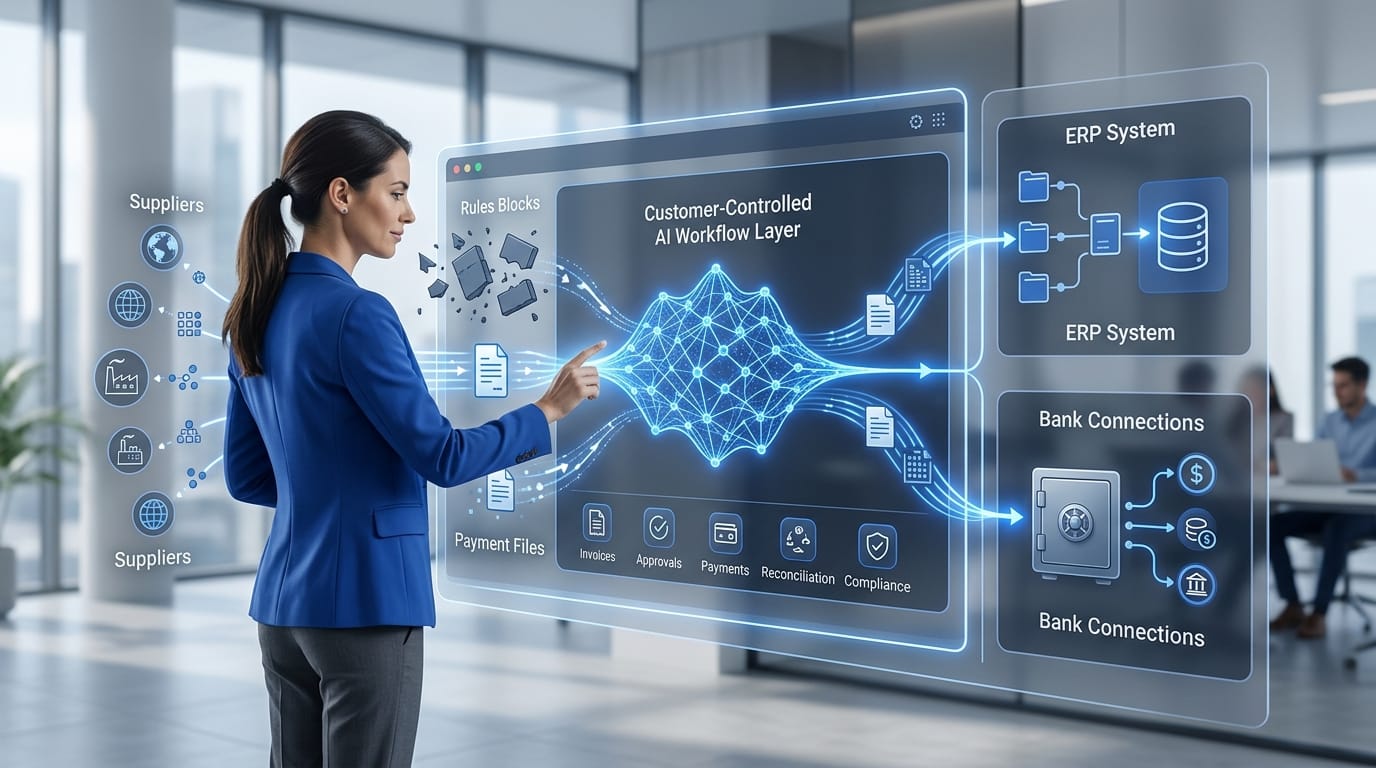
TL;DR: AI-native AP automation is replacing RPA in mid-market ecommerce finance because payable work is no longer a stable set of rules. McKinsey's State of AI research keeps making the same point in different ways: adoption is rising, but value capture is uneven. Gartner added a hard budget signal in March 2024 when it said 55% of supply chain organizations will invest in applications supporting AI and advanced analytics by 2026. The spend is real. The failure mode is still execution. In ecommerce AP, rule bots fail when exceptions multiply. AI-native systems win when they can gather evidence across ERP, bank data, supplier records, marketplaces, inboxes, and approval rules, then act inside a customer-controlled boundary.
That distinction matters because ecommerce finance is one of the least honest places in enterprise software. Everybody says “automation,” but much of the stack still depends on people repairing broken handoffs between invoices, receipts, settlement files, landed costs, return adjustments, and supplier disputes. If the workflow still breaks every time a policy changes, the company did not automate AP. It just moved the chaos into a more expensive interface.
RPA works until the business changes. Ecommerce businesses change every week.
Why are ecommerce finance teams moving past RPA?
Because ecommerce AP is an exception-handling problem disguised as a document-processing problem.
That difference is where most automation projects go sideways. The invoice is not the hard part. The hard part is everything around it: a marketplace deduction that does not match the supplier expectation, a freight surcharge that arrived in a different system, a receipt posted late, a landed-cost adjustment that changed the math, a return reserve that affected the payable, a vendor master inconsistency, or an approval threshold that now depends on margin pressure rather than a static amount. Rule bots can move the happy path quickly, but ecommerce finance is full of unhappy paths.
Classic RPA breaks because it assumes workflow logic stays stable long enough to justify endless script maintenance. In ecommerce, it rarely does. Merchants add channels. Procurement patterns shift. Suppliers change. Promotions distort demand. Returns spike. Cross-border tax and duty treatment evolve. PSP settlements introduce their own reconciliation weirdness. The business changes, and the bot breaks. Then humans become the middleware again.
This is also why the old ERP-centered view is too narrow. Systems like SAP, Oracle, NetSuite, and channel-side finance tooling remain important systems of record, but the decision path no longer lives neatly inside them. AP teams need evidence from procurement systems, inboxes, warehouse events, payment rails, expense logic, and policy notes that may never have been fully formalized. Stripe's AP automation explainer is useful for showing the market direction toward digitized payables, but generic AP content usually stops before the real issue: who owns the cross-system judgment layer when conditions stop matching the template?
Governance pressure makes this more urgent. The European Commission says the AI Act entered into force on 1 August 2024. Even when a payable workflow is not directly classified as high-risk AI, the practical message is obvious across Europe and increasingly the US as well: know your intervention path, know your audit trail, know your data boundary. That is a bad fit for brittle automation patches nobody can fully explain six months later.
Direct answer: Ecommerce finance teams are moving past RPA because payable work keeps changing, exceptions are cross-system by nature, and static bots cannot carry the judgment, evidence, and governance requirements now attached to AP automation.
What is broken in the old AP automation model?
The old model assumes that if you digitize invoices, add OCR, and route approvals, the hard work is done. It is not.
In a mid-market ecommerce business, the payable decision usually depends on much more than invoice extraction. Was inventory actually received? Did the 3PL book quantities correctly? Did the marketplace or PSP take a fee that changes the expected amount? Was a credit memo created but not tied back cleanly? Is a supplier being put on tighter controls because of fulfillment issues? Did somebody authorize a rush replenishment over email? Did a return wave create downstream adjustments that accounting has not yet reflected? None of these questions are exotic. They are normal. That is the problem.
Old AP automation stacks typically fail in one of three ways. First, they overfit to the happy path, so exception queues just grow. Second, they move the bottleneck from entry to triage, forcing AP analysts to inspect more records manually because the system cannot assemble enough context. Third, they create operational debt through script sprawl. Every new supplier edge case, tax nuance, approval branch, or settlement pattern becomes another patch. Finance leaders think they bought automation, but what they really bought was a maintenance backlog.
The ecommerce environment makes that backlog nastier than in simpler industries. Margin sensitivity is high. Inventory timing matters. Chargebacks and deductions eat time. Refund and return behavior can affect how liabilities are interpreted. International operations drag in VAT, duty, and currency variation. Meanwhile, AP still has to close the books on time. The cost is not just labor. It is delayed visibility and slower reaction when the business is already under pressure.
Direct answer: The old AP model is broken because it automates document intake but not judgment. In ecommerce, judgment is the expensive part.
What does AI-native AP automation actually look like?
It looks less like a bot that follows a script and more like a governed workflow layer that can gather evidence, apply policy, and prepare or execute action safely.
The first requirement is connectors. A real AP system cannot reason well if it only sees invoice images and ERP tables. It needs governed access to procurement data, receipts, PO status, supplier history, settlement files, payment records, approval rules, and often the messy side channels where exception truth lives. That is why enterprise connector architecture matters so much. The model choice is not irrelevant, but in week one the bigger determinant of value is whether the system can see the right evidence at the right time.
The second requirement is context assembly. A useful AI-native AP workflow does not just classify a document. It assembles a decision packet: what was ordered, what was received, what changed, which policy applies, who can approve, what risk flags exist, and what write-back should happen next. That is the architectural jump RPA never really makes. RPA follows a path. AI-native workflow systems can decide which path should even be taken.
The third requirement is policy encoding. AP exceptions become expensive because business rules are partly formal and partly tribal. Some invoices can auto-approve under threshold. Some need dual approval if margin is compressed. Some suppliers can be paid despite a mismatch because of continuity risk; others must be held. Some deductions are acceptable if a marketplace settlement explains them; others require dispute creation. A good system has to make those rules executable, inspectable, and adjustable.
The fourth requirement is deployment boundary control. Mistral's May 2025 Le Chat Enterprise launch matters here because it made enterprise deployment options explicit: self-hosted, private cloud, public cloud, and hosted. That is not trivia. It is a market signal that serious buyers now expect boundary choice. In finance workflows, that choice affects data movement, review friction, security sign-off, and vendor risk. If the payable logic depends on infrastructure you do not control, you are still outsourcing part of your operating judgment. That is exactly why security and data-control design should be in scope from day one.
The fifth requirement is write-back and auditability. AI-native AP should not stop at summarizing a discrepancy. It should route the case, prepare evidence, draft the approver action, update the relevant record, and keep an audit trail of what happened and why. That is the difference between an assistant and a workflow system. It is also where InfraHive's approach fits naturally: customer-controlled AI data processing and workflow automation deployed on infrastructure the customer owns, with policy and system actions living inside that boundary rather than outside it.
Direct answer: AI-native AP automation combines governed connectors, context assembly, executable policy, customer-controlled deployment, and auditable system actions so finance teams can automate exceptions instead of merely documenting them faster.
What does implementation look like in practice?
Usually 3 to 4 weeks for the first serious workflow if the team starts with one painful exception class and behaves honestly about the mess.
The best first target is not “AP transformation.” It is one expensive failure pattern: PO-invoice mismatches above threshold, freight and landed-cost exceptions, supplier credits not being netted correctly, marketplace deduction handling, or invoice approvals that keep stalling because evidence lives in five systems. Pick a case where people are obviously acting as the integration layer between software and reality. That is where AI-native workflow design pays back fastest.
Week one are about evidence, not promises. Which systems hold authoritative receipt status? Where do supplier disputes actually begin? Which fees or deductions are predictable enough to codify? Which approvals are formal, and which ones still happen over Slack or email? This is the phase where many teams discover the process map was too clean. Good. Better to learn that before rollout than after.
Week two are connector and policy work. Bring the relevant ERP, procurement, banking, channel, and inbox signals into one governed boundary. Decide what the system may read, recommend, draft, and execute. Define confidence thresholds. Define mandatory evidence. Define when a human must intervene. This is where RPA-era teams often get exposed, because the old automation assumed the path was already known. In reality, the path has to be reconstructed from fragmented operational truth.
Week three are behavior, monitoring, and rollout. Start with one supplier group, one entity, one exception type, or one approval band. Compare cycle time, manual touches, escalation volume, and rework. Keep ERP as the book of record if needed. Replace the judgment layer first. That migration path is much safer than trying to replatform finance all at once.
The objections are familiar. “Our supplier data is messy.” Of course it is. “Our policies are changing.” Then static bots are the wrong architecture. “Security will slow this down.” Only if the design pretends boundary control is an afterthought. “We already automated AP.” If analysts still spend their day reconstructing context and explaining exceptions, you automated intake, not AP.
Direct answer: Real implementation starts narrow, maps the ugly exception path first, builds connectors and policy before polish, and expands only after the first workflow proves it can survive production finance reality.
What results should operators expect?
The first result is less drag in the payable chain, not a flashy AI demo.
When AI-native AP is done properly, cycle times shrink because the system assembles the evidence before the analyst touches the case. Manual touches fall because exceptions arrive with context instead of as mystery tickets. Approver time drops because the system can explain what changed, what rule applies, and what action is recommended. Rework declines because write-back and audit logic are designed into the workflow rather than bolted on later.
The second result is compounding infrastructure. Once the business has usable connectors, policy patterns, review logic, and audit trails for AP, the next workflow gets cheaper. Expense controls, close support, deduction handling, revenue-adjacent reconciliations, and IT-finance approval paths can reuse the same foundation. That is the better economic story. It is also why products like MetricFlow matter in the InfraHive stack: the value is not one isolated workflow, but a governed operating layer that can expand across finance and operations.
You can see the same logic in customer deployment outcomes. The proof is not that the model can read an invoice. The proof is that fewer humans need to play detective before money moves.
Direct answer: Expect faster exception resolution, fewer manual handoffs, better auditability, and lower marginal cost for each additional workflow built on the same governed foundation.
What does this mean for ecommerce operators in Europe and the US?
It means finance automation is now an infrastructure decision, not just a tooling decision.
European operators will feel the governance and data-boundary pressure more explicitly as AI controls tighten and buyer expectations shift. US operators may frame the same issue through vendor risk, security review, and operating leverage. Either way, the conclusion is similar: if your payable workflow depends on judgment, your AI system needs a boundary you can defend technically and commercially.
Ecommerce leaders who move first will not just process invoices faster. They will turn AP into a cleaner operating signal for the rest of the business: inventory, procurement, margin, supplier performance, and close readiness all get sharper when payable exceptions stop living in inboxes and tribal memory.
Direct answer: EU and US ecommerce operators should evaluate AP automation partly on who controls the workflow boundary, the policy logic, and the system actions—not just on OCR accuracy or chatbot polish.
So what should a finance team do next?
Pick one payable workflow where humans are obviously serving as the glue between old systems and current business reality. Rebuild that path first. Keep the ERP if you need it. Just stop pretending script maintenance is a long-term finance strategy.
If you want to explore what customer-controlled AI workflow automation looks like on infrastructure you control, start at https://infrahive.ai and explore how this works for your stack. The next generation of AP automation will not be the team with the prettiest bot. It will be the team that owns the workflow.
Direct answer: Start with one expensive exception path, choose a governed AI workflow system over script sprawl, and expand only after the first deployment earns trust.
Frequently Asked Questions
Why does ecommerce AP break RPA so often?
Because ecommerce payable workflows change constantly across suppliers, channels, settlements, returns, freight, and approval rules, so static scripts keep colliding with new exceptions.
Does AI-native AP automation replace ERP?
Usually no. The safer first move is to keep ERP as the system of record and replace the judgment-heavy workflow layer around it.
What systems should an AP workflow connect to?
At minimum it usually needs ERP, procurement, receipts or warehouse data, payment and bank records, supplier documents, approval logic, and the communication channels where exceptions are resolved.
Why does deployment boundary matter in finance workflows?
Because boundary decisions affect security review, data movement, auditability, vendor risk, and whether the business truly controls how sensitive financial context is processed.
What is the biggest mistake in AP automation projects?
The biggest mistake is treating extraction as the product. In production, the real product is the governed workflow that resolves exceptions and writes back safely.