
Predictive Maintenance in Manufacturing: Stop Renting AI, Start Owning It
TL;DR: Predictive maintenance in manufacturing creates real value only when the models, telemetry, and decision loops run close to the machines and under the manufacturer's control. IBM cites Deloitte findings that predictive maintenance can reduce facility downtime by 5-15% and

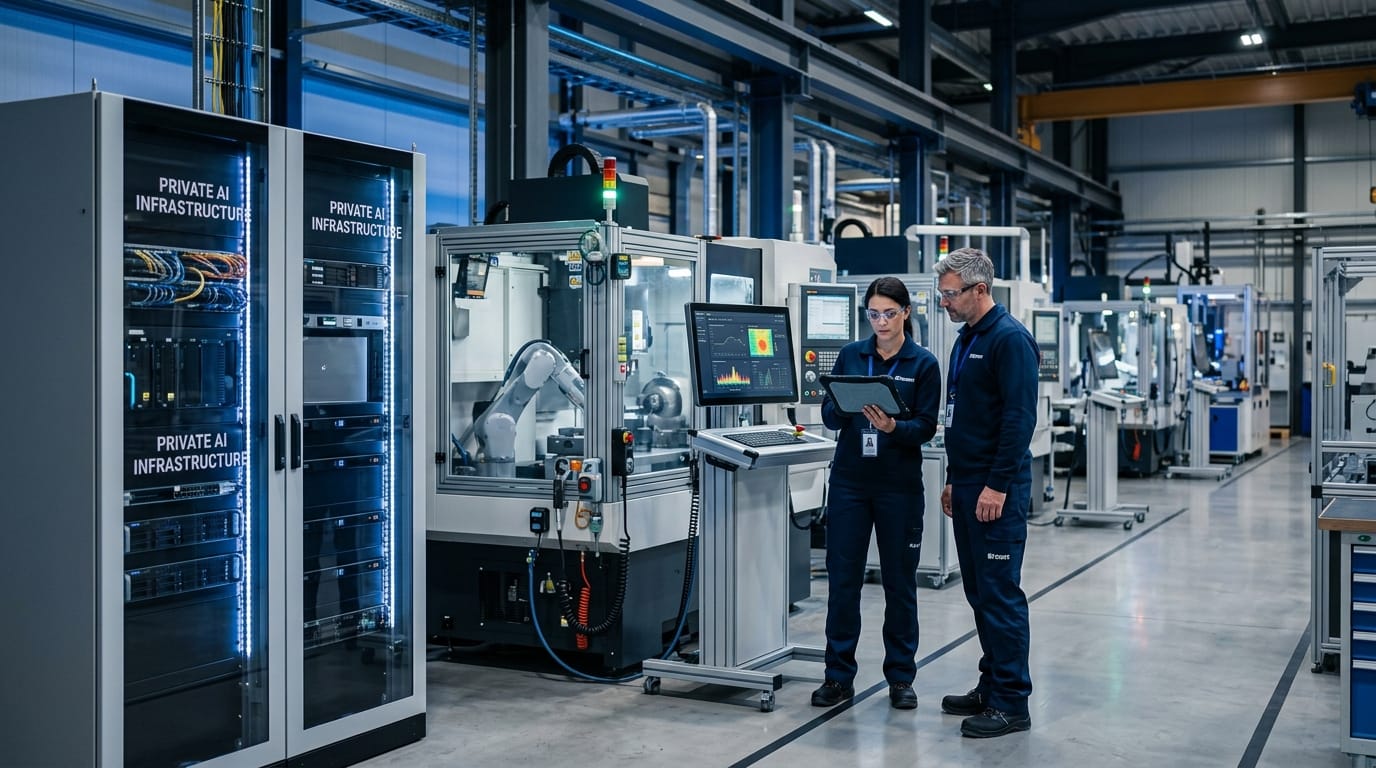
TL;DR: Predictive maintenance in manufacturing creates real value only when the models, telemetry, and decision loops run close to the machines and under the manufacturer's control. IBM cites Deloitte findings that predictive maintenance can reduce facility downtime by 5-15% and increase labor productivity by 5-20%, but those gains get diluted fast when the workflow depends on another vendor boundary, another cloud hop, and another fragile connector chain. The manufacturers that win here will not just buy maintenance AI. They will own the system that decides when action happens.
Most factories do not have a maintenance-data problem. They have a maintenance-judgment problem. The signals already exist: vibration, temperature, current draw, failure history, operator notes, work orders, and production context. What is missing is a system that can reason across all of it fast enough to matter. ERP and CMMS platforms were built to record work. They were not built to continuously decide what should happen next.
The maintenance stack that protects your uptime should not depend on somebody else's default architecture, pricing model, or API terms.
Why is predictive maintenance in manufacturing being re-architected now?
The shift is happening because predictive maintenance has moved from analytics theater into operational infrastructure. Plants are no longer asking for another dashboard that predicts failure in theory. They want a system that can triage an anomaly, compare it to maintenance history, rank likely root causes, suggest an intervention, and push the result back into the workflow before downtime compounds.
That change breaks the old architecture. In the legacy model, telemetry goes one way, records go another, and the judgment layer still lives in a planner's head or a maintenance manager's notebook. Historians hold machine data. MES holds production context. ERP and CMMS hold work orders and asset history. None of those systems wants to be the reasoning engine. Teams bolt cloud analytics on top, then wonder why the last mile still depends on screenshots, spreadsheets, and escalations.
There is also a broader market signal. In May 2025, Mistral launched Le Chat Enterprise with self-hosted, private cloud, public cloud, and hosted deployment options. Major model vendors usually optimize for easy revenue. When they invest in self-hosted and hybrid delivery, they are responding to enterprise demand for control. That matters in manufacturing because maintenance is not a chatbot use case. It is an uptime use case.
The regulatory pressure is rising too. The European Commission says the AI Act is the world's first comprehensive legal framework on AI and that it entered into force on 1 August 2024. Whether a manufacturer operates in Europe or sells into it, governance and traceability are no longer side issues. If an AI system influences maintenance decisions on critical equipment, the ability to explain inputs, rules, and deployment boundaries starts to matter in a boring, expensive way.
Direct answer: Predictive maintenance is being re-architected now because the value lives in operational decisions, not in monthly reporting. Once AI starts shaping maintenance actions in real time, low-latency access, data custody, and infrastructure control become design requirements rather than nice-to-haves.
What is broken in the ERP-and-CMMS-centered model?
The problem is not that ERP or CMMS systems are useless. The problem is that they are systems of record pretending to be systems of judgment.
A typical maintenance flow still looks like this: a machine starts behaving strangely, telemetry crosses a threshold, an operator flags an issue, someone opens a ticket, a supervisor checks historical failures, another person reviews the planned production schedule, and only then does the organization decide whether to intervene. Every step is defensible. The overall system is still slow. The delay is not one giant failure. It is death by twenty tiny handoffs.
Legacy enterprise software also fragments the evidence. The technician note that explains the real issue is buried in a work order comment. The process upset that caused the anomaly sits in MES. The spare-parts constraint is in ERP. The image of a recurring defect is in a file store. The actual model cannot reason well unless those systems are connected, permissioned, and queryable in one place. Most maintenance programs never solve that. They just buy a tool that scores anomalies and hope the organization will absorb the rest manually.
That is why so many predictive maintenance programs stay stuck at pilot stage. The model may be accurate enough, but the surrounding workflow is still rented architecture. The plant ships sensitive operational data into a cloud product, waits for a score, and then manually reconciles the answer with systems that were never designed to cooperate. It is not that the AI is wrong. It is that the architecture is weak.
And the economics are not forgiving. IBM's maintenance overview cites Deloitte findings of a 5-15% reduction in facility downtime and a 5-20% increase in labor productivity. Those are serious numbers. But if the path from signal to action is buried under connector delays, governance reviews, token cost, and analyst cleanup, the architecture taxes the very ROI it claims to unlock.
Direct answer: The ERP-and-CMMS-centered model breaks because maintenance decisions depend on evidence spread across multiple systems, while the actual judgment still happens manually. Predictive maintenance only works at scale when the reasoning layer can read across those systems and act fast enough to matter.
What does an AI-native maintenance architecture actually look like?
The replacement is not "CMMS, but with an assistant." It is a controlled decision system built around local data access, governed connectors, and action-oriented inference.
At a practical level, the architecture looks like this. Telemetry from PLCs, historians, vibration systems, and condition-monitoring tools stays inside a governed plant or enterprise boundary. Maintenance history, asset master data, and work orders remain available from CMMS and ERP replicas. SOPs, troubleshooting guides, and technician notes are indexed into a retrieval layer with access controls. A model orchestration layer reads across those sources, using smaller local models for classification and anomaly tagging and larger controlled models for ranked reasoning over combined context. Outputs are not just summaries. They are maintenance recommendations with evidence: likely fault, confidence, affected asset, relevant precedent, and suggested next action.
That system behaves differently from the old stack in three important ways.
1. It keeps the sensitive loop on infrastructure you control
Maintenance AI is not just text generation. It touches plant telemetry, asset behavior, production schedules, and often proprietary process knowledge. When that data is competitively sensitive or operationally critical, the default answer should be infrastructure you control: on-prem GPU nodes, edge servers near the plant, or a tightly governed private cloud. That is why controlled AI deployment and security design matters as architecture, not brochure copy.
2. It treats connectors as product, not project clutter
Most enterprise AI deployments fail in connector hell. Maintenance is especially vulnerable because the relevant data is scattered across OT and IT boundaries. The winning setup standardizes access to work orders, sensor streams, failure history, spare-part data, and SOPs early, then exposes those connectors as reusable capabilities. That is exactly why a governed connector layer is central to the system rather than an afterthought.
3. It writes back into the workflow with evidence
The point is not to generate a clever paragraph about bearing wear. The point is to help the plant act. A useful system opens or enriches a work order, flags a likely root cause, points to the relevant maintenance precedent, and shows what evidence it used. It turns fragmented signals into operational action with traceability.
The architecture is usually hybrid, not ideological. Some plants will keep the highest-sensitivity inference entirely local. Others will let non-sensitive workloads burst into a private cloud. The important thing is that the manufacturer chooses the boundary. The vendor does not choose it by default.
Direct answer: An AI-native maintenance architecture keeps telemetry and records in a governed client-controlled boundary, uses connectors to reason across MES, CMMS, ERP, and plant data, and pushes evidence-backed actions back into the workflow. That is fundamentally different from buying another hosted scoring layer.
What does implementation look like in the real world?
A real deployment is narrower, faster, and more operational than most buying committees expect.
Week one is scope discipline. Pick one failure mode or asset family where the economics are obvious: recurring stoppages on a constrained line, chronic bearing failures, compressor anomalies, or a machine class where maintenance notes already contain useful pattern data. If you start plant-wide, you are buying confusion.
Weeks two and three are connector and data work. That means identifying the minimum viable sources: sensor data, maintenance logs, recent work orders, equipment hierarchy, spare-part references, and production context. This is where teams discover whether they actually own their data paths or whether every useful signal is trapped inside a vendor-specific screen. The answer determines whether the deployment becomes product or PowerPoint.
Weeks four through six are model and workflow tuning. Smaller models can classify issues, normalize notes, and tag anomalies cheaply near the data. A stronger reasoning model can sit behind retrieval and citation requirements to explain why one maintenance action is ranked above another. Human review stays in the loop at the start because the goal is not blind automation. The goal is trusted compression of human judgment.
Weeks seven through ten are where a forward-deployed engineer earns their keep. This role matters because predictive maintenance is not solved by generic solution architecture. Someone has to sit between the plant, IT, reliability engineering, and management and make the system useful under real constraints. They have to learn how technicians describe failures, which alerts are ignored, what evidence a planner trusts, and where the rollout can safely begin without disrupting production.
The migration path should also stay sane. Do not rip out ERP or CMMS. Keep them as systems of record while the AI-native layer replaces the manual judgment loop around them. Let the old systems store work order history and asset structure while the new layer handles reasoning, ranking, retrieval, and recommendation. If it proves itself, more of the workflow can move later.
Common objections are predictable.
"Our data is too fragmented." Of course it is. Manufacturing data is fragmented by default. That is why the connector layer matters.
"We cannot send plant data outside approved environments." Good. Then do not. Use on-prem or tightly controlled private deployment.
"We need proof before rollout." Also good. Start with one measurable workflow and instrument it hard.
Direct answer: A serious predictive maintenance deployment starts with one high-value workflow, a controlled connector layer, and a forward engineer who can bridge maintenance reality and model behavior. It does not start with a generic enterprise assistant.
What results should manufacturers expect?
The first result is usually not magic accuracy. It is decision compression.
A good system reduces time spent gathering evidence, shortens the path from anomaly to intervention, and makes maintenance decisions more consistent across shifts and sites. That is where the downtime and labor-productivity gains start to show up. The model matters, but the surrounding architecture matters more. If the reasoning layer can see the evidence and return an action with context, teams stop wasting hours assembling the picture manually.
The second result is compounding reuse. Once the plant has a governed layer that can read telemetry, work orders, SOPs, and enterprise context in one place, new workflows become cheaper to add. The same foundation that handles maintenance triage can support quality root-cause analysis and operator copilots. That is the real payoff of owning the stack instead of renting a point solution.
This is where InfraHive's approach becomes more interesting than generic implementation work. The point is not to add another dashboard. It is to replace brittle decision paths with AI-native systems running on infrastructure the client controls. The same pattern shows up in customer-story style proof and transformation work and in products like MetricFlow: shrink the software stack, move logic closer to the operating problem, and stop paying for systems that mainly document yesterday.
Direct answer: Expect the first gains to show up as fewer manual hops, faster interventions, and more consistent maintenance calls. Expect the larger gains to come later, when the same governed AI foundation starts replacing multiple ERP-adjacent workflows without rebuilding the stack each time.
What does this mean for manufacturers in Europe and the US?
For European manufacturers, the signal is straightforward. AI governance and data control are moving from policy language into system design. If your maintenance AI affects critical assets, regulated production, or cross-border data flows, ownership of the deployment boundary is becoming the safer default. The EU AI Act did not create this operational need, but it made it harder to ignore.
For US manufacturers, the pressure often sounds more practical than regulatory: cost control, resilience, labor scarcity, and IP protection. But it lands in the same place. Nobody wants the line's most important maintenance decision delayed by a cloud round trip, a broken integration, or a pricing change from a vendor that does not carry the downtime risk.
The early movers will not just have better models. They will own the connectors, the inference boundary, and the logic that decides when the plant acts.
Direct answer: In both Europe and the US, predictive maintenance is becoming an infrastructure decision as much as an analytics decision. The advantage goes to manufacturers that own the stack rather than renting the judgment layer.
So what should a manufacturer do next?
Pick one maintenance workflow where everyone already knows the current process is fake automation held together by tribal knowledge and ticket comments. Build the reasoning layer there first. Keep the record systems if needed, but move judgment closer to the data, closer to the plant, and closer to the people who carry the downtime risk.
If you want to explore what that looks like on your own infrastructure instead of in somebody else's sandbox, the sensible next step is to visit https://infrahive.ai and explore how this works for your stack. The goal is not more software. It is fewer fragile handoffs between signal and action.
Direct answer: Start with one workflow, measure it hard, and expand only when the evidence is real. Explore this on your infrastructure, not in a vendor sandbox.
Frequently Asked Questions
Why does predictive maintenance need on-prem or hybrid AI?
Because the highest-value maintenance workflows depend on low-latency access to telemetry, technician notes, and plant context, while also requiring data custody, predictable cost, and auditability.
Does AI-native maintenance replace the CMMS or ERP immediately?
Usually no. The first step is replacing the manual judgment layer around those systems while keeping them as systems of record during migration.
What data sources matter most for predictive maintenance?
Machine telemetry, maintenance history, work orders, sensor trends, SOPs, technician notes, and operating context from MES and ERP usually matter more than any single model choice.
How long does a first deployment take?
A narrow first workflow can usually go live in roughly 3 to 4 weeks if the data sources are known and a forward engineer can work directly with plant, IT, and maintenance teams.