
Sovereign AI for Manufacturing: Why ERP-Adjacent Workflows Are Leaving the Public Cloud
TL;DR: Sovereign AI for manufacturing is moving from strategy slide to plant-floor requirement. Manufacturers are discovering that the fastest way to improve scheduling, maintenance, quality triage, and operator support is not to bolt another cloud product onto SAP or Oracle, but

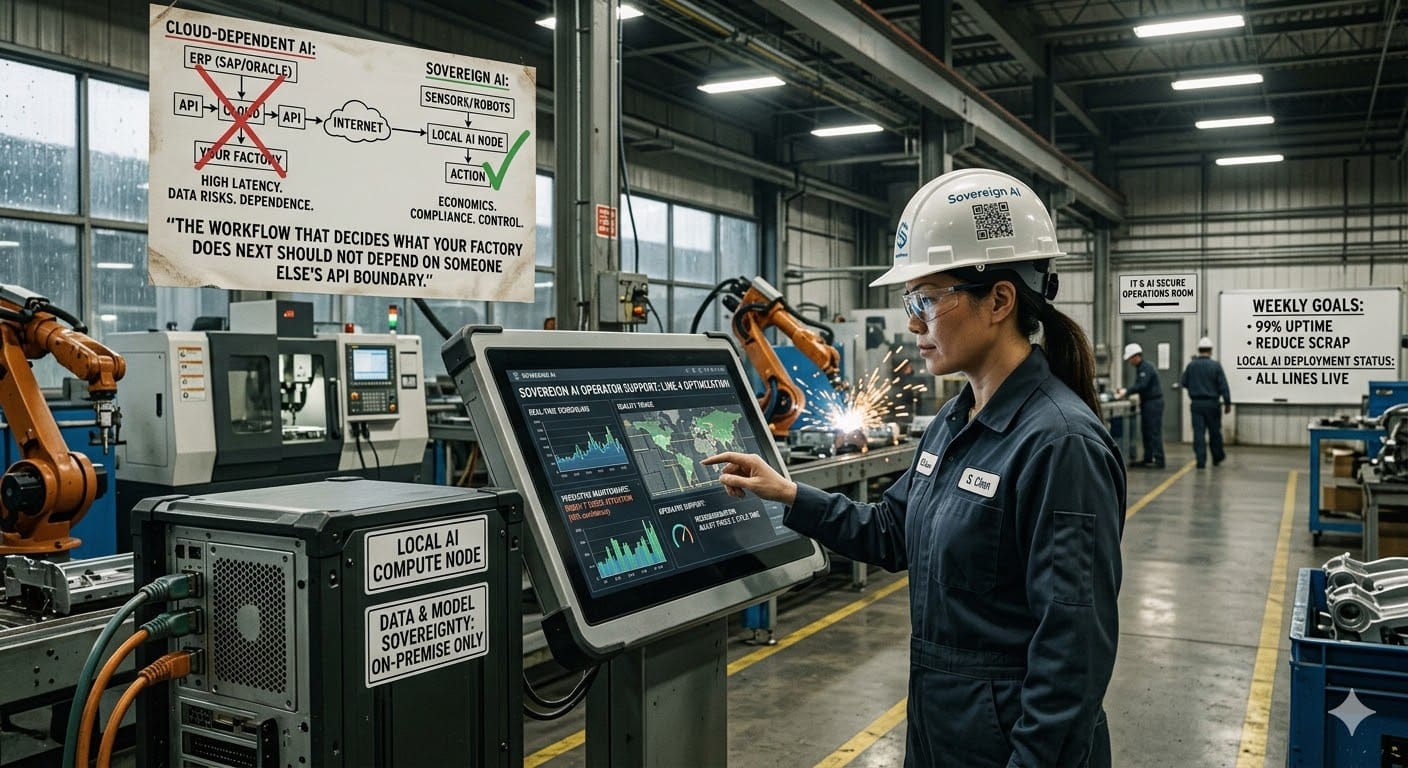
TL;DR: Sovereign AI for manufacturing is moving from strategy slide to plant-floor requirement. Manufacturers are discovering that the fastest way to improve scheduling, maintenance, quality triage, and operator support is not to bolt another cloud product onto SAP or Oracle, but to run AI systems on infrastructure they control, close to the data and close to the line. The shift is driven by economics, latency, compliance, and one blunt realization: the workflow that decides what your factory does next should not depend on someone else’s API boundary.
For the last decade, manufacturers treated ERP as the operating center of the factory. That worked when the job was record-keeping. It breaks when the job is real-time judgment. Plants need systems that can reroute a batch, flag a defect pattern, or pull a machine out of rotation before it fails.
Why is sovereign AI for manufacturing suddenly urgent?
The urgency is not ideological. It is operational. Manufacturing data is messy, local, and high consequence. Machine telemetry lives in historians. Quality data sits in MES tables. Supplier constraints live in ERP. Maintenance notes are half structured, half tribal knowledge. If your AI stack depends on shipping all of that into a third-party boundary before it can reason, you have already added latency, security review, legal review, and integration drag before you get to the first useful answer.
That drag used to be tolerable because most enterprise software only needed to systematize transactions. Modern AI workflows classify images, rank likely failure causes, generate operator guidance, and recommend schedule changes across systems that were never designed to speak cleanly to each other. ERP becomes one input among many, not the decision-maker.
There is also a clear market signal behind the shift. In May 2025, Mistral launched Le Chat Enterprise with hybrid deployment options spanning self-hosted, private cloud, public cloud, and hosted service. That matters because major model vendors usually chase the easiest revenue path. If they are investing in self-hosted and hybrid enterprise delivery, it is because customers are demanding it. In 2026, AWS entered the same conversation with on-prem “AI factories” positioned for customer data centers, explicitly tied to sovereignty and compliance concerns. The vendors have stopped pretending that every serious enterprise AI workload belongs in public cloud.
The compliance side is just as real. The European Commission announced that the EU AI Act entered into force on 1 August 2024, and the European Parliament describes it as the world’s first comprehensive AI law. Manufacturers selling into Europe, operating in Europe, or sharing data across European entities now have a regulatory reason to care about traceability, governance, and where systems run. Data sovereignty stopped being a procurement checkbox. It became architecture.
Direct answer: Sovereign AI becomes urgent in manufacturing when AI starts shaping operational decisions instead of writing marketing copy. At that point, infrastructure control, auditability, and low-latency access to plant data matter more than the convenience of a generic cloud API.
What is broken in the legacy ERP-centered model?
The polite version is that ERP was built for process consistency, not plant intelligence. The honest version is that ERP becomes a very expensive bottleneck once manufacturers ask it to support decisions it was never designed to make.
Take production scheduling. In many plants, the actual scheduling logic still happens outside ERP: spreadsheets, planner intuition, shift calls, supplier emails, maintenance workarounds, and side databases. ERP records the official plan, but it does not continuously reason over changing machine availability, scrap rates, late inbound material, weather disruptions, or energy-cost spikes. That is why teams keep building brittle manual bridges around it.
Quality is similar. ERP can log a nonconformance. It cannot inspect an image stream, compare defect clusters across product families, and suggest whether the likely cause is tooling wear, operator variance, or upstream material drift. Maintenance is worse. The CMMS or ERP module stores work orders, but the real predictive signal comes from vibration, temperature, current draw, line speed, and technician notes. The value is in fusing those signals, not filing them.
The cost profile is ugly. A cloud-first AI workflow adds token cost, egress cost, integration cost, and review cost at the same time. Teams pay to move sensitive manufacturing data out, reason over it remotely, then send a recommendation back into a system that still cannot act without custom glue.
There is evidence the market is reacting. A 2026 enterprise survey highlighted by MinIO reported that 93% of organizations were either repatriating AI workloads or evaluating a move away from public cloud. That number should make every manufacturing CTO pay attention. It says the issue is not a niche objection from regulated industries. It is a broad enterprise correction.
And the ROI math is unforgiving. IBM’s predictive maintenance overview cites Deloitte findings that predictive maintenance can deliver a 5-15% reduction in facility downtime and a 5-20% increase in labor productivity. If that value sits behind slow connectors, network hops, and data-governance fights, then the architecture is literally taxing the improvement you are trying to unlock.
Direct answer: The legacy model breaks because ERP is a system of record, while AI-native manufacturing workflows are systems of judgment. Once decisions depend on live plant signals, ERP cannot be the center of the architecture anymore.
What does the AI-native alternative actually look like?
The replacement is not “ERP, but with a chatbot.” It is a composable decision system built around data locality, model control, and workflow execution.
At a practical level, the architecture looks like this. Plant data stays where it is generated or in a governed internal data plane: historians, MES, ERP replicas, document stores, image buckets, sensor streams. A connector layer pulls from those systems into a private retrieval and orchestration layer. Models run in a controlled environment: on-prem GPU nodes, private cloud, or a hybrid boundary where sensitive inference remains local and less sensitive tasks can burst out when needed. Policy, observability, and ACL enforcement sit in front of every model call. Output is not just text. It is action: create a case, flag a batch, open a maintenance work order, or recommend a schedule change with evidence attached.
That architecture behaves differently from legacy enterprise software in three important ways.
1. It reasons across systems instead of forcing one system to own everything
ERP, MES, SCADA, QMS, and maintenance tools remain useful, but none of them has to become the brain. The AI layer can read across all of them, reconcile contradictions, and present ranked actions with traceable evidence.
2. It keeps the sensitive loop close to the plant
For visual inspection, root-cause analysis, operator copilots, and maintenance guidance, low latency matters. So does data custody. If an image of a defect, a process recipe, or a supplier-specific production pattern is competitively sensitive, you do not want it bouncing through an opaque external stack by default. This is where a strong security posture matters, and why links like InfraHive’s security approach for controlled AI deployment are not marketing decoration but design requirements.
3. It treats integration as product, not services sprawl
Most failed enterprise AI efforts die in connector hell. The winning teams standardize access to ERP tables, MES events, file stores, and ticketing systems early, then expose them as reusable capabilities to every workflow. That is the difference between a one-off demo and an operating system for plant decisions. If you want that stack to survive beyond one pilot, the connectors must be deliberate; that is exactly why a reusable integration layer like a governed connector architecture matters.
Notice what is missing here: a requirement to replace every legacy platform on day one. Good migrations start by replacing the expensive judgment work happening beside ERP. Once that layer proves itself, parts of the legacy workflow become optional.
Direct answer: An AI-native manufacturing stack keeps data local, uses connectors to read across ERP and plant systems, runs models inside infrastructure you control, and writes decisions back into the workflow with audit trails. That is fundamentally different from sending prompts to a remote API and hoping for the best.
How does a real deployment work in practice?
A serious deployment is narrower than most boardroom conversations and more technical than most vendor demos.
Week one is scope control. Pick one workflow where the economic signal is obvious: production rescheduling after supply disruption, defect-image triage, maintenance recommendation on a constrained asset, or operator knowledge retrieval. Do not start with “enterprise assistant for everyone.” That is how budgets disappear.
Weeks two and three are data and connector work. You identify the minimum viable sources: ERP order and inventory data, MES events, quality logs, machine telemetry, maintenance history, SOPs, and shift notes. Then you map permissions, build the first retrieval layer, and decide what must remain strictly local. This is usually where architecture either gets honest or collapses.
Weeks four through six are model and workflow tuning. That means choosing the right model mix, not the biggest model available. For classification and extraction, smaller local models often beat giant remote ones on cost and latency. For reasoning over messy plant context, a larger controlled model may sit behind retrieval with citation requirements. Human-in-the-loop review stays on for the first release.
Weeks seven through ten are where the forward engineer earns their keep. This is not old-school consulting theater. A forward engineer sits between plant operations, IT, and leadership, turning abstract business goals into concrete system behavior. They decide what evidence a planner needs to trust a recommendation. They sit with maintenance teams to understand how failure language actually appears in notes. They close the gap between the model and the real work.
That operating model is one reason AI-native service firms beat generic implementation shops here. The job is not shipping software. It is replacing a workflow under live operating constraints with connectors, policy, observability, and rollback paths.
Objections usually sound familiar.
“We can’t rip out SAP.” Good. Do not. Keep SAP as the transactional backbone while the AI layer replaces the manual judgment happening around it.
“Our data is too fragmented.” That is normal. Fragmented data is the default state in manufacturing. The right response is a governed retrieval layer, not another six-month data-lake detour.
“We need proof before broad rollout.” Also correct. Start with one workflow, instrument it hard, and publish the before-and-after numbers.
Direct answer: A real sovereign AI deployment does not begin with a companywide assistant. It begins with one high-value workflow, a tight connector layer, local or hybrid inference, and a forward engineer who can make the system useful under plant-floor conditions.
What results should manufacturers expect?
The honest answer is uneven gains at first, then compounding returns once the connector and policy layers are in place.
On the first workflow, you are usually buying faster decisions, fewer disruptions, lower planner workload, or better compliance evidence. Predictive maintenance and quality workflows are strong candidates because they create measurable deltas quickly.
The second-order gain is more important. Once your AI layer can reliably read governed data from ERP, maintenance systems, image stores, and plant logs, you stop rebuilding infrastructure for each new use case.
This is where InfraHive’s model is more interesting than generic enterprise software rollouts. The real product is not one app. It is the ability to replace brittle legacy decision paths with AI-native systems that run on your stack, with your rules. In finance-heavy workflows, the same design logic shows up in products like customer stories and representative transformation work and in InfraHive’s MetricFlow narrative: shrink the stack, move logic closer to the business, and stop paying rent on software that mostly records yesterday.
The proof standard should stay strict. Measure planner touch time, downtime hours avoided, scrap or rework deltas, exception-resolution speed, and inference cost per operational action. If the model is clever but the workflow is still slow, you have not actually replaced anything.
Direct answer: Expect the first result to be workflow compression: fewer manual hops, faster decisions, and clearer evidence. Expect the bigger result to come later, when the same sovereign AI foundation starts replacing multiple ERP-adjacent workflows without rebuilding the stack each time.
What does this mean for manufacturers in Europe and the US?
For European manufacturers, the direction of travel is obvious. AI governance, traceability, and data control are moving from legal language into system design. If you sell regulated products, operate across borders, or share sensitive production data with partners, sovereign AI is quickly becoming the safer default.
For US manufacturers, the pressure looks slightly different but lands in the same place: cost discipline, resilience, labor constraints, and IP protection. Plants want AI, but they do not want unpredictable inference bills, avoidable latency, or another layer of dependency wedged between the line and the decision. That is why on-prem and hybrid patterns are suddenly attractive even to companies that spent years centralizing in cloud.
The early movers get a real advantage because they redesign how decisions are made before competitors untangle themselves from ERP-centered process debt. The companies that win here will own their models, connectors, and deployment boundary.
So what should a manufacturer do next?
Pick one workflow where your team already knows the current system is fake automation held together by spreadsheets, side channels, and human heroics. Start there. Keep the system of record if needed, but replace the judgment layer with something that can actually think across plant signals. Build it on infrastructure you control. Instrument it ruthlessly. Then expand only after the numbers are real.
If you are exploring what that looks like on your own stack, not in a vendor sandbox, a reasonable next step is to explore how an AI-native deployment would fit your environment. The point is not to add more software. It is to remove the parts of your operating model that should have stopped being manual years ago.
Frequently Asked Questions
What does sovereign AI mean for a manufacturer?
It means the models, data pipelines, inference stack, and access controls run on infrastructure the manufacturer controls, with plant data staying inside approved environments instead of being copied into someone else’s SaaS boundary.
Does sovereign AI replace ERP completely?
Usually not on day one. The first wins come from replacing ERP-adjacent workflows such as scheduling decisions, quality triage, maintenance recommendations, and operator copilots while ERP remains the system of record during migration.
Why not just use a public-cloud AI API?
Because plant latency, data residency, IP sensitivity, and connector sprawl become operational problems fast. Public APIs are useful for experiments, but core manufacturing workflows need predictable cost, auditability, and infrastructure control.
How long does a real deployment take?
A focused first deployment can go live in roughly 3 to 5 weeks if the scope is narrow, the data sources are known, and a forward engineer can work directly with plant, IT, and operations teams.