
Why Manufacturing AI Execution Layers Should Come Before Agentic ERP Lock-In
TL;DR: A manufacturing AI execution layer is the architecture decision that matters in 2026, not whether your ERP vendor has announced agents. SAP says agentic AI is being operationalized across resilient, end-to-end manufacturing workflows at Hannover Messe 2026. ERP Today says

TL;DR: A manufacturing AI execution layer is the architecture decision that matters in 2026, not whether your ERP vendor has announced agents. SAP says agentic AI is being operationalized across resilient, end-to-end manufacturing workflows at Hannover Messe 2026. ERP Today says agentic AI is rewiring manufacturing ERP and pushing execution closer to operations. Oracle is repositioning enterprise software around agentic applications, and Reuters reported in March that Oracle reworked cloud software around agentic apps. The question for manufacturers is blunt: do you want AI inside your workflow boundary, or inside your vendor's?
If the answer is the vendor's, prepare for a more expensive version of the same lock-in cycle, just with better demos.
The next manufacturing moat will not be who bought the loudest AI suite. It will be who owns the execution layer that decides how AI can act across production, quality, supply, and finance.
Why is a manufacturing AI execution layer suddenly urgent?
Because enterprise software vendors have stopped talking about AI as a helper and started talking about it as the system that acts.
That shift matters. In April 2026, SAP used Hannover Messe to push agentic AI deeper into resilient, end-to-end manufacturing. ERP Today covered the same move as evidence that execution is moving closer to operations. Oracle has been equally direct, repositioning enterprise applications around agentic software and making it clear that the next commercial battle will be fought over workflow ownership, not just reporting screens. Reuters underlined the point when it reported that Oracle had reworked cloud software around agentic apps. Even SAP's April 2026 cloud results matter here. They show that incumbents are not experimenting at the edges. They are monetizing the shift.
That is exactly why manufacturers should be suspicious of the default pitch. When a vendor says AI is moving into execution, what they usually mean is that more of your operating logic should move inside their boundary. Purchase prioritization, production exception handling, quality triage, supplier escalation, maintenance routing, and cost-control workflows start looking less like your know-how and more like product features you rent back from the suite.
Direct answer: A manufacturing AI execution layer is urgent because AI is moving into real plant and supply decisions, while most manufacturers still lack a customer-controlled way to let software act across the systems that actually run operations.
What is broken in the current manufacturing stack?
The problem is not that manufacturers lack software. The problem is that the decision chains that matter most run between systems, not inside one of them.
A typical manufacturer already has an ERP, some mix of MES, WMS, quality systems, maintenance tooling, supplier portals, planning software, spreadsheets, local plant workarounds, and a finance layer that tells the truth after the fact. Each system can report on its own slice of reality. Very few can coordinate the next action when reality changes quickly.
Take a quality exception. A station flags drift. A supervisor sees rework building. Inventory starts getting constrained. Procurement knows a replacement component is late. Customer service or account teams hear schedule pressure from downstream commitments. Finance can see the margin hit later, but not in the moment. The decision that matters now is not whether the event appears in ERP. It is whether the business can decide, with evidence and policy, to reroute work, isolate a batch, reorder supply, adjust schedule priority, or escalate for approval before the disruption expands.
That is where ERP-centered AI often disappoints. An AI copilot inside one suite may summarize the issue beautifully and still fail to act because the actual workflow spans plant systems, supplier data, warehouse state, and finance constraints that do not live cleanly in one product boundary. This is why ERP Today's framing is useful. If agentic AI is truly rewiring manufacturing ERP, then manufacturers need to ask who owns the new execution boundary. If the answer is the suite vendor, the old dependency problem gets worse, not better.
Europe adds another layer of pressure. Manufacturers operating across the EU increasingly care about where sensitive production data, process logic, and quality decisions live as AI moves deeper into operations. US manufacturers feel the same pressure through speed, resilience, labor availability, and supplier volatility. The driver differs slightly by region. The architecture conclusion does not.
Direct answer: The current stack is broken because production, quality, maintenance, supply, and finance decisions span multiple systems, but most manufacturers still have no governed layer that assembles evidence, applies policy, and executes the next move.
What does a manufacturing AI execution layer actually look like?
It is not a chatbot for plant managers. It is a governed workflow layer across the operational graph of the factory and its supply chain.
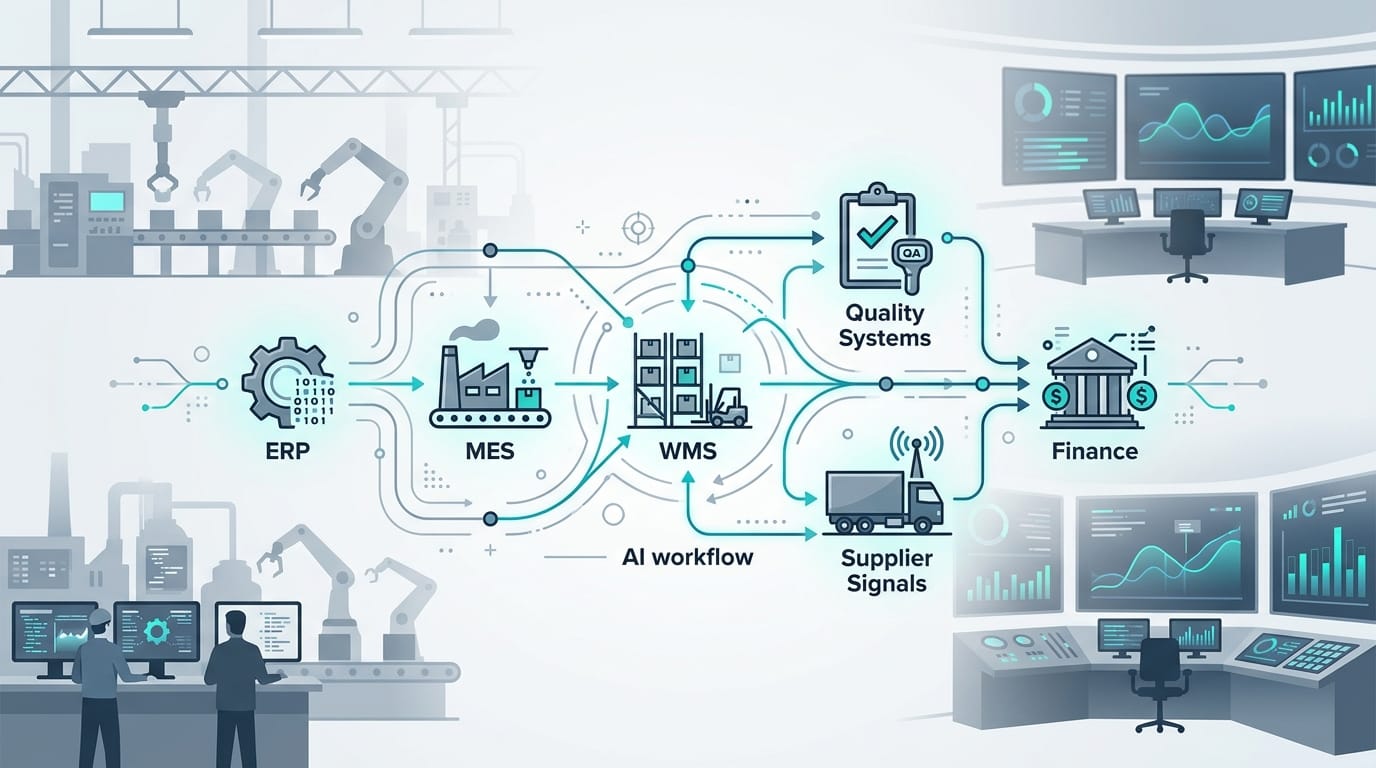
Keep the systems of record. Keep ERP where it is strong. Keep the MES, WMS, quality, maintenance, supplier, and planning systems that already contain real operational state. The architectural change is to add an execution layer that can collect evidence from those systems, evaluate explicit business policy, decide which actions are permitted, trigger those actions, and record outcomes for audit and continuous improvement.
The first requirement is connector depth. Manufacturing automation fails when AI sees only administrative truth and not operational truth. A real workflow may need machine state, work-center backlog, batch genealogy, inventory by location, supplier commit changes, inspection outcomes, maintenance windows, labor constraints, and the financial impact of delays or scrap. That is why deep operational connectors matter. If the system sees only ERP transactions, it reacts too late. If it sees only shop-floor events, it misses cost, procurement, and revenue consequences. The execution layer must see both.
The second requirement is executable policy. Most manufacturers already have rules. They are just scattered across SOP documents, planner habits, exception spreadsheets, quality playbooks, supplier terms, and plant-specific tribal knowledge. Which defects justify automatic batch isolation? When may the system pull work forward to protect a critical customer order? Which supplier delays trigger alternate sourcing versus production resequencing? When should a maintenance issue stop a line versus route work elsewhere? These are not model questions first. They are policy questions. A manufacturing AI execution layer turns them into software-enforceable rules with bounded autonomy.
The third requirement is deployment control. Production logic, supplier relationships, tolerances, routing priorities, and quality thresholds are part of the manufacturer's operating edge. They should not vanish into an opaque multi-tenant workflow engine. That is why customer-controlled deployment and security boundaries matter. Some manufacturers need regional controls. Some need a private environment. Some need to keep AI inference next to operational data because latency, governance, or IP sensitivity make that the only sane option. The architecture should support that by design.
The fourth requirement is measurement tied to economics. Automation without operating math is just faster confusion. Teams need to know which exception classes recur, which plants or suppliers generate the most intervention, where quality drift turns into scrap cost, and which decisions protect margin or throughput. A reporting spine such as MetricFlow matters because workflow automation only compounds when the business can connect actions to throughput, cost, service, and working-capital outcomes.
InfraHive's natural position is here. The useful question is not “how do we add AI to manufacturing software?” It is “how do we build an AI-native execution system across production, quality, supply, and finance while keeping the manufacturer in control?” The answer is a workflow layer that reasons over connected systems, acts inside explicit boundaries, and hands decisions to humans only when business risk justifies escalation.
Direct answer: A manufacturing AI execution layer is a governed evidence, policy, and action system running across ERP, MES, WMS, quality, maintenance, supplier, and finance tools on infrastructure the manufacturer controls.
What does implementation look like in practice?
Usually eight to twelve weeks for the first production-grade workflow, not a giant ERP rewrite.
The wrong starting point is “let's make the factory agentic.” That is slogan fog. The right starting point is one ugly, expensive decision chain that already burns time, output, or margin. It might be quality exception handling, component shortage response, maintenance-driven production rerouting, batch release coordination, rework prioritization, or supplier-delay escalation where operations and finance keep colliding.
Phase one is evidence mapping. Which system is authoritative for current production state? Where do quality events appear first? Which supplier signal is trusted? What lag exists between plant events and ERP visibility? Which finance codes should attach when an expedite, resequence, or scrap decision happens? Most teams discover that the real bottleneck is not intelligence. It is the absence of a single place where evidence from multiple systems can be assembled before the business commits to an action.
Phase two is policy design. Define what the system may do automatically, what requires recommendation plus approval, and what must always stay human-controlled. Good manufacturing AI does not mean reckless autonomy. It means bounded autonomy. A repeated low-risk reorder can be executed automatically. A recurring inspection failure can isolate a batch and open a preapproved workflow. A supplier delay can trigger alternate sourcing recommendations with cost context. A line issue can gather evidence and escalate to the right plant lead instead of spraying alerts at five teams.
Phase three is rollout. Start with one plant, one family of SKUs, one failure mode, one supplier cohort, or one exception class. Measure cycle time, override rate, rework hours, expedite frequency, scrap exposure, and approval latency. Expand only when the workflow reduces manual work without creating hidden operational or financial damage.
The objections are predictable. “Our plants are too customized.” Exactly. That is why a customer-controlled layer across systems is more useful than forcing everything into one vendor model. “Our ERP vendor already has AI.” Fine, but AI inside one boundary rarely sees the full operational and financial context of the decision. “We cannot replace everything.” You should not. Keep systems of record and replace the brittle decision layer first. That is the practical migration path.
Direct answer: Start with one expensive cross-system manufacturing workflow, keep existing systems in place, and build a bounded AI process that assembles evidence, applies policy, executes allowed actions, and escalates the rest.
What results should a manufacturer expect?
First, less lag between signal and response. Teams stop behaving like middleware between plant, supply, and enterprise systems.
Second, fewer policy leaks. Quality, production, sourcing, and maintenance decisions become more consistent because the workflow applies the same operating rules every time instead of relying on who happened to notice the issue first.
Third, cleaner coordination between operations and finance. Scrap risk, premium freight, missed throughput, supplier recovery actions, and customer service exposure stop showing up as after-the-fact surprises. They become part of one controlled decision chain.
Fourth, a better foundation for scaling manufacturing AI. Once one workflow runs with clear evidence, policy, and auditability, the next workflow gets cheaper to deploy. That is where customer-controlled workflow automation outcomes start compounding: fewer manual handoffs, faster exception response, better quality containment, and more confidence that AI is operating inside plant guardrails rather than outside them.
Direct answer: Expect faster operational response, tighter policy consistency, better visibility into the cost of exceptions, and a more realistic path from pilot AI to plant-scale execution.
What does this mean for manufacturing over the next 24 months?
It means the control point is shifting away from the suite and toward the workflow boundary.
For years, manufacturers treated ERP as the natural center of gravity for digital decision-making. That made sense when the job was mainly planning, recording, and routing work for humans. It makes less sense when AI can ingest live plant evidence, reason over quality, inventory, supplier, and cost trade-offs, and trigger actions in near real time. The strategic edge now sits in owning the layer that governs those actions. In Europe, that intersects with governance, resilience, and data-control pressure. In the US, it intersects with speed, labor, and supply volatility. In both markets, the conclusion is the same: the manufacturers that win will own the workflow, not just subscribe to the agent interface.
Direct answer: The next competitive edge in manufacturing is not having AI somewhere in the stack. It is owning the execution layer that decides how AI interacts with real production, quality, supply, and cost decisions.
So what should a manufacturing team do next?
Pick one ugly workflow where the business still depends on spreadsheets, local workarounds, email threads, and expert memory to move from signal to action. Rebuild that path as a customer-controlled AI workflow on infrastructure you trust. Keep the systems that still earn their place. Stop pretending that an agent bolted onto an ERP screen is the same thing as owning execution.
If you want to see what that architecture looks like in practice, start at https://infrahive.ai, review the customer-controlled deployment model, and explore how this could fit your stack. In manufacturing, the real moat is not the model. It is the workflow boundary you control.
Direct answer: Build the execution layer before your next AI program turns into a more expensive agentic ERP customization cycle.
Frequently Asked Questions
Does a manufacturing AI execution layer replace ERP or MES?
No. The practical model is to keep systems of record in place and add a governed workflow layer across them so production and supply decisions stop depending on disconnected tools and manual coordination.
What workflow should a manufacturer automate first?
Start with one expensive decision chain such as quality exception handling, component shortage response, production rerouting, batch release coordination, or supplier-delay escalation where multiple systems and teams already collide.
Why is customer-controlled deployment important in manufacturing AI?
Because the strategic asset is not only the data. It is the manufacturer's operating logic: tolerances, routing rules, supplier trade-offs, quality thresholds, and plant-specific decision policies.
As an event approaches, it is worth considering how details related to Genshin Impact cosplay costumes will affect the complete look. With practical wear in mind, reviewing details related to men's cosplay costumes also makes comfort and movement easier to judge. To organise preparations involving details related to fabric and comfort, character costumes with delivery information can help narrow the options for a specific purpose. When planning for care after the photoshoot, a balanced view of details related to cosplay shoes can support both detail and comfort.
How is this different from an ERP copilot or agent?
An ERP copilot can summarize or recommend from inside one suite boundary. A manufacturing AI execution layer can gather evidence across systems, apply policy, execute allowed actions, and create an audit trail across the real workflow.
What is the biggest mistake manufacturers make with agentic AI?
The biggest mistake is treating AI as a feature inside the existing suite instead of redesigning the cross-system workflow where the real operational decision actually happens.