
Why Manufacturers Need a Manufacturing AI Execution Layer Before Agentic ERP Becomes Another SAP Upgrade
TL;DR: A manufacturing AI execution layer is becoming the real architectural decision for factories, not another ERP copilot. SAP says visibility alone does not prevent disruption and that AI must be embedded directly into core business processes. NVIDIA says manufacturing is at

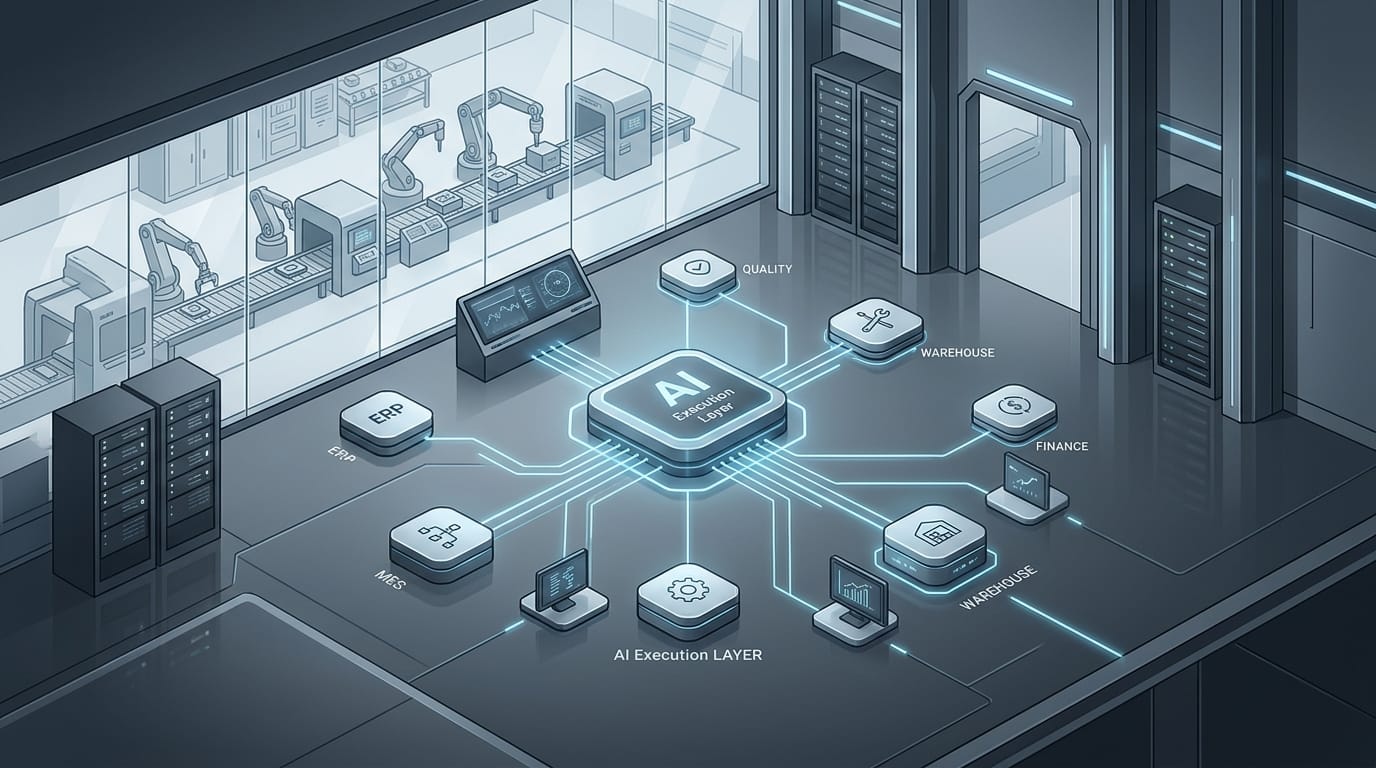
TL;DR: A manufacturing AI execution layer is becoming the real architectural decision for factories, not another ERP copilot. SAP says visibility alone does not prevent disruption and that AI must be embedded directly into core business processes. NVIDIA says manufacturing is at an inflection point and highlights a secure sovereign foundation for industrial-scale AI. The manufacturers that win this cycle will not be the ones with the prettiest agent demo. They will be the ones that can let AI execute quality, maintenance, planning, and service decisions across plant systems they actually control.
The danger is obvious: if agentic manufacturing gets bolted straight into the same legacy ERP stack that already slows change, the industry will call it innovation while buying a more expensive version of the old bottleneck.
The factory of the next three years will not be defined by whether it has AI. It will be defined by who owns the execution layer that decides what AI is allowed to do.
Why is a manufacturing AI execution layer suddenly urgent?
Because the conversation has moved from insight to action.
Hannover Messe 2026 made that plain. SAP is no longer talking as if dashboards and visibility are enough. Its manufacturing message now says visibility alone does not prevent disruption and that AI must be embedded directly into core business processes. NVIDIA is saying something similar from the infrastructure side: manufacturing is at an inflection point, and industrial AI now depends on a secure sovereign foundation that can support agents, simulation, vision systems, and robotics at scale.
That is the right diagnosis, but most factories are still built for recommendation, not execution. A planner sees an exception in one system. A quality engineer checks another. Maintenance has a separate queue. Finance learns about the consequence later when scrap, warranty, or expedite cost lands in the wrong bucket. The AI market is moving toward action at exactly the moment many plants still route decisions through ERP custom code, emails, tribal knowledge, and manual approvals.
Direct answer: A manufacturing AI execution layer is urgent because vendors are pushing AI into production workflows now, while most factories still lack a controlled cross-system way to let software make or route operational decisions.
What is broken in the current manufacturing stack?
The problem is not that factories lack systems. They have too many systems with no shared execution boundary.
A typical mid-market manufacturer already runs an ERP, MES, quality system, maintenance platform, warehouse tooling, supplier portals, spreadsheets, and a reporting layer. The issue is that the most expensive decisions sit between those systems. A machine anomaly arrives, but the maintenance action depends on spare availability, production schedule impact, technician skill, and customer-order priority. A quality hold appears, but the release path depends on inspection evidence, batch traceability, contract terms, and finance treatment. A supplier delay hits the line plan, but the mitigation route depends on inventory policy, changeover cost, and downstream delivery commitments.
Legacy ERP estates are bad at this kind of work because they centralize records without actually owning real-time plant context. MES tools see the line. Quality systems see the deviation. SCADA and historians see the signal. Finance sees the cost. Support and field-service systems see the customer impact. The action chain stretches across all of them.
That is why the newest deployment signal matters. VentureBeat reports Gemini can run on a single air-gapped server and vanish when you pull the plug. Whether a manufacturer uses Gemini or not, that matters because it removes one lazy excuse: “we would automate plant decisions if only secure deployment were possible.” It is becoming possible. At the same time, Accenture and Avanade, working with Microsoft, announced Agentic Factory to help reduce manufacturing downtime. The market is clearly moving toward plant-side execution, not abstract AI pilots.
The trap is letting this wave get absorbed by the ERP layer alone. ERP Today frames agentic AI as rewiring manufacturing ERP and breaking the execution barrier. True. But if the execution logic ends up trapped inside one vendor stack, manufacturers will gain new automation while losing architectural control.
Direct answer: The current stack is broken because operational decisions span ERP, MES, quality, maintenance, and finance systems, but no single layer assembles the evidence, applies plant policy, and executes the next step cleanly.
What does a manufacturing AI execution layer actually look like?
It is not another chatbot window. It is a customer-controlled workflow layer that sits across the operational graph of the plant.
Keep the systems of record. Keep the ERP. Keep the MES. Keep the historians, quality applications, maintenance tools, and warehouse systems that already hold real data. The change is architectural: add an execution layer that can pull evidence from those systems, evaluate explicit policy, decide which actions are allowed, trigger those actions, and record the result so humans can audit it later.
The first requirement is connector depth. Manufacturing automation fails when the AI sees only one fragment of reality. A serious workflow needs order priority, machine state, inspection records, maintenance history, inventory position, supplier commitments, labor constraints, and financial impact. That is why deep operational connectors matter. If the system only sees ERP records, it will miss plant truth. If it only sees sensor data, it will miss commercial consequences. The execution layer has to see both.
The second requirement is executable policy. Most factories already have rules. The problem is that those rules are scattered across SOPs, custom ERP logic, team habits, and exception spreadsheets. Can a borderline quality batch be released for a specific customer class? Which machine anomaly should create a work order immediately, and which one should wait for a shift review? When should a supplier delay trigger replanning versus premium freight? These are not model questions. They are policy questions. The execution layer turns them into something software can apply consistently.
The third requirement is customer-controlled deployment. Manufacturing leaders are right to care about security, but the deeper issue is control over process IP and operating judgment. Yield rules, tolerances, quality thresholds, supplier substitutions, downtime responses, and margin tradeoffs are part of the business itself. They should not disappear into a black-box SaaS workflow. That is why customer-controlled deployment and security boundaries matter. If a plant needs an on-prem or air-gapped footprint, the architecture should support it without turning the factory into a science project.
The fourth requirement is closed-loop measurement. An action layer that cannot show outcomes is just a faster way to make mistakes. Manufacturers need to know which exception classes are recurring, which quality rules create unnecessary holds, which maintenance actions actually reduce downtime, and where expediting, scrap, or warranty cost is leaking. A reporting spine such as MetricFlow matters because it turns workflow automation into operating economics rather than a pile of isolated task completions.
InfraHive's angle fits here naturally. The useful question is not “how do we add AI to the plant?” It is “how do we build an AI-native execution system across the plant, the back office, and the service chain while keeping the manufacturer in control?” The answer is a workflow layer that can reason over connected systems, act within defined boundaries, and hand control to a human only when the business risk justifies it.
Direct answer: A manufacturing AI execution layer is a governed evidence, policy, and action system running across ERP, MES, quality, maintenance, warehouse, and finance tools on infrastructure the manufacturer controls.
What does implementation look like in practice?
Usually eight to twelve weeks for the first production-grade workflow, not a two-year replatform.
The wrong starting point is “let's make the factory agentic.” That is a slogan, not a plan. The right starting point is one high-friction decision chain that already wastes money. It might be nonconformance disposition, maintenance triage for repeated machine alarms, shortage response when supplier commitments slip, expedited replacement approval, or a quality-to-finance handoff that currently takes three teams to reconcile.
Phase one is evidence mapping. Which system holds the authoritative production state? Where does live machine context come from? Which quality records determine release or hold? Where is supplier risk visible? Which financial codes should be attached to a scrap, rework, or downtime event? Most plants learn quickly that the bottleneck is not intelligence. It is the absence of one place where evidence from different systems can be assembled before action.
Phase two is policy design. Define what the system may do automatically, what requires a ranked recommendation, and what always requires human approval. Good plants do not need reckless autonomy. They need bounded autonomy. A maintenance anomaly with a known failure pattern may open a work order and reserve parts automatically. A marginal quality event may gather evidence and route a recommendation to an engineer. A supplier delay may trigger a replanning workflow and finance alert while preserving the final commitment decision for a planner.
Phase three is rollout. Start with one line, one plant, one product family, or one exception class. Measure cycle time, override rate, downtime impact, hold duration, scrap leakage, and expedite cost. Expand only when the workflow is reducing manual work without creating hidden quality or customer damage.
The usual objections are predictable. “Our plant is too customized.” That is exactly why a cross-system execution layer is useful. “Our ERP vendor already has AI.” Fine, but an ERP add-on rarely sees line-state nuance, quality evidence, and service impact together. “We cannot replace everything.” You should not. Keep systems of record and replace the brittle decision layer first. That is the practical migration path.
Direct answer: Start with one expensive factory decision chain, keep existing systems in place, and build a bounded AI workflow that assembles evidence, applies policy, executes allowed actions, and escalates the rest.
What results should a manufacturer expect?
First, less latency between signal and response. Teams stop acting like middleware between plant systems.
Second, fewer policy leaks. Quality, maintenance, and planning decisions become more consistent across shifts, sites, and managers because the workflow applies the same rules every time.
Third, cleaner coordination between operations and finance. Scrap, rework, downtime, premium freight, and warranty consequences stop showing up as after-the-fact surprises. They become part of the same controlled action chain.
Fourth, a better base for scaling plant AI. Once one workflow runs with clear evidence, policy, and auditability, the next workflow is cheaper to stand up. That is where customer-controlled workflow automation outcomes start to compound: fewer manual handoffs, faster cycle times, and more confidence that automation is operating inside business guardrails rather than outside them.
Direct answer: Expect faster operational response, tighter policy consistency, better visibility into the cost of exceptions, and a more realistic path from pilot AI to plant-scale execution.
What does this mean for manufacturing over the next 24 months?
It means the control point is shifting.
For twenty years, manufacturers treated the ERP as the natural center of gravity for operational logic. That made sense when the main job was recordkeeping and planning coordination. It makes less sense when AI can ingest live evidence, reason over multiple systems, and trigger actions in near real time. The strategic advantage now sits in owning the layer that governs those actions. European manufacturers will feel this especially hard because sovereignty, resilience, and compliance are no longer side issues. US operators will feel it through speed, labor pressure, and service expectations. In both markets, the same conclusion is emerging: the winners will own the workflow, not just subscribe to the interface.
Direct answer: The next competitive edge in manufacturing is not having AI somewhere in the stack. It is owning the execution layer that decides how AI interacts with your real production, quality, and cost decisions.
So what should a manufacturing team do next?
Pick one ugly workflow where the plant still depends on ERP tickets, spreadsheet coordination, and expert memory to move from signal to action. Rebuild that path as a customer-controlled AI workflow on infrastructure you trust. Keep the systems that still earn their place. Stop pretending another ERP AI add-on is the same thing as owning execution.
If you want to see what that architecture looks like in practice, start at https://infrahive.ai, review the customer-controlled deployment model, and explore how this could fit your stack. In manufacturing, the real moat is not the model. It is the workflow boundary you control.
Direct answer: Build the execution layer before your next AI program turns into a more expensive ERP customization project.
Frequently Asked Questions
Does a manufacturing AI execution layer replace ERP or MES?
No. The practical approach is to keep systems of record in place and add a governed workflow layer across them so plant decisions stop depending on disconnected tools and manual coordination.
What workflow should a manufacturer automate first?
Start with one expensive decision chain such as nonconformance disposition, maintenance triage, shortage response, or expedited replacement approval where multiple systems and teams already collide.
Why is customer-controlled deployment important in manufacturing AI?
Because the valuable asset is not only the data. It is the plant's operating logic: tolerances, quality thresholds, downtime responses, supplier substitutions, and margin tradeoffs.
How is this different from an ERP copilot?
An ERP copilot can summarize or recommend from inside one system. A manufacturing AI execution layer can gather evidence across plant and business systems, apply policy, execute allowed actions, and create an audit trail.
What is the biggest mistake manufacturers make with agentic AI?
The biggest mistake is treating AI as a feature inside the existing legacy stack instead of redesigning the cross-system workflow where the real decision actually happens.