
Agentic Commerce Infrastructure: Why Retailers Need an AI-Native Control Layer Before Shopping Agents Own the Checkout
TL;DR: Agentic commerce infrastructure is the layer retailers need before AI shopping agents become a real sales channel. The market is moving quickly: AWS says retail AI could exceed $164 billion by 2030, and Mirakl cites Gartner research suggesting AI agents could drive 20% or

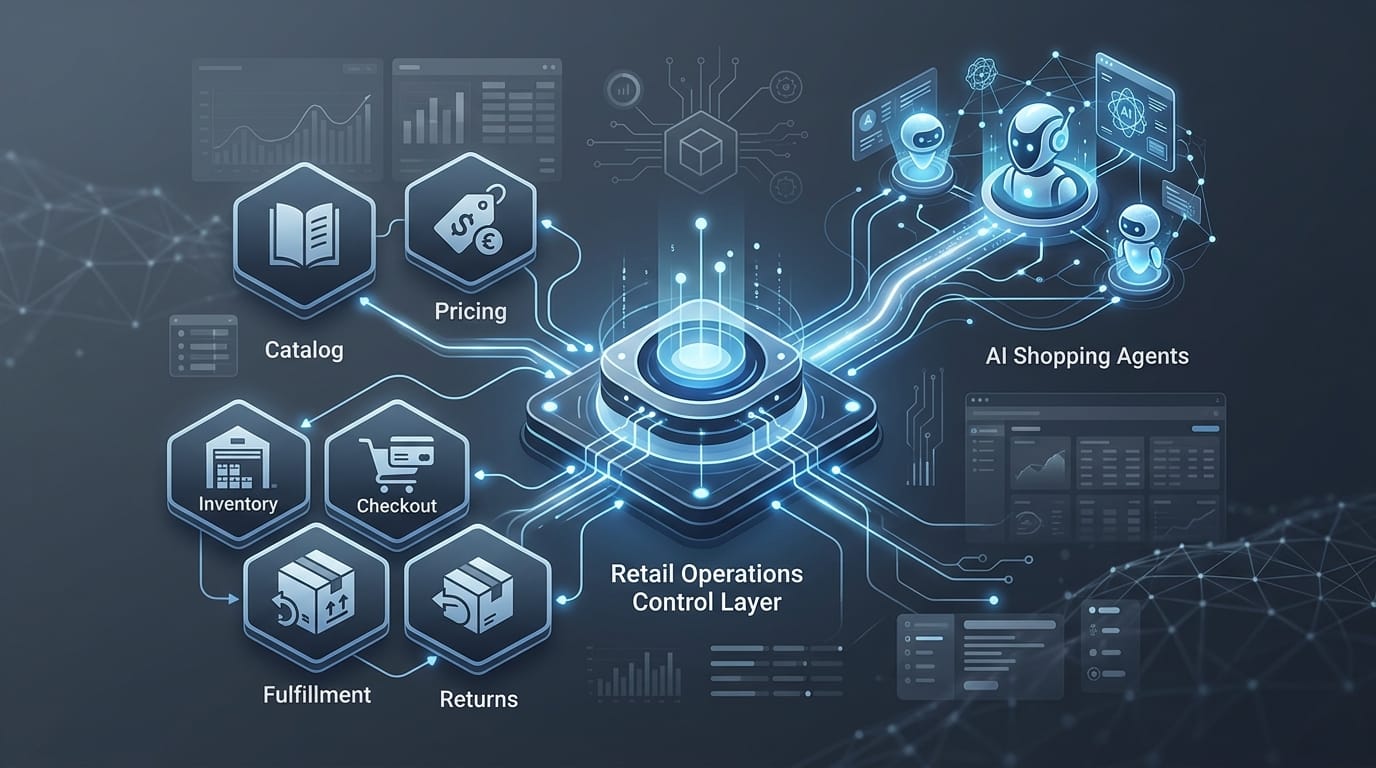
TL;DR: Agentic commerce infrastructure is the layer retailers need before AI shopping agents become a real sales channel. The market is moving quickly: AWS says retail AI could exceed $164 billion by 2030, and Mirakl cites Gartner research suggesting AI agents could drive 20% or more of ecommerce traffic within five years. That does not mean retailers need another storefront plugin. It means they need a customer-controlled control layer for pricing, inventory, policy, fulfillment, returns, and checkout decisions.
If an AI agent can discover a product but your business still relies on brittle plugins, manual overrides, and vendor-owned logic to decide what can be sold, shipped, refunded, or repriced, the weak point is not discovery. It is architecture.
Agentic commerce will not reward the retailer with the flashiest bot demo. It will reward the retailer whose operating stack can expose trusted decisions to machines without giving away control.
Why is agentic commerce infrastructure suddenly urgent?
Because agentic commerce is moving from marketing concept to operating constraint.
For years, ecommerce teams optimized for human browsing: category pages, search bars, merchandising rules, promotions, and checkout funnels designed around a person clicking through a storefront. AI shopping agents change that flow. They compress discovery, comparison, and even purchasing into machine-mediated interactions. AWS now frames AI shopping agents as a strategic retail shift, not a novelty, and projects that the market for retail AI could exceed $164 billion by 2030. Mirakl goes one step further, citing Gartner research that AI agents could account for 20% or more of ecommerce traffic within five years.
Those numbers matter because they change the question. The issue is no longer whether a retailer should add AI to the storefront. The issue is whether the underlying commerce stack can expose clean, governable decisions to machines. An agent does not care that a promotion was configured in one app, inventory lives in another, returns rules sit in a spreadsheet, and finance approval thresholds live in someone's head. It simply exposes whether your business can answer a machine's request in a reliable way.
Direct answer: Agentic commerce infrastructure is urgent because AI agents are becoming a real interface to retail systems, and legacy commerce stacks were not designed to serve as a trusted machine-facing control plane.
What breaks in the legacy ecommerce stack?
Almost everything that looked acceptable when the customer journey was slower, more human, and easier to patch manually.
Most mid-market and enterprise retailers already have a familiar tangle: Shopify, Magento, Salesforce Commerce, or Adobe Commerce on the front end; ERP in the back office; inventory feeds somewhere in between; shipping and warehouse systems off to the side; returns tools, fraud tools, payment tools, merchandising rules, and customer support tooling each adding their own logic. That architecture is manageable when humans absorb the friction. It is fragile when an AI agent expects structured access to current price, inventory, eligibility, lead times, substitution logic, shipping constraints, and policy outcomes in one coherent exchange.
Shopify's own 2026 guidance around agentic commerce is a useful signal here. Even the platform vendors now recognize that merchant systems must become machine-readable and agent-facing. Practical Ecommerce's automate-first argument points to the same operational truth from the other direction: if your workflow quality is poor, AI will simply hit the bottleneck faster.
The core problem is not that legacy platforms are useless. It is that they were built as applications with bolt-on integrations, not as a governed decision layer for autonomous agents. Product data may be clean enough for a website but not for an agent comparing constraints. Pricing might be technically available but not tied to approval logic or margin protection. Returns and refund rules may exist, but in macros, notes, or tribal memory rather than an executable policy system. The old stack assumes a human operator will smooth over the gaps.
For retailers in Europe, the problem also intersects with sovereignty and auditability. Once external AI systems influence pricing, recommendations, refunds, or post-purchase actions, the question of where the decision path runs becomes commercial as much as regulatory. In the US, the pressure shows up faster in conversion, service cost, and margin leakage. Different regions, same conclusion: ungoverned AI layers are a bad operating model.
Direct answer: The legacy stack breaks because it spreads critical commerce logic across platforms, plugins, and people, while AI agents need one trustworthy system that can answer and act across that sprawl.
What is agentic commerce infrastructure, really?
It is not a chatbot. It is not a shopping widget. It is a control layer that sits across the systems of record and turns messy retail operations into governable machine-facing workflows.
Keep the commerce platform, ERP, warehouse systems, payment stack, and support tools. Those still matter. The change is architectural: instead of forcing every new AI experience to integrate separately with each system, you build a customer-controlled layer that can gather evidence, apply policy, recommend or execute the next action, and log the outcome. That layer becomes the interface between AI agents and commerce reality.
The first requirement is connector depth. If the system cannot read catalog state, inventory truth, order history, promotion logic, shipping constraints, payment status, and returns eligibility, it cannot safely answer anything useful. That is why deep operational connectors matter more than surface-level API claims. Machine-facing commerce only works when the AI layer can see the full decision context.
The second requirement is explicit policy. Retailers already have rules for markdown authority, refund thresholds, substitution logic, damaged-item handling, split-shipment promises, fraud exceptions, and VIP treatment. The problem is that those rules are usually scattered. Agentic commerce infrastructure turns them into governed logic: what can be auto-approved, what needs human review, what must never be executed without a stronger signal, and which system remains the final authority.
The third requirement is customer-controlled deployment. If a vendor-owned black box is allowed to mediate catalog exposure, checkout decisions, or post-purchase actions, the retailer is effectively renting its own operating logic back from someone else. That is strategically weak. Customer-controlled deployment means the retailer owns the data path, the audit trail, and the iteration cycle. It is not abstract compliance theater. It is how a business keeps control over margin, policy, and customer trust. That is exactly why deployment boundary and security design matter so much.
The fourth requirement is cross-functional visibility. Commerce decisions are financial decisions. Price exceptions, shipping promises, refund policies, and stock substitutions all affect gross margin and working capital. A useful AI control layer therefore cannot end at the storefront. It needs to connect into finance and reporting so the business can see the consequences of automation in real time, not weeks later in a postmortem. That is where a system like MetricFlow becomes relevant: the point is not vanity dashboards, but operational and financial feedback tied to the same workflows.
InfraHive's value in this architecture is not another assistant sitting on top of the mess. It is building AI-native workflow systems that replace brittle, screen-driven handoffs with governed execution on infrastructure the customer controls. For retail and ecommerce teams, that means the AI layer can orchestrate catalog checks, pricing rules, support actions, returns logic, and finance visibility without forcing all strategic logic into a storefront plugin or an external SaaS roadmap.
Direct answer: Agentic commerce infrastructure is a customer-controlled workflow and policy layer that lets AI agents interact with pricing, inventory, checkout, fulfillment, and post-purchase systems safely and audibly.
What does implementation look like in practice?
Usually eight to twelve weeks for the first meaningful workflow if the team chooses one painful path instead of trying to reinvent the entire commerce stack in one program.
The wrong starting point is “make our store agent-ready.” That is too vague. The right starting point is one recurring commerce decision that currently bounces across systems and people: price-override approvals, substitution logic for low-stock items, delayed-shipment resolution, return-eligibility decisions, cross-border shipping promises, or marketplace listing governance. These are frequent enough to matter and messy enough to expose the real architecture.
The first phase is mapping. Which systems hold the true values? Where does policy actually live? Which exceptions create the most margin leakage or customer frustration? This step usually reveals that “commerce logic” is spread across platform settings, middleware, spreadsheets, inboxes, and experienced operators.
The second phase is boundary design. Keep the existing systems of record, but insert a control layer that can read the required signals, assemble a decision packet, and apply explicit policy. Some actions can auto-execute under threshold. Others can draft a recommendation for a human approver. Others can surface a hard stop. That design is what separates useful automation from reckless automation.
The third phase is rollout. Start with one brand, one geography, one queue, or one decision family. Measure latency, override rate, policy accuracy, margin impact, customer wait time, and operational load. Expand only after the evidence is clean. This is also where the forward-deployed engineer model matters. Retail workflows are rarely standard enough for generic templates, and the fastest route to value is usually a tight build-measure-iterate loop close to the operating team.
The common objections are predictable. “Our data is too messy.” That is not a reason to wait; it is the reason to centralize policy and evidence assembly. “Our platform vendor is adding agent features.” Fine, but that does not solve cross-system governance. “We do not want to replace the stack.” Good, because you usually should not. The practical move is to replace the brittle reasoning layer first while leaving systems of record in place.
Direct answer: Start with one high-friction commerce decision, build a governed control layer around it, prove the economics, and then expand across adjacent workflows.
What results should a retailer expect?
The first result is cleaner machine-readiness. Instead of exposing a patchwork of APIs, scripts, and human escalation paths, the retailer gives agents a single governed way to ask for product, pricing, inventory, and policy outcomes.
The second result is fewer manual overrides. Teams stop using people as glue between the commerce platform, ERP, fulfillment systems, and support stack. Exceptions still exist, but they arrive with evidence and policy context already assembled.
The third result is faster experimentation without surrendering control. A retailer can test new agent-facing experiences, catalog exposure logic, or post-purchase automations without waiting for a platform vendor to make its roadmap line up with internal priorities.
The fourth result is better economic visibility. When the same layer connects operational decisions to reporting and workflow metrics, leadership can see whether automation is improving conversion, reducing service burden, or quietly leaking margin. That is far more useful than celebrating an AI pilot that looks clever but cannot be tied to business outcomes. The pattern is consistent with workflow automation results across enterprise teams: fewer manual handoffs, better throughput, and stronger compounding returns as more processes move onto the same controlled foundation.
Direct answer: Expect cleaner agent integration, fewer human handoffs, faster iteration, and much better visibility into whether AI is helping or hurting retail economics.
What does this mean for retailers in the US and Europe?
It means commerce strategy is becoming infrastructure strategy.
In the US, retailers will feel the pressure first through speed, conversion, and service cost. AI agents will compress comparison and increase the premium on accurate availability, fast policy decisions, and consistent post-purchase execution. In Europe, the same pressure comes with a sharper sovereignty and trust lens. Retailers will need to answer not only whether the agent works, but where the decision ran, what data moved, and how it can be audited afterward.
The winners will not be the companies with the loudest AI announcement. They will be the ones that can let machines transact against their business without letting machines—or vendors—govern the business. That is a different standard, and it pushes directly toward customer-controlled architecture.
Direct answer: Retailers should treat agentic commerce as a control-plane problem now, because the businesses that own policy and data boundaries will be much harder to displace later.
So what should a retail operator do next?
Pick one ugly commerce workflow where your team is still acting as middleware between systems. Rebuild that path as a governed AI workflow running in an environment you control. Keep the platform if it still earns its place. Just stop confusing the storefront with the operating system.
If you want to explore what that architecture looks like in practice, start at https://infrahive.ai, review the security model for customer-controlled deployment, and explore how this works for your stack. Agentic commerce is coming either way. The real choice is whether your business meets it with governed infrastructure or rented guesswork.
Direct answer: Build the control layer before agent traffic becomes material, because retrofitting governance after machines are already in the loop is the expensive version.
Frequently Asked Questions
Does agentic commerce infrastructure replace Shopify, Magento, or Salesforce Commerce?
No. The practical first move is to keep systems of record in place and add a governed AI workflow layer across them so machine-facing decisions stop depending on plugins and manual handoffs.
What should a retailer automate first?
Start with one high-friction decision such as substitution logic, return eligibility, delayed-shipment handling, price-override approvals, or marketplace listing governance.
Why is customer-controlled deployment important in retail AI?
Because pricing, inventory, checkout, returns, and refunds all affect margin and customer trust. Retailers need clear control over the data path, policy engine, and audit trail.
How is this different from an AI shopping assistant?
An assistant improves the interface. Agentic commerce infrastructure governs the underlying decisions and actions across commerce, fulfillment, finance, and support systems.
What is the biggest mistake retailers make with agentic commerce?
The biggest mistake is adding an AI layer to the storefront while leaving the real operational logic fragmented across plugins, spreadsheets, and legacy systems.