
Why Retailers Need an AI Commerce Control Layer Beyond SAP's Agentic AI Push
TL;DR: An AI commerce control layer is becoming the real retail software upgrade because inventory, service, fulfillment, and finance decisions now move faster than ERP queues, OMS dashboards, and suite add-ons can handle. The 2026 signal stack is already clear: SAP used NRF 2026

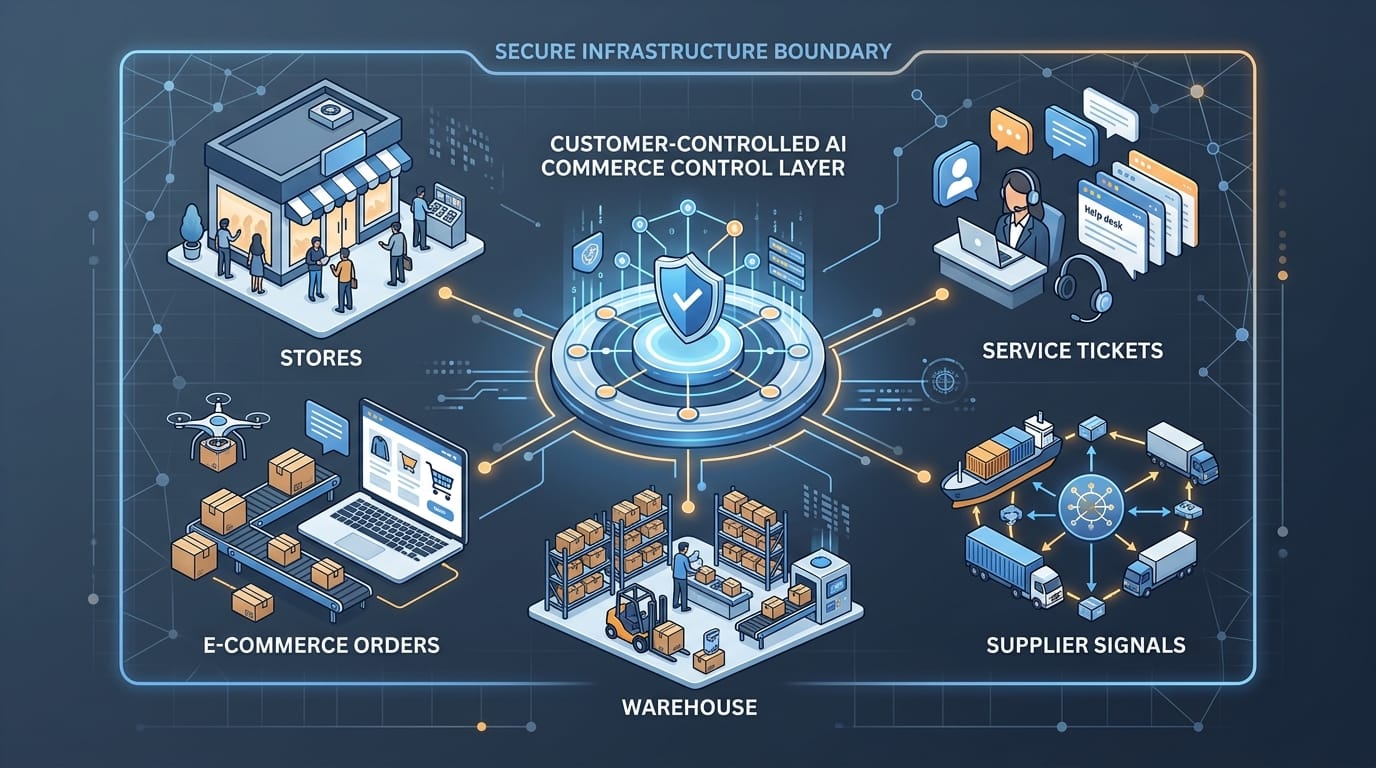
TL;DR: An AI commerce control layer is becoming the real retail software upgrade because inventory, service, fulfillment, and finance decisions now move faster than ERP queues, OMS dashboards, and suite add-ons can handle. The 2026 signal stack is already clear: SAP used NRF 2026 to position AI as a core retail operating layer; Mastercard published NRF 2026 agentic commerce insights; IBM released an NRF-linked study arguing AI is shaping consumer decisions before shopping begins; Microsoft highlighted AI retail startups at NRF 2026; and Reuters reported that Starbucks scrapped an AI inventory tool across North America. Retailers do not need another AI tab in a legacy suite. They need a workflow layer they actually control.
The real question is not whether AI belongs in retail operations. It already does. The question is where the policy boundary lives once AI starts influencing replenishment, order exceptions, service responses, and margin decisions across the business.
If your retail team still needs people to stitch together ERP state, OMS events, support tickets, supplier updates, and finance implications before anything useful happens, you do not have an analytics gap. You have an execution-architecture gap.
Why is retail AI turning into a workflow boundary fight?
Because the valuable work in retail is no longer report generation. It is cross-system judgment under time pressure.
SAP used NRF 2026 to position AI as a core retail operating layer. Mastercard published NRF 2026 agentic commerce insights. IBM's NRF-linked 2026 study argued AI is shaping consumer decisions before shopping begins. Microsoft used NRF 2026 to highlight AI startups aimed at retail. Those signals all point in the same direction: retail AI is moving from isolated personalization widgets and copilots into the operating flow itself.
That sounds exciting until you look at where real retail friction lives. Inventory problems rarely stay inside one planning module. A forecast drift changes replenishment. A delayed inbound shipment changes availability. Availability changes digital merchandising. Merchandising changes service volume. Service changes refund risk. Refund risk changes finance visibility. The decision path crosses ERP, OMS, WMS, ecommerce, CRM, ticketing, and finance. The point of pain is the handoff between systems, not any single screen.
This is why vendor language around agentic commerce matters. Once AI is allowed to recommend, route, escalate, or execute inside those workflows, the strategic issue becomes control. Who owns the connectors? Who defines the approval logic? Who decides which data stays local? Who gets to change the workflow when the business changes next quarter?
European retailers will read that through data residency, governance, auditability, and supplier-network sensitivity. US retailers may frame it through margin, labor efficiency, and channel speed. Same practical conclusion either way: if AI is becoming part of operations, then the workflow boundary is too important to outsource casually.
Direct answer: Retail AI is becoming a workflow boundary fight because the high-value work now happens across inventory, service, fulfillment, and finance systems, and AI is starting to sit directly inside those decisions rather than merely summarizing them.
What is broken in the old retail operating model?
The old model assumes teams can absorb operational complexity with dashboards, exports, and heroic coordination. That assumption gets more expensive every quarter.
Take a representative retail scenario. A promotion spikes demand faster than expected. Store stock and warehouse stock diverge. A supplier ETA slips. The ecommerce site is still promising delivery windows that operations will struggle to hit. Customer support starts seeing cancellation-risk conversations. Finance wants to understand markdown, expedite, and refund exposure before the week closes. The software stack contains all of those facts somewhere, but almost never in one governed workflow at the moment the business needs to act.
So humans become the control layer. Merchandising pulls reports. Supply-chain teams compare spreadsheets against OMS snapshots. Support leaders ask operations for exception guidance. Finance discovers the cost impact after the operational decision is already half-made. The same thing happens on the reverse side of commerce too. Returns, order exceptions, substitutions, fraud reviews, and stock reallocation decisions are often handled by a patchwork of rules engines, inboxes, and manual intervention rather than a coherent action system.
The Reuters report that Starbucks scrapped an AI inventory tool across North America is useful precisely because it cuts through the hype. Retailers do not fail because they lacked AI branding. They fail when the workflow is not trustworthy in store reality, when policy is unclear, when signals are brittle, and when frontline teams end up compensating for a system that sounds smart but does not carry the operational burden.
Generic retail AI demos usually skip that. They show a model producing a nice answer after someone else has already done the ugly integration work. But a search box with opinionated language is not the same as a governed operating layer. Retailers do not need another interface floating above broken handoffs. They need the handoff itself rebuilt.
Direct answer: The old retail model breaks because real commerce decisions depend on cross-system context and governed action, while legacy stacks mostly record activity after the fact instead of orchestrating the exception work that protects revenue and margin.
What does an AI commerce control layer actually look like?
It looks less like a chatbot and more like a retailer-owned workflow engine sitting above brittle system boundaries.
The first layer is connectors. No retailer gets value from AI if the system only sees partial truth. A serious commerce workflow needs governed access to ERP, OMS, WMS, ecommerce events, pricing systems, support tools, supplier signals, returns data, and finance metrics. This is where many pilots fail quietly. Teams obsess over model selection when the real product problem is connector design. That is why cross-system connector coverage matters so much. It determines whether the AI sees live operational reality or stale fragments.
The second layer is context assembly. Useful retail AI does not throw raw tables at a model and hope for the best. It retrieves the exact evidence needed for the workflow: inventory state, inbound delays, channel demand shifts, historical return patterns, customer-value exposure, supplier reliability, approval thresholds, and expected financial impact. That is what turns AI from commentary into governed decision support.
The third layer is policy. Some actions can be automated, such as drafting support guidance, routing a return exception, or triggering a replenishment review. Some should require approval, such as altering promise dates for a major account or changing fulfillment priority. Some must stay human-controlled because of fraud risk, contractual obligations, or local operating rules. A retailer-owned control layer keeps those rules in a boundary the retailer can inspect and change instead of burying them inside another vendor roadmap.
The fourth layer is execution. Advice is cheap. Operational value appears when the system can open an exception case, assemble the evidence, draft the customer response, trigger the supplier escalation, create the finance review, update support guidance, and write an approved outcome back into systems of record with a clean audit trail. That is the difference between retail AI theater and a real operating layer.
The fifth layer is measurement. If the workflow layer cannot connect actions back to stockouts, canceled orders, refund exposure, service backlog, and margin, it is just faster confusion. This is where a measurement spine like MetricFlow matters. It ties automation to economics, not vanity dashboards.
The broader platform story matters too. Retailers should stop buying a separate AI brain for every function. The same workflow engine that handles order exceptions in commerce can process invoices in Finance, resolve Tier-1 requests in IT, or automate support workflows. It is one platform, configured differently. That is a stronger operating model than collecting disconnected point solutions that all want to own one narrow slice of the workflow boundary.
Direct answer: An AI commerce control layer combines governed connectors, workflow-specific context retrieval, a retailer-owned policy boundary, auditable write-backs, and customer-controlled deployment so inventory, service, and order decisions can move faster without surrendering control.
How do you implement this without another giant retail transformation program?
By refusing to start with a slogan and starting with one painful workflow instead.
The wrong kickoff is, "We need agentic commerce." That is how teams buy a theme. The right kickoff is choosing one operational path that already burns time, margin, or customer trust: out-of-stock exception handling, delayed order promise management, returns triage, substitute-product approval, supplier-delay response, chargeback documentation, or store-support request routing. Those are places where the current stack already leaks money because people are acting as the integration layer between systems.
Implementation usually has three layers. First comes evidence mapping: which systems hold trustworthy state, which events arrive late, where the approvals really live, and which team actually owns the decision today. Second comes policy design: what the system may automate, what it may recommend with approval, and what must stay human-only. Third comes rollout: one brand, one region, one order-exception type, one supplier class, or one return path first, with tight measurement around cycle time, override rate, service impact, and margin consequences.
The forward-deployed model matters because retail architecture diagrams lie almost as much as enterprise ones do. The slide says the data is integrated. Operators know better. Somebody has to sit with merchandising, operations, support, ecommerce, finance, and IT to map where truth actually lives. Somebody has to encode policy around what really happens when a product goes out of stock at 4 p.m. on a campaign day. That is why the strongest deployments begin with a painful operating path, not an abstract AI platform rollout.
The objections are predictable. "Our ERP and OMS are too customized." Fine. That is an argument for an execution layer above them, not against one. "We cannot rip and replace." Good. Do not. "Our vendor already has AI." Also fine, but a suite assistant rarely sees the full economics of a decision that crosses planning, inventory, support, returns, and finance boundaries. "We need a business case." Then start where the current process already causes canceled orders, avoidable refunds, or manual service load.
The migration path is almost always hybrid. Keep ERP, OMS, and WMS as systems of record if they still earn that role. Replace the brittle workflow layer first. That lets the retailer reclaim judgment work without betting the estate on one giant program, while also creating reusable connectors, approvals, and monitoring for the next workflow.
Direct answer: Real implementation starts with one ugly exception workflow, maps messy reality first, builds governed connectors and policy controls, uses a forward-deployed builder to bridge teams, and expands through a measured hybrid rollout.
What results should retailers actually expect?
The first result is cleaner commerce throughput, not another shiny demo.
When judgment-heavy work moves into a retailer-owned execution layer, teams spend less time gathering context manually. Order exceptions move faster because the system assembles evidence, applies policy, and prepares the next action before humans lose hours reconciling the state across tools. Support gets better guidance faster. Operations sees fewer avoidable escalations. Finance gets earlier visibility into refunds, markdowns, and expedite costs. Merchandising decisions become less detached from real operational consequences.
The second result is control. A retailer-owned workflow layer is easier to inspect, adapt, and audit than a pile of SaaS AI features. The same connector patterns that support order-exception handling can support finance close workflows, customer support, or IT operations. That is the strategic point behind InfraHive's platform story. The same workflow engine that processes invoices in Finance can also coordinate retail service and order workflows. One platform. Different configurations. Shared control boundary.
The third result is compounding capability. Once the workflow layer is customer-controlled, the business can change systems beneath it over time without rebuilding everything from scratch. That reduces lock-in pressure while increasing reuse across the estate. You can see the same logic in deployment patterns and customer outcomes and in security and deployment design: the first workflow may be narrow, but the control layer becomes reusable.
Direct answer: Expect faster exception resolution, fewer manual touches, earlier visibility into service and margin impact, and a reusable automation layer that compounds across retail, finance, IT, and support.
What does this mean for retailers in Europe and the US?
It means AI advantage will increasingly belong to the retailer who owns the workflow boundary, not the retailer who buys the loudest conference demo.
In Europe, that boundary intersects with sovereignty, governance, and auditability more explicitly. In the US, the same architecture shows up as speed, labor leverage, and margin discipline. Different language, same engineering reality: the closer AI gets to live commerce decisions, the less sensible it is to leave the action layer inside a vendor black box.
The early movers will not just add intelligence to dashboards. They will strip exception-heavy work out of ERP- and suite-centric operating loops and rebuild it as controlled, inspectable systems that fit how modern retail actually runs.
Direct answer: In both Europe and the US, retailers that own their AI workflow boundary will modernize faster and with less lock-in risk than those waiting for suite vendors to solve the problem for them.
So what should a retailer do next?
Pick one workflow where people are still acting as the integration layer between ERP, OMS, suppliers, support, finance, and reality. Rebuild that path first. Keep the systems of record if you need them. Just stop pretending the judgment layer belongs inside old enterprise software.
If you want a practical view of customer-controlled workflow AI running on infrastructure you control, start at https://infrahive.ai, inspect deployment control and security, review connector coverage, and explore how this works for your stack. The strategic choice is not whether AI will enter retail operations. It is whether your team gets to own the part that matters.
Direct answer: Start with one ugly workflow, own the control boundary, prove the economics, and expand from there.
Frequently Asked Questions
What is an AI commerce control layer?
It is a retailer-owned workflow layer that connects ERP, OMS, WMS, ecommerce, support, supplier, and finance systems so AI can assemble context, apply policy, and trigger auditable actions.
Does this mean replacing SAP, OMS, or WMS immediately?
No. Most retailers keep core systems as systems of record and replace the judgment-heavy workflow layer around them first.
Which retail workflows are best to start with?
Order exceptions, returns triage, delayed-promise management, substitute approvals, supplier-delay response, and service guidance are strong starting points because they already span multiple systems and teams.
Why does customer-controlled deployment matter in retail AI?
Because the strategic asset is not only the data. It is the policy logic, action rights, approvals, and audit boundary that determine how the retailer responds when inventory, service, and margin drift off plan.
What is the biggest mistake in retail AI projects?
Treating the model as the product. In production, the real product is the connector boundary, policy layer, write-back logic, and measurement system wrapped around the model.
When choosing a first cosplay outfit, it is worth considering how details related to cosplay costumes will affect the complete look. When the final look will be photographed, a comparison of details related to cosplay wigs can clarify differences in colour and construction. For combinations connected with details related to cosplay wigs, cosplay props for women offers a useful starting point for practical preparation. Before the preparation is complete, it is useful to check details related to fabric and comfort against the wearer's own needs.