
Why the Manufacturing AI Execution Layer Is Replacing Dashboards in 2026
TL;DR: A manufacturing AI execution layer is becoming the real 2026 upgrade. The market signals are lining up: the World Economic Forum published 2026 analysis on how applied AI is changing manufacturing risk management; Telecompaper reported that NTT and IBM Japan began testing

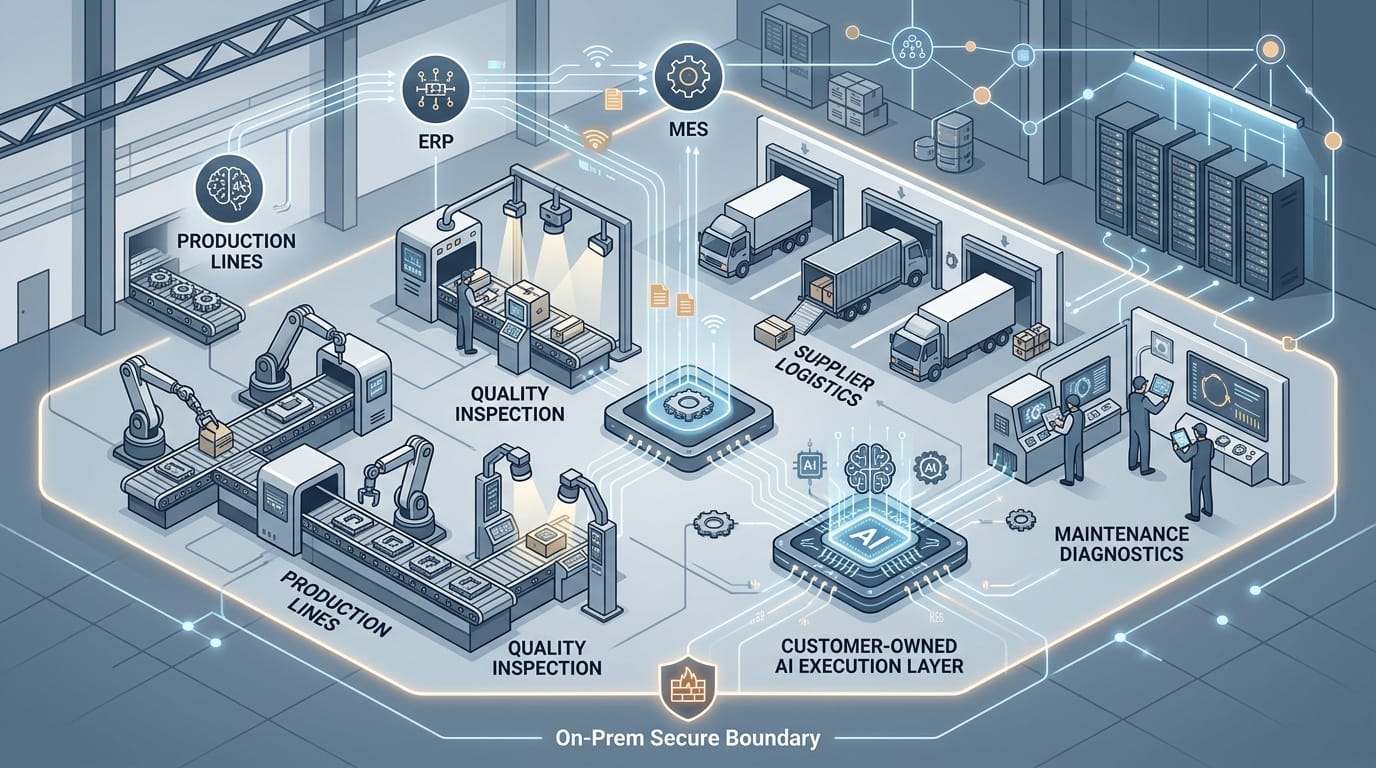
TL;DR: A manufacturing AI execution layer is becoming the real 2026 upgrade. The market signals are lining up: the World Economic Forum published 2026 analysis on how applied AI is changing manufacturing risk management; Telecompaper reported that NTT and IBM Japan began testing on-prem AI infrastructure using Spyre; IT Brief UK reported that Dell and AMD expanded on-prem AI servers for enterprises; The Register reported that an AI clause in a new SAP API policy provoked lock-in concern; and Financial IT reported that Pivot raised $40 million Series B to replace legacy procurement software with an enterprise AI operating system. The pattern is obvious: AI is moving closer to operational decisions, and manufacturers need the action layer on infrastructure they control.
The important shift is not from no AI to AI. It is from analytics and copilots toward governed execution across plant, supplier, quality, support, and finance workflows.
If humans still spend most of their day assembling context from MES, ERP, quality systems, maintenance logs, inboxes, and spreadsheets before anything safe can happen, your plant does not have an intelligence problem. It has an execution-boundary problem.
Why is the manufacturing AI execution layer replacing dashboards and copilots?
Because manufacturing value is not trapped in reporting. It is trapped in exceptions.
For years, industrial AI conversation stayed comfortably inside forecasting, anomaly detection, predictive scoring, and dashboard layers. Those systems can be useful, but they rarely solve the expensive part of plant operations: what happens next. A machine issue gets detected. A quality deviation appears. A supplier delay lands. A customer order is now at risk. Finance needs to understand the margin impact. Support needs a defensible answer. Somebody still has to collect context, make a decision, route approvals, and push the action back into the operating systems. That is the work that burns hours and margin.
The 2026 signal stack shows that buyers are noticing. The World Economic Forum published analysis on how applied AI is changing manufacturing risk management, which matters because it reframes AI as an operations-control problem rather than a pure productivity experiment. Telecompaper reported that NTT and IBM Japan began testing on-prem AI infrastructure using Spyre, and IT Brief UK reported that Dell and AMD expanded on-prem AI servers for enterprises. Those stories matter because they show the infrastructure side of local deployment is moving from theory into standard enterprise planning.
Then there is control risk. The Register reported that an AI clause in a new SAP API policy provoked lock-in concern. Whether one agrees with every detail of that dispute is secondary. The strategic lesson is clear: once AI becomes part of the decision path, integration policy becomes power. Manufacturers should be very careful about who owns that layer.
Direct answer: Manufacturing AI is moving beyond dashboards because the expensive part of operations is no longer detecting that something happened. It is coordinating the next safe, fast, and financially sensible action across systems and teams.
What is broken in the old ERP-centered manufacturing model?
The problem is not that ERP, MES, and quality systems exist. The problem is that none of them owns the full decision path when reality stops matching the planned flow.
Take a familiar plant scenario. A quality check flags a defect pattern on one line. Maintenance suspects a calibration problem but is waiting on a spare part. Procurement knows a replacement supplier can help but with a different lead time. Production planning is deciding whether to reroute work or protect customer orders. Customer support needs updated ETA language. Finance wants to understand the revenue and expedite exposure before the week closes. Every team has part of the truth. No one system owns the whole action path.
So humans become the middleware. Engineers inspect logs. Supervisors cross-check shift notes. Planners compare MES with ERP assumptions. Procurement hunts through portal updates and emails. Quality drafts a containment pack. Finance finds out late. The systems of record are still useful, but they are not an execution layer. They document what happened or what got booked. They do not reliably orchestrate the cross-functional, policy-constrained work required when plant reality diverges from plan.
This is why vendor copilots often underwhelm in industrial settings. They can summarize a screen or answer a narrow question, but they usually cannot assemble the exact multi-system evidence needed for a consequential decision, apply the local policy boundary, write back safely, and leave an audit trail that plant, compliance, and finance teams trust. A talking interface is not the same thing as a governed workflow engine.
Lock-in makes the problem worse. If the intelligence layer sits inside a suite vendor's product boundary, then the manufacturer is renting critical judgment paths. That is a fragile operating model when one decision crosses MES, ERP, warehouse, quality, maintenance, supplier, support, and finance systems before it is actually complete.
Direct answer: The old model breaks because the valuable work in manufacturing lives in cross-system exceptions, while legacy systems mainly record state after the fact instead of coordinating governed actions in the moment.
What does a manufacturing AI execution layer actually look like?
It looks less like a chatbot on top of ERP and more like a customer-controlled workflow platform sitting above multiple systems of record.
The first requirement is connector depth. A real execution layer has to see MES events, ERP transactions, quality records, maintenance tickets, warehouse state, supplier updates, support context, and financial exposure in one operating frame. That is why connector coverage across enterprise systems matters more than splashy demo prompts. If the system can only see one application boundary at a time, it will always be smarter in the demo than in the plant.
The second requirement is workflow-specific context assembly. Good manufacturing automation does not dump raw data into a model and hope for the best. It retrieves the exact evidence needed for the task: line history, defect pattern, approved work instructions, supplier ETA changes, inventory exposure, customer commitments, and expected financial consequence. That is how AI becomes operationally useful instead of cosmetically impressive.
The third requirement is local policy control. Some actions should be automatic: creating a triage pack, opening a supplier-delay case, drafting a support answer, or routing a maintenance escalation. Some should require approval: changing a production sequence, overriding a quality hold, authorizing a substitute part, or reclassifying a revenue-impacting order. Some should stay human-only. The key is that those action rights belong inside the manufacturer's environment, not inside a vendor feature stack the plant team cannot meaningfully inspect.
The fourth requirement is auditable write-back. The execution layer cannot stop at recommendation. It should open the case, attach the evidence, route the approval, update the relevant systems, trigger downstream finance review when needed, and leave logs clean enough for compliance and postmortems. In production systems, the hard part is not language generation. The hard part is changing live work safely.
The fifth requirement is measurement. A useful AI layer must tie actions to scrap, downtime, expedite cost, order risk, service exposure, and revenue timing. That is where a measurement spine such as MetricFlow matters. It connects workflow automation to economics instead of vanity usage metrics.
The broader InfraHive point is even more important. Manufacturers should stop buying one AI tool for quality, another for maintenance, another for support, and another for finance. The same workflow engine that triages a plant exception can also process invoices in Finance, resolve Tier-1 IT tickets, or automate customer support escalations. It is one platform, configured differently. That platform-first architecture is a better control model than collecting siloed tools that each own a tiny fragment of the workflow boundary.
Direct answer: A manufacturing AI execution layer combines deep connectors, workflow-aware context retrieval, customer-owned policy rules, auditable system actions, and economic measurement so the manufacturer can automate real work without giving away the control plane.
How do manufacturers implement this without another giant transformation program?
By starting with one ugly workflow and rebuilding the action path first.
The wrong kickoff is, “We need an industrial AI strategy.” That usually produces architecture diagrams, committees, and vendor roadshows. The right kickoff is choosing one exception-heavy workflow that already burns time and money: non-conformance triage, supplier-delay containment, spare-parts escalation, engineering-change coordination, chargeback resolution, or invoice mismatch handling tied to plant receipts. Those are the workflows where people are already acting as the integration layer because no existing tool owns the full path.
Implementation normally starts with evidence mapping. Which system holds authoritative line state? Where do quality rules actually live? Which maintenance signals are trustworthy? Which approvals are policy, and which are just habit? Then comes policy design: what the system may do automatically, what it may propose with approval, and what must remain human. Then comes rollout: one plant, one line family, one supplier class, or one exception type first, with instrumentation around cycle time, override rate, and downstream cost impact.
The forward-deployed model matters because manufacturing process diagrams are always cleaner than plant reality. Somebody has to sit with operations, engineering, quality, procurement, finance, and IT and translate ambiguous local judgment into inspectable system behavior. Somebody has to make sure the workflow writes back cleanly without creating another shadow system. That is not glamorous work, but it is the difference between a pilot that demos well and a layer the business can actually reuse.
The predictable objections are manageable. “Our ERP is too customized.” Fine. That is an argument for lifting the execution layer above it, not for keeping brittle process logic trapped inside it. “We cannot rip and replace.” Good. Do not. Keep ERP and MES as systems of record where they still serve. “Our vendor already has AI.” Maybe, but a vendor assistant rarely sees the full economics of a decision crossing operations, quality, supplier, service, and finance boundaries. “We need ROI first.” Start where manual reconciliation already creates overtime, scrap, expedite cost, or delayed revenue recognition.
Direct answer: Real implementation starts narrow, maps messy operational reality, defines action rights inside the customer boundary, and expands through measured hybrid rollout rather than a multi-year ERP rewrite.
What results should manufacturers expect from an execution-layer approach?
The first result is faster containment. When a workflow layer can assemble context before a human spends half a day chasing it, exception cycles compress. Quality incidents move faster because the system prepares the case and routes the right approvals. Supplier delays get contained earlier because planning, procurement, and order commitments are visible in one action path. Maintenance and operations stop re-arguing facts that already exist in different systems.
The second result is better financial visibility. A manufacturer-owned execution layer can quantify what an operational decision does to scrap, expedite cost, backlog risk, and revenue timing while the decision is still being made. Finance no longer has to discover the cost after the operational path is already locked in.
The third result is control that compounds. Once the workflow boundary is customer controlled, the manufacturer can reuse the same architecture across operations, finance, IT, and support. You can see the logic in practical deployment outcomes and in deployment control and security design: the first workflow may be narrow, but the execution layer is reusable. That reuse is where the economics get interesting.
Direct answer: Expect faster exception handling, earlier cost visibility, fewer manual reconciliation steps, and a reusable automation boundary that compounds across plant, finance, support, and IT workflows.
What does this mean for manufacturers in Europe and the US?
It means the competitive line is shifting from who has the flashiest AI demo to who owns the workflow boundary.
European manufacturers will feel the pressure through sovereignty, governance, and data-control requirements more explicitly. US manufacturers may phrase it in terms of uptime, resilience, and vendor concentration risk. The operating conclusion is similar in both regions: keep the action layer close to the systems, data, and policies that actually run the business.
The winners will not be the companies that bolt the most assistants onto legacy screens. They will be the ones that reclaim the cross-functional workflow paths where plant events, supplier realities, customer commitments, and financial consequences meet.
Direct answer: In both Europe and the US, manufacturers that own their AI execution layer will modernize faster and with less strategic dependence than manufacturers waiting for suite vendors to define the control plane.
So what should a manufacturer do next?
Pick one workflow where people are still acting as the glue between MES, ERP, quality, maintenance, suppliers, and finance. Rebuild that path first on infrastructure you control. Keep the systems of record if they still earn that role. Just stop assuming they should also own the judgment layer.
If you want a practical view of customer-controlled workflow AI, start at https://infrahive.ai, inspect deployment and security controls, review integration coverage, and explore how this works for your stack. The point is not to buy more AI features. It is to own the layer that turns system state into governed action.
Direct answer: Start with one painful cross-functional workflow, prove the economics on your own infrastructure, and expand from there.
Frequently Asked Questions
What is a manufacturing AI execution layer?
It is a customer-controlled workflow layer that assembles context across systems, applies local policy, routes approvals, and triggers actions inside infrastructure the manufacturer controls.
Does this require replacing ERP or MES first?
No. Most manufacturers keep ERP and MES as systems of record and replace the brittle exception-handling layer around them first.
Which workflows are best to start with?
Non-conformance triage, supplier-delay containment, spare-parts escalation, engineering-change coordination, and invoice mismatch handling are strong starting points because they already span multiple teams and systems.
Why does on-prem or customer-controlled deployment matter?
Because the strategic asset is not only the data. It is also the policy logic, approval boundary, and write-back rights that determine how the business reacts when reality diverges from plan.
What is the biggest mistake in manufacturing AI projects?
Treating the model as the product. In production, the real product is the connector boundary, policy layer, write-back logic, and measurement system wrapped around the model.
When planning a cosplay look, it is worth considering how details related to heat resistant cosplay wigs will affect the complete look. As fans study the source material, reviewing details related to long cosplay wigs also makes comfort and movement easier to judge. To shape a complete look around details related to anime cosplay costumes, cosplay wigs can help narrow the options for a specific purpose. To reuse the pieces at future events, a balanced view of details related to Halloween styling can support both detail and comfort.