
Why European Manufacturers Are Moving AI Execution On-Prem Before Replacing ERP
TL;DR: AI execution on-prem is moving from a compliance preference to a manufacturing architecture decision. The 2026 signal stack is hard to ignore: Bloomberg reported that Mistral signed Airbus and BMW as it brought AI to manufacturing; the World Economic Forum published analys

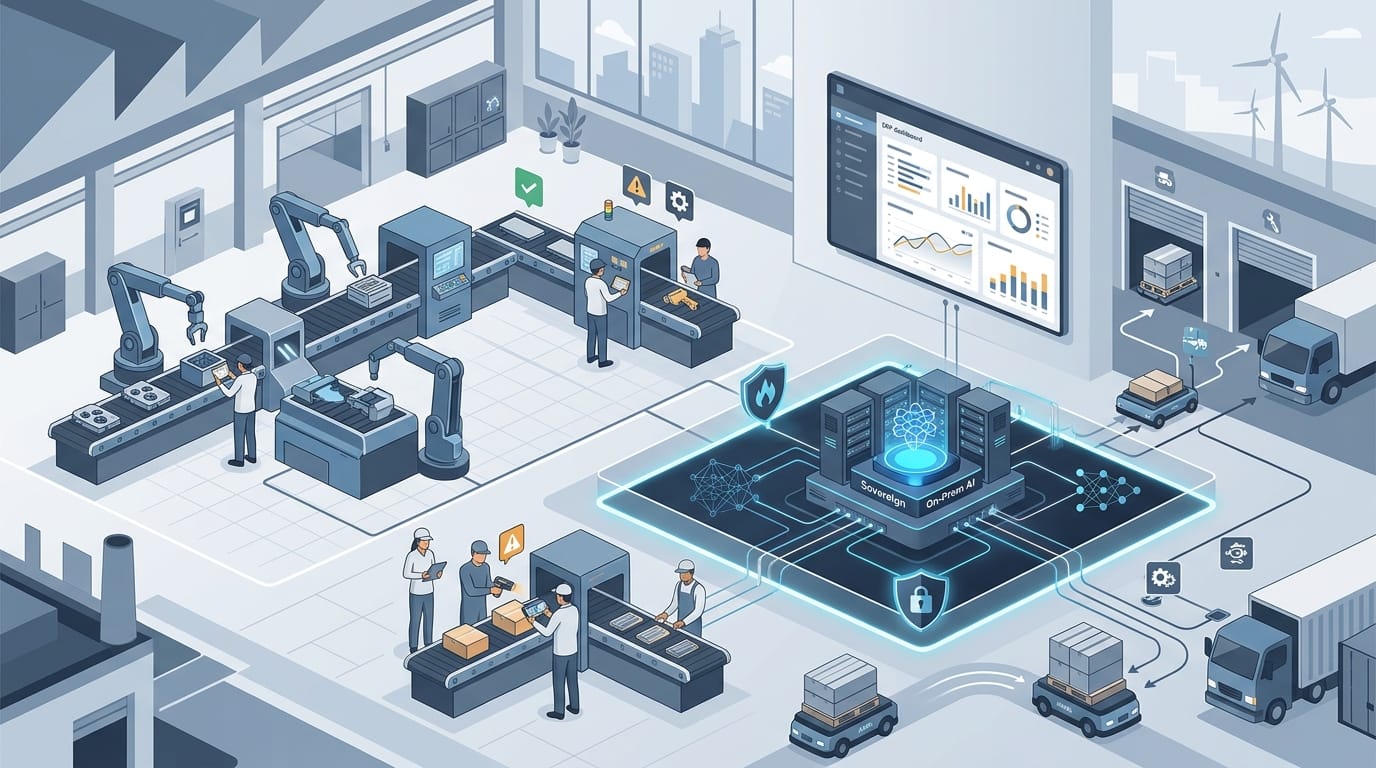
TL;DR: AI execution on-prem is moving from a compliance preference to a manufacturing architecture decision. The 2026 signal stack is hard to ignore: Bloomberg reported that Mistral signed Airbus and BMW as it brought AI to manufacturing; the World Economic Forum published analysis on how applied AI is changing manufacturing risk management; The Register reported that an AI clause in a new SAP API policy provoked lock-in concern; Fierce Network reported that Dell was building a sovereign AI stack for the on-prem era; and Telecompaper reported that NTT and IBM Japan began testing on-prem AI infrastructure using Spyre. Manufacturers do not need another ERP-side assistant. They need a customer-controlled execution layer that can act across plant, supplier, quality, and finance workflows without shipping control outside their environment.
The real strategic choice is no longer whether AI belongs in manufacturing. It is whether the action layer will live inside your control boundary or inside somebody else's product roadmap.
If your plant, quality, maintenance, supplier, and finance teams still need humans to reconcile system state before every consequential decision, your problem is not model access. Your problem is that the execution layer still belongs to legacy software boundaries.
Why is AI execution on-prem becoming urgent for manufacturers?
Because industrial AI has moved past the stage where it can hide inside lab demos and slideware.
Bloomberg reported in 2026 that Mistral signed Airbus and BMW as it brought AI to manufacturing. That matters because it signals that serious European industrial operators now see AI as production-adjacent capability, not just office productivity software. The World Economic Forum's 2026 analysis on manufacturing risk management points the same way from a different angle: once AI influences operational decisions, governance, auditability, and failure modes matter as much as raw model performance.
At the same time, infrastructure signals changed. Fierce Network reported that Dell was building a sovereign AI stack for the on-prem era, and Telecompaper reported that NTT and IBM Japan began testing on-prem AI infrastructure using Spyre. In plain terms, the market is no longer arguing only about whether local deployment is philosophically nice. It is investing in the plumbing required to make it practical.
Then there is control risk. The Register reported that an AI clause in a new SAP API policy provoked lock-in concern. Whether or not a given buyer agrees with every detail of that controversy, the broader lesson is obvious: when the workflow boundary sits too close to a legacy suite vendor, integration policy becomes strategy. That is dangerous in manufacturing, where one operational decision often crosses MES, ERP, quality, maintenance, procurement, warehouse, support, and finance systems before it is actually complete.
European manufacturers feel this earlier because sovereignty, auditability, and plant-level data control are already board-level concerns. But this is not only a Europe story. It is an architecture story. When AI starts deciding how work moves, deployment location and workflow control stop being secondary implementation details.
Direct answer: AI execution is becoming urgent on-prem because manufacturing AI is now operationally real, sovereign infrastructure is viable, and lock-in around legacy workflow boundaries is becoming more visible at the exact moment AI is moving closer to production decisions.
What is broken in the old ERP-centered operating model?
The old model records work well enough. It does not coordinate exception-heavy work well enough.
Take a common manufacturing scenario. A machine drifts out of tolerance. Quality detects a pattern that may affect one line but not another. A supplier shipment is late. Maintenance has a partial diagnosis. Production planning needs to understand whether to reroute work, consume buffer stock, or change the build sequence. Customer support may need updated lead-time guidance. Finance wants to quantify expedite cost, scrap risk, and revenue timing impact before the week closes. The required evidence exists somewhere across MES, ERP, quality systems, ticketing, supplier portals, spreadsheets, and email threads. It usually does not exist in one governed action path.
So people become the middleware. Engineers collect traces from one system, planners compare them with ERP assumptions, quality teams draft containment logic, procurement calls the supplier, support waits for an answer, and finance sees the impact late. ERP is often accurate as a system of record, but that is not the same as being a strong execution layer. It tells you what is booked. It does not reliably orchestrate the ugly cross-functional judgment work that protects service level, margin, and compliance when reality deviates from plan.
This is why generic manufacturing AI demos tend to disappoint. They answer a question inside one application boundary after somebody else has already assembled the context manually. A copilot attached to one screen may summarize an issue nicely, but it still leaves humans to pull plant data, supplier updates, policy rules, cost exposure, and approval history into one place before anything safe can happen.
When buyers treat AI as an add-on feature inside the same old suite boundary, they inherit the same old bottleneck. The decision path still has to cross brittle interfaces. The only difference is that one of the screens now talks back.
Direct answer: The ERP-centered model breaks because manufacturing value is lost in cross-system exceptions, while legacy systems mostly document state after the fact instead of coordinating the governed actions required when production, quality, supplier, and finance realities collide.
What does an on-prem AI execution layer actually look like?
It looks less like an assistant bolted onto ERP and more like a customer-controlled workflow engine that sits above multiple systems of record.
The first requirement is connector depth. An industrial workflow layer has to see MES events, ERP transactions, quality records, maintenance tickets, supplier updates, warehouse state, service implications, and cost metrics in the same operating context. That is why connector coverage across enterprise systems matters more than glossy model branding. If the system only sees one application at a time, it will always be smarter in the demo than in production.
The second requirement is context assembly. Good manufacturing automation does not dump raw tables into a model and hope for the best. It retrieves the exact evidence needed for the workflow: line state, defect history, approved work instructions, maintenance logs, supplier ETA changes, inventory exposure, customer-order commitments, and expected financial consequence. This is how AI moves from commentary to operational usefulness.
The third requirement is policy control. Some actions can be fully automated: create a quality triage pack, route a supplier-delay exception, draft a plant support response, trigger a parts availability review. Some should require approval: changing a production sequence, overriding a quality hold, approving a substitute component, or altering customer delivery commitments. Some must remain human only. The crucial point is that those action rights belong inside the manufacturer's boundary, not buried in a vendor feature stack the plant team cannot meaningfully inspect.
The fourth requirement is write-back with auditability. The workflow layer must not stop at recommendation. It should open the case, attach evidence, route the approval, update downstream systems, create the finance review, and leave an audit trail clean enough for compliance and postmortem analysis. This is where most "AI for manufacturing" talk gets vague, because the hard part is not generating language. The hard part is safely changing live work across systems.
The fifth requirement is measurement. A useful execution layer should connect actions to scrap, downtime, expedite cost, supplier recovery time, backlog, service exposure, and revenue timing. That is where a measurement spine such as MetricFlow matters. It ties automation to economics, not to chatbot usage numbers.
The broader platform point is even more important. Manufacturers should stop buying one AI product for quality, another for maintenance, another for support, and another for finance. The same workflow engine that routes a supplier-delay containment path in operations can process invoices in Finance, resolve Tier-1 IT requests, or automate support escalations. It is one platform, configured differently. That is a better control model than collecting siloed products that each want to own a tiny, disconnected fragment of the workflow boundary.
Direct answer: An on-prem AI execution layer combines cross-system connectors, workflow-specific context retrieval, customer-owned policy rules, auditable write-backs, and measurement tied to operating and financial outcomes so manufacturers can automate real decisions without losing control.
How do you implement this without another multi-year ERP program?
By choosing one ugly workflow and rebuilding the action path first.
The wrong kickoff is, "We need an industrial AI strategy." That produces committees and vendor tours. The right kickoff is selecting one path that already burns time and margin: non-conformance triage, supplier-delay response, spare-parts escalation, engineering change coordination, warranty exception handling, or parts shortage containment. Those are workflows where humans are already acting as the integration layer between systems because no existing tool owns the full decision path.
Implementation normally starts with evidence mapping. Which system holds authoritative line state? Where do quality rules actually live? Which maintenance signals are trustworthy? Which approvals are policy, and which are habit? Then comes policy design: what the system may do automatically, what it may propose with approval, and what must stay human. Then comes rollout: one plant, one product family, one supplier class, or one exception type first, with tight instrumentation around cycle time, override rate, and downstream cost effect.
The forward-deployed model matters because manufacturing diagrams are almost always neater than reality. Somebody has to sit with plant engineers, quality leads, procurement, operations, finance, and IT to map where the real decisions happen. Somebody has to translate the rule that exists in a senior planner's head into an inspected policy boundary. Somebody has to make sure the workflow writes back cleanly without creating a second shadow system. That is not glamorous work, but it is the difference between a plant pilot and a reusable operating layer.
The predictable objections are easy to answer. "Our ERP is too customized." Fine. That is an argument for lifting the execution layer above it, not for keeping brittle process logic trapped inside it. "We cannot rip and replace." Good. Do not. Keep ERP and MES as systems of record where they still serve. "Our vendor already has AI." Maybe, but a vendor assistant rarely sees the full economics of a decision crossing quality, maintenance, supplier, service, and finance boundaries. "We need a business case." Start where manual triage already creates scrap, overtime, expedite fees, or delayed revenue recognition.
The migration path is usually hybrid. Preserve the core systems that still matter. Replace the exception-handling layer first. That gives the manufacturer a reusable set of connectors, approval controls, and observability patterns for the next workflow rather than another isolated pilot.
Direct answer: Real implementation starts with one painful exception workflow, maps messy system reality, codifies action rights inside a customer-owned policy boundary, and expands through a tightly measured hybrid rollout rather than a giant ERP replacement program.
What results should manufacturers actually expect?
The first result is faster operational containment.
When a workflow layer can assemble evidence across plant, supplier, quality, and finance systems before a human spends half a day chasing it, exception cycles compress. Quality incidents move faster because the system prepares the triage pack and routes the right approvals. Supplier delays get contained earlier because planning, procurement, and customer commitments are visible in one action path. Maintenance and operations stop re-arguing facts that already exist in different systems.
The second result is better economic visibility. A manufacturer-owned execution layer can quantify what an operational decision does to scrap, expedite cost, inventory exposure, customer delivery risk, and revenue timing while the decision is still being made. That changes the quality of management, because finance is no longer discovering operational cost after the operational path is already locked in.
The third result is control that compounds. Once the workflow boundary is customer controlled, the manufacturer can reuse the same architecture across operations, support, IT, and finance. You can see the logic in practical deployment outcomes and in deployment control and security design: the first workflow may be narrow, but the execution layer is reusable.
Direct answer: Expect faster exception handling, earlier cost visibility, fewer manual reconciliation steps, and a reusable automation boundary that compounds across plant operations, finance, IT, and customer support.
What does this mean for European manufacturers specifically?
It means sovereignty is no longer a legal footnote. It is becoming an operating advantage.
European manufacturers are navigating export sensitivity, supplier exposure, plant know-how, customer requirements, and governance expectations at the same time they are being told to adopt more AI. That combination makes customer-controlled deployment more than a compliance preference. It becomes the cleanest way to modernize without handing the action layer to a third party.
The winners will not be the firms that buy the most AI demos. They will be the ones that reclaim the workflow boundary first: the path where defects, maintenance, suppliers, service promises, and financial consequence meet.
Direct answer: For European manufacturers, on-prem execution is becoming the safest and fastest way to modernize AI workflows while preserving control over industrial data, policy logic, and operational decision rights.
So what should a manufacturer do next?
Pick one workflow where humans are still acting as the glue between MES, ERP, quality, maintenance, suppliers, and finance. Rebuild that path first on infrastructure you control. Keep the systems of record if they still earn that role. Just stop assuming they should also own the judgment layer.
If you want a practical view of customer-controlled workflow AI, start at https://infrahive.ai, inspect deployment and security controls, review integration coverage, and explore how this works for your stack. The point is not to buy more AI features. It is to own the layer that turns system state into governed action.
Direct answer: Start with one ugly cross-functional workflow, prove the economics on your own infrastructure, and expand from there.
Frequently Asked Questions
What does AI execution on-prem mean in manufacturing?
It means the workflow layer that assembles context, applies policy, and triggers actions runs inside infrastructure the manufacturer controls instead of relying on a vendor-hosted action boundary.
Does this require replacing ERP or MES first?
No. Most manufacturers keep ERP and MES as systems of record and replace the brittle exception-handling layer around them first.
Which manufacturing workflows are best to start with?
Non-conformance triage, supplier-delay containment, spare-parts escalation, engineering change coordination, and warranty exception handling are strong starting points because they already span multiple teams and systems.
Why does sovereignty matter beyond compliance?
Because the strategic asset is not just plant data. It is the policy logic, action rights, approvals, and audit boundary that determine how the company reacts when production reality diverges from plan.
What is the biggest mistake in manufacturing AI projects?
Treating the model as the product. In production, the real product is the connector boundary, policy layer, write-back logic, and measurement system wrapped around the model.
For anyone exploring a character design, it is worth considering how details related to festival costumes will affect the complete look. With practical wear in mind, reviewing details related to fabric and comfort also makes comfort and movement easier to judge. To review details related to cosplay accessories before the event, cosplay shoes for character accuracy can help narrow the options for a specific purpose. Before the preparation is complete, a balanced view of details related to Halloween styling can support both detail and comfort.