
Why Ecommerce Brands Need AI Order Exception Management Before Agentic Commerce Breaks Operations
TL;DR: AI order exception management is becoming the part of ecommerce architecture that matters most as agentic commerce grows. Mirakl cites Gartner research suggesting AI agents could account for 20% or more of ecommerce traffic within five years, and AWS says the retail AI mar

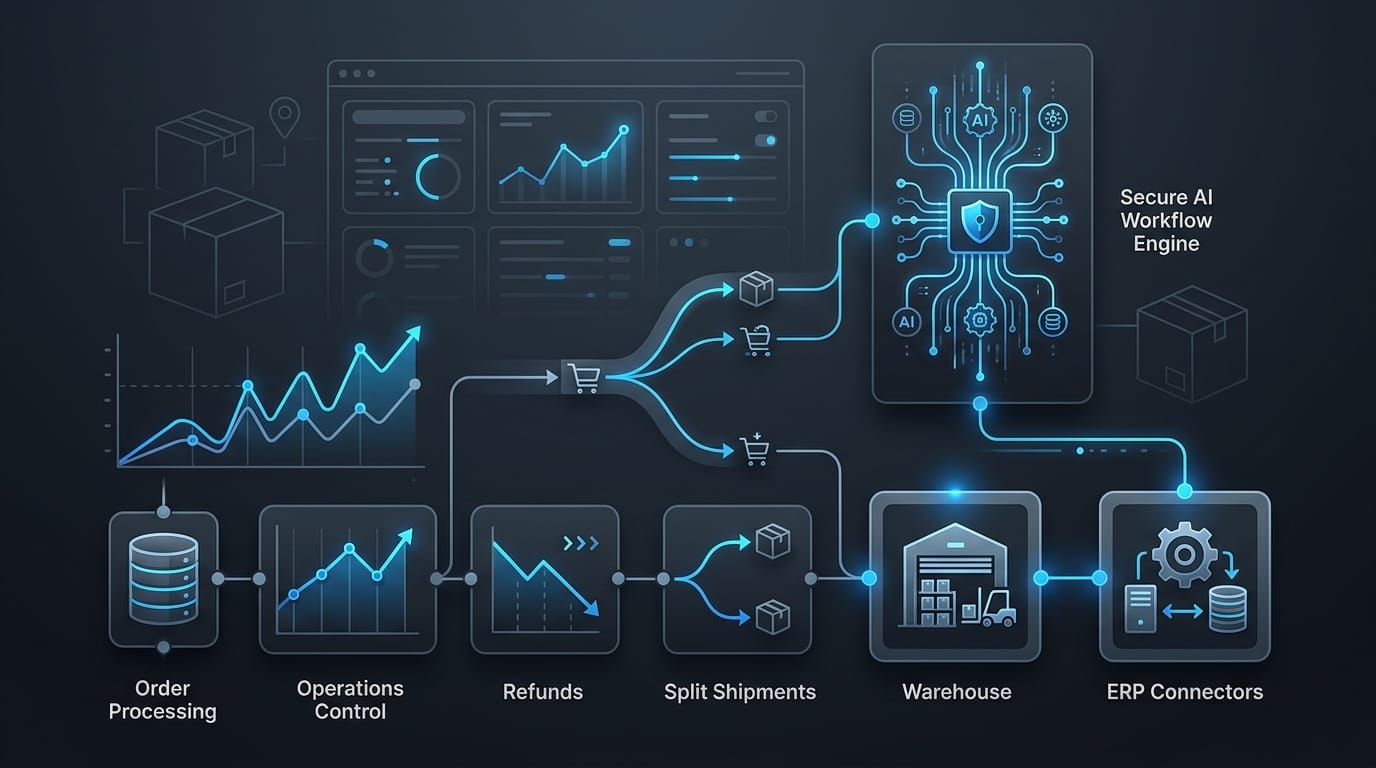
TL;DR: AI order exception management is becoming the part of ecommerce architecture that matters most as agentic commerce grows. Mirakl cites Gartner research suggesting AI agents could account for 20% or more of ecommerce traffic within five years, and AWS says the retail AI market could exceed $164 billion by 2030. The hard problem is not getting an AI agent to help a shopper discover a product. It is governing what happens when the order hits a refund rule, a stock conflict, a fraud review, a split shipment, or a customer-service edge case.
Ecommerce brands rarely lose margin on the happy path. They lose it in the exceptions that bounce between the storefront, OMS, WMS, ERP, helpdesk, and payments stack with no single system actually in charge.
The retailer that wins the AI-commerce era will not be the one with the flashiest shopping assistant. It will be the one that owns the workflow deciding what happens when the order stops being simple.
Why is AI order exception management suddenly urgent?
Because the industry is building the front door to machine-mediated commerce faster than it is fixing the back office that has to absorb it.
Shopify's 2026 agentic commerce guidance makes the direction obvious: merchant systems are becoming machine-readable and agent-facing. Mirakl goes further and cites Gartner research suggesting AI agents could account for 20% or more of ecommerce traffic within five years. AWS, meanwhile, says the retail market for AI could exceed $164 billion by 2030. Those are not toy numbers. They point to a world where more traffic, more discovery, and eventually more transactions are initiated, negotiated, or influenced by software acting on behalf of buyers.
That sounds exciting until the order leaves the storefront and enters the exception layer where most brands still operate like it is 2019. Inventory shifts after checkout. Fraud tools disagree with payment signals. Warehouse cutoffs collide with promised delivery dates. Customers change addresses after fulfillment has started. Returns windows vary by channel, SKU, region, and promotion. Finance wants one answer, support needs another, and the helpdesk agent ends up acting as middleware across six systems. Mirakl also highlights ecosystem moves from PayPal, Perplexity, Visa, and Mastercard as signs that agent-mediated shopping and payment rails are arriving now, not later. That means exceptions will not stay isolated inside support queues. They will increasingly sit inside automated payment, promise, and post-purchase flows.
Direct answer: AI order exception management is urgent because agentic commerce will increase the volume and speed of edge cases hitting merchant operations, and most brands still govern those decisions through fragmented tools and human glue.
What is broken in the current post-order stack?
Almost everything that sits between customer intent and controlled execution.
The average mid-market ecommerce brand has a storefront platform, an order-management layer, a warehouse or 3PL system, payment tooling, fraud controls, a helpdesk, ERP, and a reporting stack. In theory, that is enough. In practice, the logic that determines what happens when an order goes off the happy path is scattered everywhere. Refund eligibility may live partly in policy docs, partly in macros, partly in a support manager's judgment. Split-shipment logic may depend on warehouse rules, inventory latency, and channel promises that no single workflow engine can actually reconcile. Address changes may require one team to manually inspect fulfillment state, another to validate risk, and a third to update finance or customer records after the fact.
Practical Ecommerce argues for an automate-first approach before chasing AI-commerce wins. That is the right instinct, but the operational gap is more specific than generic automation readiness. Brands do not just need faster tickets. They need a governed way to gather evidence, apply policy, and decide whether the action is safe, profitable, compliant, and consistent with customer promises.
This is where the glossy agentic commerce narrative gets thin. Existing coverage is strong on discovery, product data, and conversational buying. It is weak on what happens when an AI-influenced order runs into a cancellation deadline, damaged shipment, duplicate order risk, backorder event, partial fulfillment, region-specific return rule, or goodwill refund request. If those decisions still depend on swivel-chair operations, the merchant has not built AI-native commerce. It has built a faster path into the same old operational bottleneck.
Direct answer: The current post-order stack fails because exception policy is fragmented across systems, people, and vendor tools that were never designed to make one governed decision together.
What does an AI-native order-exception system actually look like?
Not another chatbot. A customer-controlled workflow layer sitting across the commerce stack.
Keep the systems of record. Keep Shopify, Adobe Commerce, Salesforce Commerce, the OMS, ERP, WMS, payment rails, and support tools already doing useful work. The architectural change is to add a control layer that can assemble context from those systems, evaluate explicit policy, propose or execute the next action, and record the decision in a way the brand can audit later.
The first requirement is connector depth. An exception workflow cannot run on ticket text alone. It needs order state, inventory truth, fulfillment milestones, carrier events, customer history, channel source, refund method, fraud score, promotion conditions, and finance impact. That is why deep operational connectors matter. If the system only sees the support inbox, it will make shallow decisions. If it sees the actual order graph, it can do real work.
The second requirement is executable policy. Most retailers already have rules for refunds, appeasements, partial shipments, cancellations, and return eligibility. The problem is that those rules are usually split across macros, SOPs, vendor settings, and tribal memory. A serious control layer turns policy into something the system can actually apply. Can this order be rerouted after label creation? Can a refund be approved automatically if the package is still inside a warehouse cutoff window? Should a damaged-item claim trigger replacement, store credit, or manual review? Which VIP exceptions are allowed, and which ones should be blocked because they create policy leakage?
The third requirement is merchant-controlled deployment. As more of commerce becomes machine-mediated, the margin logic inside these workflows becomes strategically important. This is not just about protecting customer data. It is about protecting operational judgment: fraud thresholds, refund rules, high-risk SKUs, promotion guardrails, and fulfillment priorities. That is why customer-controlled security and deployment boundaries matter. A brand should not have to outsource its exception brain to a black-box vendor to get automation.
The fourth requirement is a closed loop into finance and operations. Exceptions are not just service events. They affect gross margin, recovery rate, chargebacks, shipping cost, working capital, and customer lifetime value. If the workflow layer cannot show the business which exception classes are growing, which policies are being overridden, and where refunds or reships are leaking value, the brand is still flying blind. A reporting spine such as MetricFlow matters here because it turns exception handling from ticket noise into measurable operating economics.
InfraHive's natural angle is not “AI on top of ecommerce.” It is building AI-native workflow systems that sit across commerce, finance, and support environments so the merchant owns the logic. The order exception should not disappear into another SaaS queue. It should enter a governed workflow that knows the policy, the data boundary, the allowed actions, and the exact point where a human should intervene.
Direct answer: An AI-native order-exception system is a merchant-controlled evidence, policy, and action layer that coordinates OMS, ERP, WMS, support, and payments data to decide what should happen next.
What does implementation look like in the real world?
Usually eight to twelve weeks for the first serious workflow, not a giant replatform.
The wrong starting point is “let's automate customer service.” That is too vague to survive contact with actual operations. The right starting point is one expensive, repetitive exception class. It might be address changes after checkout, partial-fulfillment refund decisions, high-volume return eligibility checks, damaged-in-transit replacement routing, or cancellation windows that currently depend on a support agent asking the warehouse, then checking the OMS, then sending a finance note because the payment state changed in the meantime.
Phase one is decision-chain mapping. Which system is authoritative for order state? Where is the live inventory truth? What warehouse event makes a cancellation impossible? Which refund actions require payment-method validation? Where are the region-specific return rules defined? Which exceptions can be auto-resolved safely and which ones must be reviewed? This exercise usually shows that the bottleneck is not lack of AI. It is lack of one workflow boundary where all the relevant context meets.
Phase two is boundary design. Keep systems of record in place, but let the workflow layer assemble the evidence packet and apply explicit policy. Some cases can be auto-approved. Some can open a ranked review path for an agent. Some can trigger a warehouse or carrier update. Some can update finance directly while the customer receives a precise explanation. The goal is not reckless autonomy. It is controlled autonomy with intervention paths that match business risk.
Phase three is rollout. Start with one market, one channel, one policy family, or one fulfillment flow. Measure handle time, policy override rate, refund leakage, reship cost, and first-contact resolution for that exception class. Expand only when the workflow is reliably reducing manual work without creating hidden customer or margin damage.
The common objections are predictable. “Our policies are too messy.” Good. That means the workflow layer is overdue. “Our platform already has automations.” Fine, but point automations rarely coordinate support, warehouse, payments, ERP, and finance decisions well enough. “We cannot replace everything.” You should not. Replace the brittle decision layer first while keeping systems of record intact. That is the practical path.
Direct answer: Start with one painful exception class, keep your systems of record, and build a controlled AI workflow around evidence assembly, policy execution, and human escalation.
What results should a brand expect?
First, lower handle time on repetitive edge cases because agents stop reconstructing context manually.
Second, fewer policy leaks. The system applies the same rules across channels, teams, and shifts instead of relying on whoever happened to answer the ticket.
Third, better coordination between support, fulfillment, and finance. Refunds, reships, cancellations, and appeasements stop behaving like isolated service events and start behaving like governed operational decisions.
Fourth, better visibility into the true economics of exceptions. Brands can see which policies create cost, which workflows drive recovery, and which failure modes should be redesigned upstream. That is consistent with customer-controlled workflow automation outcomes: fewer manual handoffs, faster cycle times, and cleaner decision consistency as more adjacent processes move onto the same foundation.
Direct answer: Expect faster resolution, tighter policy consistency, less avoidable margin leakage, and better visibility into where post-order operations are actually bleeding money.
What does this mean for ecommerce brands in the next 24 months?
It means the control layer behind the storefront is becoming a competitive asset.
As AI agents get better at discovery, comparison, and even transaction initiation, brands that still run exceptions through macros and manual coordination will feel the strain first. More machine-mediated demand does not simplify operations. It amplifies the need for clear policy, trusted data, and merchant-owned execution logic. The brands that move early will not just respond faster. They will protect margin better because they can let software handle high-volume exceptions without giving away the judgment that determines refund cost, fraud exposure, and service quality.
Direct answer: The strategic advantage is not merely acquiring AI-assisted demand. It is owning the workflow that governs what happens when that demand collides with operational reality.
So what should an operator do next?
Pick one ugly post-order workflow where your team still behaves like middleware between the storefront, OMS, WMS, ERP, support, and finance stack. Rebuild that path as a governed AI workflow running in an environment you control. Keep the tools that still earn their place. Stop pretending the exception layer is back-office detail.
If you want to see what that architecture looks like in practice, start at https://infrahive.ai, review the customer-controlled deployment model, and explore how this could fit your stack. In the agentic commerce era, the brands that own their exception workflow will keep their margin when everyone else is still forwarding tickets.
Direct answer: Build the workflow around the order now, because AI shopping volume without controlled exception handling is just a faster route to operational chaos.
Frequently Asked Questions
Does AI order exception management replace an OMS or ERP?
No. The practical move is to keep systems of record in place and add a governed AI workflow layer across them so post-order decisions stop depending on disconnected tools and manual handoffs.
What should an ecommerce brand automate first?
Start with one repetitive exception class such as address changes, cancellation windows, damaged-shipment replacements, return eligibility checks, or partial-fulfillment refund decisions.
Why is customer-controlled deployment important here?
Because the real asset is not just customer data. It is the brand's margin logic, fraud thresholds, refund rules, escalation paths, and fulfillment priorities.
How is this different from a support chatbot?
A chatbot can talk about an order. An AI-native exception workflow can gather evidence from core systems, apply policy, execute allowed actions, and escalate when business risk requires a human decision.
What is the biggest mistake brands make with commerce AI?
The biggest mistake is improving discovery and service surfaces while leaving the expensive operational judgment spread across macros, inboxes, vendor settings, and tribal memory.