
Ecommerce Support AI Agents: Why Teams Are Replacing Helpdesk Macros With Customer-Controlled Workflows
TL;DR: Ecommerce support AI agents are replacing helpdesk macros because support is no longer just a conversation problem. It is an operational workflow problem touching orders, refunds, returns, shipping events, and policy controls across multiple systems. Reuters reported renew

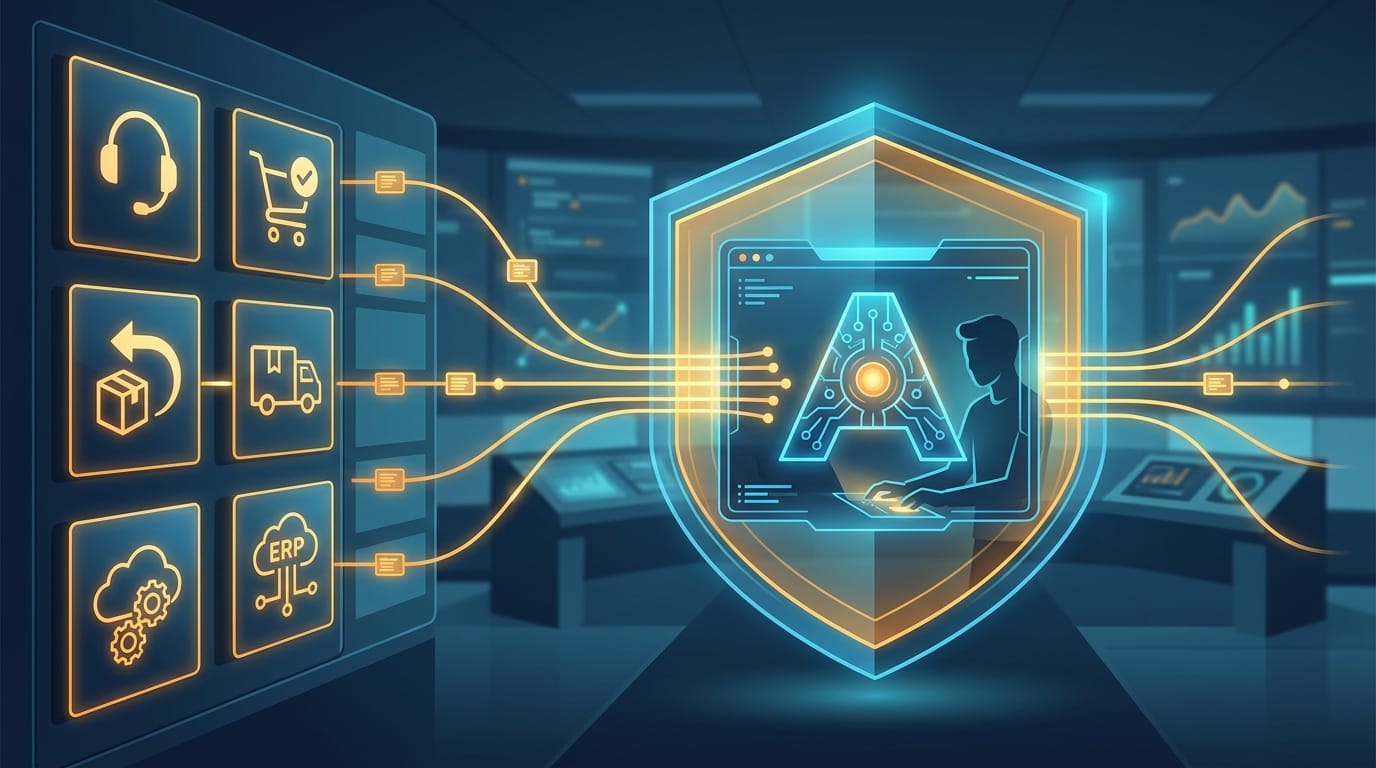
TL;DR: Ecommerce support AI agents are replacing helpdesk macros because support is no longer just a conversation problem. It is an operational workflow problem touching orders, refunds, returns, shipping events, and policy controls across multiple systems. Reuters reported renewed AI disruption jitters across software stocks on 9 April 2026, and Shopify keeps pushing automation guidance because repetitive support demand is now a margin problem, not just a service annoyance. The conclusion is simple: if your support team still acts as glue between a helpdesk, Shopify, ERP, WMS, and returns tools, your architecture is behind.
Most ecommerce support stacks were built to move tickets around. They were not built to read live order context, apply policy, and safely take action. That is why the next replacement wave is not about a nicer chatbot. It is about a customer-controlled AI workflow layer that can actually resolve work.
If a support system can answer questions but cannot inspect the order, apply the rule, and trigger the next step, it is still glorified triage.
Why are ecommerce support AI agents replacing helpdesk macros now?
Because macro-based support breaks the moment the issue is even slightly operational.
Macros are fine for repetitive language. They are terrible for decisions. An order-status question can be answered with a canned reply until the shipment is late, split, partially refunded, blocked by fraud review, or tied to an out-of-policy return. Then the agent has to leave the helpdesk, inspect the commerce platform, check fulfillment events, look at the warehouse state, review the return rule, maybe ask finance about refund timing, and then come back to the customer with an answer. The actual work happens outside the ticketing system.
That is why the market keeps sliding toward agentic software. Reuters' report on AI disruption pressure across software stocks matters here because it captures the structural shift: old workflow software made money by owning screens, queues, and seat licenses. AI starts to erode that value when reasoning and action can happen across systems instead of inside one user interface. Shopify's own customer service automation guidance points in the same direction from the operator side. Merchants want automation because support demand stays high while expectations for speed keep rising.
For ecommerce businesses in the US and Europe, the problem is worse because support is tied directly to margin, chargebacks, logistics cost, and customer retention. A bad answer is expensive. A slow answer is expensive. A wrong refund is expensive. The old stack turns too many of those decisions into manual detective work.
Direct answer: Teams are moving past helpdesk macros because modern ecommerce support requires governed decisions across operational systems, not just faster text responses.
What is broken in the legacy helpdesk model?
The helpdesk still assumes that the ticket is the center of the universe. In ecommerce, it is not.
A customer writes in because something happened in the operating stack: a package stalled, a refund is pending, an item arrived damaged, a return label failed, or a subscription order changed at the wrong time. The answer depends on evidence from the commerce platform, carrier tracking, warehouse events, ERP records, customer policy, fraud posture, and payment status. Yet the typical support setup still treats the ticket as the primary object and the rest of the stack as external lookup tables. That design forces humans to act as the integration layer.
Three failure modes follow. First, agents waste time assembling context manually. They copy order IDs between tools, chase shipment events, interpret policy exceptions, and paste notes back into the ticket. Second, teams automate the visible front door but not the real operational path. A bot can greet the customer and classify the issue, but then the case falls into a queue because the system cannot actually decide or act. Third, exception handling becomes the default mode of work. Every edge case creates more macros, more tags, more routing rules, and more tribal knowledge living in side channels instead of governed logic.
This is why "AI in the helpdesk" often disappoints. If the system can draft a better reply but still cannot tell whether an order qualifies for a reshipment, whether a refund should be partial or full, whether a damaged-item claim needs warehouse evidence, or whether a VIP customer falls under a different service rule, then the team still owns the heavy lifting. The software sounds smarter while the workflow stays broken.
Legacy architecture also creates risk. Once support teams touch refunds, RMAs, entitlements, or subscription changes, every weak handoff becomes a control problem. You need audit trails, policy boundaries, and clear execution rights. Old ticketing stacks were not designed to be a governed decision engine.
Direct answer: The legacy model is broken because it centers the ticket instead of the operational evidence and policy needed to resolve the issue correctly.
What does a real AI-native support alternative look like?
It looks like a customer-controlled workflow layer that sits across the support and commerce stack, not just inside the helpdesk.
Keep the systems of record. Shopify, Magento, ERP, WMS, payment systems, returns platforms, and knowledge bases still matter. They should continue to own transactions and history. The AI-native layer should do something different: gather the relevant evidence, build a resolution packet, apply explicit policy, recommend or execute the next step, and log what happened for review. That turns support from a queueing problem into an operating system problem.
The first requirement is connector depth. A support agent that can only read ticket text is basically guessing. A useful system needs order state, carrier events, inventory position, payment outcome, return eligibility, loyalty status, customer history, and internal knowledge articles. That is why connector coverage across operational systems matters so much. If the AI layer cannot see the relevant evidence, it cannot safely resolve anything meaningful.
The second requirement is policy clarity. Enterprises already know many of their support rules, but they usually exist as habits and exception lore instead of explicit logic. When can the system issue a refund automatically? When must it offer store credit instead? When does a damaged-item report require photo evidence? When should a late shipment trigger a reshipment instead of a refund? When should a fraud flag block an action and escalate? AI-native support works only when those decisions are expressed as governed policy instead of buried inside agent intuition and macro sprawl.
The third requirement is customer-controlled deployment. Support automation is not low-risk when it can change orders or move money. Retailers need to know what the system read, which rule fired, whether a human approved the action, and how the decision can be inspected later. That is where customer-controlled infrastructure and security posture stop being compliance theater and become practical operating design. Own the boundary, own the audit trail, own the iteration cycle.
The fourth requirement is action, not deflection. The real goal is not to answer more tickets. It is to resolve more work. InfraHive's support automation model is built for exactly that pattern: direct ERP and knowledge-base integration so the system can resolve 65%+ tickets without humans when the workflow is well scoped. That matters because it shifts value away from better wording and toward actual throughput. If the AI can inspect the order, validate policy, draft the resolution, and update downstream systems inside a governed boundary, the customer feels speed and the business gets real operating efficiency rather than another layer of marketing language.
The fifth requirement is financial visibility. Support decisions are commercial decisions. Refund timing, replacement orders, shipping exceptions, and return handling all affect cost. That is why the support workflow should connect back into MetricFlow and finance reporting workflows rather than living as an isolated CX island. A retailer should be able to see the cost consequence of support automation, not just ticket metrics.
Direct answer: A real AI-native alternative reads support context across the stack, applies explicit policy, and takes or proposes governed actions inside infrastructure the retailer controls.
What does implementation look like in practice?
Usually six to ten weeks for the first serious workflow if the team starts narrow and picks a pain point that is ugly enough to matter.
The wrong starting point is "automate customer support." That is too broad and too vague. The right starting point is one painful workflow with obvious operational drag: order-status exceptions that require warehouse or carrier evidence, damaged-item claims, refund-eligibility checks, subscription change exceptions, RMA approval routing, or reshipment decisions for lost parcels. These are measurable, frequent, and expensive enough to justify engineering attention.
In the first two weeks, map the real flow rather than the documented one. Which systems hold the necessary fields? Which agents already know the edge cases? Where does finance get involved? Which actions are safe to automate immediately, and which ones need human approval? This step usually exposes how much "customer support" is actually hidden operations work living across ticket notes, spreadsheets, and ad hoc Slack threads.
Weeks three and four are architecture and policy. Connect the commerce platform, ERP, WMS, shipping feeds, returns tooling, and knowledge sources into one governed execution layer. Define permissions clearly. The model may read these fields, propose these actions, auto-execute only under these thresholds, and escalate under these other conditions. That boundary is what makes automation useful instead of reckless.
Weeks five and six are rollout and measurement. Start with one queue, one geography, one issue family, or one brand. Track handle time, resolution rate, refund accuracy, escalation rate, intervention rate, and customer wait time. Keep the incumbent helpdesk if it still adds value as an interface. Replace the reasoning layer first. That is a much cleaner migration path than trying to rip out every existing tool in one noisy program.
The usual objections are predictable. "Our support data is messy." Of course it is. That is why evidence assembly and policy control belong in the architecture. "We already have chatbot automation." If a human still has to inspect four systems before acting, then you automated intake, not resolution. "We should wait for the helpdesk vendor roadmap." That often means paying to preserve your current bottleneck while the real workflow logic stays fragmented.
Direct answer: Start with one high-friction support workflow, put policy and evidence around it, prove the metrics, and expand from there.
What results should an ecommerce operator expect?
The first result is faster, cleaner resolution.
Agents and customers both benefit when the system arrives with the context packet already assembled. Order facts, shipment state, return eligibility, customer tier, and policy flags are visible in one place. That cuts the dead time that normally hides inside support operations.
The second result is fewer manual touches. Once the policy layer is explicit, low-risk requests can flow automatically while higher-risk actions escalate with better evidence attached. Teams stop using senior agents as routing engines for work that should have been resolved upstream.
The third result is twenty-four-seven coverage without twenty-four-seven staffing growth. AI-native support matters most when commerce keeps running and customers expect action outside business hours. When the system can inspect context and take bounded action safely, always-on service becomes operationally realistic instead of aspirational marketing copy.
The fourth result is compounding reuse. After the first workflow ships, the retailer already has connectors, approval states, logging patterns, and policy structures ready for the next one. That is why customer-controlled systems improve economically over time. Each new workflow lands on infrastructure the business already owns rather than restarting from scratch inside another vendor feature silo. You can see the same pattern in real automation outcomes across customer workflows: less manual orchestration, better throughput, and lower marginal cost as more processes move onto the same foundation.
Direct answer: Expect faster resolution, fewer manual handoffs, more reliable off-hours service, and better unit economics as additional workflows reuse the same support infrastructure.
What does this mean for ecommerce leaders in the US and Europe?
It means support software selection can no longer be separated from operating design.
The lazy procurement question is whether the helpdesk vendor has AI. Most of them do, or say they do. The better questions are harder: where does support intelligence run, who controls the data path, how are refund and return policies encoded, what can be audited after an action, and how quickly can the business change the system without waiting for an external roadmap. Those are architecture questions, not feature-checklist questions.
The ecommerce teams that win will not be the ones with the flashiest chatbot demo. They will be the ones that can resolve operational support work faster while keeping control over policy, data, and execution boundaries. In Europe especially, that control increasingly matters for trust, auditability, and commercial resilience. In the US, it matters because speed and service cost still hit the P&L immediately.
Direct answer: Ecommerce leaders should treat customer-controlled support automation as a core operating capability, not just a CX enhancement.
So what should an operator do next?
Pick one support workflow where your agents are obviously acting as glue between systems. Rebuild that path with an AI workflow layer that can read the evidence, apply the rule, and take the next step inside a boundary you control. Keep the helpdesk if it still helps as an interface. Just stop pretending the interface is the system.
If you want to explore what that looks like in practice, start at https://infrahive.ai, review InfraHive's security model, and explore how this works for your commerce stack. The next wave in support is not better macros. It is owned workflow intelligence.
Direct answer: Start with one expensive support exception, prove the gain inside your own environment, then expand deliberately.
Frequently Asked Questions
Do ecommerce support AI agents replace the helpdesk entirely?
Not necessarily. The safer first move is to keep the helpdesk as an interface while moving the reasoning and action layer into a customer-controlled workflow system.
What should a team automate first?
Start with a high-volume, high-friction workflow such as shipment exceptions, refund eligibility checks, damaged-item claims, or RMA routing.
Why is customer-controlled deployment important for support?
Because support automation can affect refunds, reshipments, and customer entitlements, which means the business needs clear policy boundaries, audit trails, and execution control.
How is this different from a chatbot?
A chatbot mainly handles conversation. An AI workflow system assembles evidence across systems, applies policy, and can resolve or escalate the operational task itself.
What is the biggest implementation mistake?
The biggest mistake is automating the front-end conversation while leaving the real decision logic fragmented across other systems and manual steps.