
Why Manufacturers Are Rebuilding ERP Workflows Around On-Prem AI Agents
TL;DR: On-prem AI agents for manufacturing are replacing rigid ERP workflow layers because plants need faster exception handling, tighter data control, and systems that can act across MES, quality, maintenance, and finance without shipping operational logic into a vendor black bo

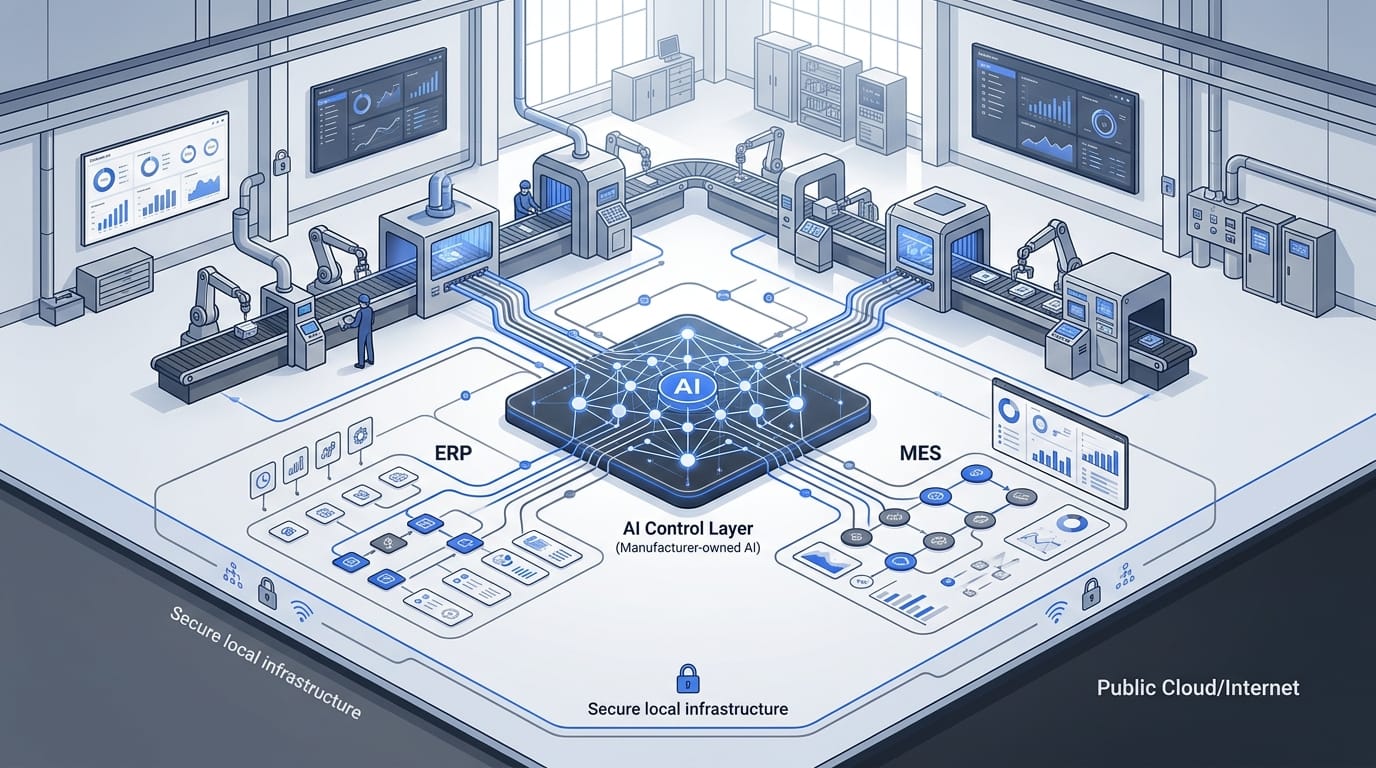
TL;DR: On-prem AI agents for manufacturing are replacing rigid ERP workflow layers because plants need faster exception handling, tighter data control, and systems that can act across MES, quality, maintenance, and finance without shipping operational logic into a vendor black box. The upgrade is not an AI chatbot on top of SAP. It is a manufacturer-owned decision layer running inside infrastructure the manufacturer controls, close to the systems that actually run production.
That shift is already visible in the market. Gartner said in March 2024 that 55% of all supply chain organizations will invest in applications that support AI and advanced analytics by 2026. Microsoft and Siemens have already been pushing industrial generative AI into mainstream manufacturing conversations. Once AI moves from experiment to workflow control, the architecture question gets blunt: who owns the connectors, the policy layer, the data boundary, and the action path?
If your plant still depends on ERP screens, spreadsheets, and email chains to resolve production exceptions, you do not have a software problem anymore. You have a workflow-architecture problem.
Why are manufacturers pulling workflow logic out of ERP?
Because ERP was built to record transactions, not to make plant-speed judgments.
That distinction matters more than most software vendors admit. Systems like SAP, Oracle, and NetSuite are strong at persistence, controls, and canonical records. They are weak at handling the messy middle where manufacturing work actually stalls: supplier exceptions, maintenance triage, quality escapes, invoice mismatches, engineering-change fallout, expedites, and the endless stream of “this does not fit the template” decisions that operators make every day.
In most factories, those decisions still bounce between ERP modules, MES screens, shared inboxes, spreadsheets, maintenance systems, and tribal knowledge. The result is predictable. Planners wait for clarifications. Supervisors re-enter data. AP teams reconcile by hand. Maintenance coordinators chase approvals across three systems. Support teams answer questions that the software stack should already be able to resolve. ERP is still the system of record, but it becomes the wrong place to host living operational judgment.
The governance pressure makes this harder to ignore. The European Commission says the AI Act is the first-ever legal framework on AI and that it entered into force on 1 August 2024. Meanwhile, industrial sovereignty initiatives such as Manufacturing-X keep pushing the same point: manufacturers want to share and use data without surrendering control of it. Once AI touches production planning, quality, maintenance, or supplier workflows, data sovereignty stops being a board-slide slogan and becomes a systems design requirement.
Direct answer: Manufacturers are pulling workflow logic out of ERP because the valuable work is no longer transaction entry. It is exception handling, prioritization, routing, and decision support across systems that ERP alone was never built to orchestrate well.
What is broken in the old ERP-centered operating model?
The problem is not that ERP exists. The problem is that too much judgment is trapped around it.
Take a common production exception. A late supplier shipment threatens a work order. Inventory says one thing, the planner spreadsheet says another, MES shows a machine window, quality has open non-conformance history on an alternate component, procurement has an updated ETA in email, and finance wants to avoid an expedite if possible. The ERP holds pieces of the truth, but not the actual decision workflow. So people compensate manually. They email. They call. They re-check screens. They create side lists. Then they push a final decision back into ERP as if the software had meaningfully supported the choice.
The same pattern shows up in maintenance. Work orders are opened, spare parts are checked, machine history is reviewed, technician availability changes, and root-cause notes live across maintenance software, MES, PDFs, and human memory. Or look at finance workflows inside manufacturing groups: invoice matching, goods-received discrepancies, chargeback disputes, and month-end close exceptions often still rely on people to interpret scattered evidence before any ERP transaction can be finalized.
This is why adding a generic AI copilot rarely solves the real issue. If the model can answer questions but cannot reach governed context from the right systems, apply business policy, and trigger actions safely, then it is just another surface sitting on top of the same bottleneck. Manufacturers do not need more interface layers. They need the decision path itself rebuilt.
Direct answer: The ERP-centered model breaks when decisions require cross-system context, local policy, and real-time operational trade-offs. That work lives around ERP, not inside its rigid transaction flows.
What does an on-prem AI agent architecture for manufacturing actually look like?
It looks less like software extension and more like a controlled workflow engine sitting between plant systems and enterprise systems.
The first layer is connectors. Without them, nothing interesting happens. A useful manufacturing agent needs governed access to ERP, MES, CMMS or maintenance tools, quality systems, document stores, procurement records, inventory data, and often email or ticketing flows. This is where most vendor demos quietly cheat. They show the model being clever after somebody has already done the painful systems work. In reality, connector design is the product. That is why reliable enterprise connectors matter so much: they determine whether the agent is reasoning over live operational truth or stale fragments.
The second layer is retrieval and context assembly. A plant-side AI agent should not merely pull raw records. It should gather the exact evidence needed for the workflow: order status, machine history, supplier ETA, quality holds, BOM substitutions, approval thresholds, or prior exception patterns. This turns the system from a search layer into a decision layer. A late-component workflow, for example, may need to weigh supplier reliability, current WIP exposure, alternate stock, cost impact, and machine schedule before recommending action.
The third layer is policy. This is where on-prem matters. Some actions should always require human approval. Some substitutions are allowed only for certain plants or customers. Some quality deviations can be routed to engineering automatically; others cannot. Some finance adjustments can be proposed but never posted without review. If those rules live only in a remote vendor product, the manufacturer is still renting judgment. The policy layer has to sit in a boundary the operator controls.
The fourth layer is execution. This is where most “industrial AI” pitches still feel thin. Useful agents do not stop at summarizing. They route exceptions, open tickets, draft supplier follow-ups, request approvals, classify defects, prepare reconciliations, and write outcomes back to core systems with auditability. That is the architecture InfraHive is built for: customer-controlled AI data processing and workflow automation running on infrastructure the customer owns, with zero ambiguity about where data moves and how actions are governed.
The fifth layer is deployment flexibility. Mistral's May 2025 Le Chat Enterprise launch explicitly offered self-hosted, private-cloud, public-cloud, and hosted options. That matters because enterprise buyers now expect boundary choice as a baseline. Manufacturing teams should demand the same from workflow AI. Some plants will want everything inside a tightly controlled environment. Others will run hybrid patterns. The key is that the manufacturer, not the vendor roadmap, decides the boundary.
Direct answer: An on-prem manufacturing agent stack combines governed connectors, workflow-specific context retrieval, a local policy layer, auditable system actions, and deployment control inside infrastructure the manufacturer chooses.
What does implementation look like in the real world?
Usually six to ten weeks for the first serious workflow, not a year-long ERP replacement fantasy.
The best starting point is an exception-heavy workflow with obvious labor drag and measurable business cost. Good candidates include purchase-order and invoice mismatch handling, maintenance triage for repetitive machine faults, quality deviation classification, spare-parts exception routing, supplier-delay response, or Tier-1 support requests from plants that keep bouncing between operations and IT. These are exactly the places where ERP records exist but operational judgment still lives in people.
Weeks one and two are about operating truth. Which systems actually contain the latest trustworthy status? Where are the approvals? Which fields are reliable? Which exceptions matter enough to automate? Most manufacturers discover fast that the official process map is too clean. Real work happens across inboxes, workaround sheets, shift notes, and system comments. If you automate before mapping that reality, you will just produce a more elegant failure.
Weeks three and four are about connectors and hard boundaries. Bring ERP, MES, maintenance, quality, and support signals into one governed workflow boundary. Define what the agent can read, what it can recommend, what it can write back, and what always needs a human. Decide where logs live. Decide which plant or business unit gets the first rollout. This is also where the forward-deployed engineer model matters. Somebody has to translate plant reality into system behavior. A generic consultant collecting requirements is not enough. You need a builder who can sit with operations, engineering, finance, and IT and turn ambiguity into working rules.
Weeks five and six are execution design and controlled rollout. Start narrow. Let the new agent handle one exception class for one plant, line, or region while the old ERP flow remains intact underneath. Compare cycle time, manual touches, rework, and escalation frequency. Expand only once the system proves that it is not just smart in a demo but trustworthy in production.
The migration path is almost always hybrid. Keep ERP as the book of record if needed. Replace the workflow layer first. That means the manufacturer avoids a giant rip-and-replace project while still clawing back the judgment work that causes the most delay. It also means connectors, policies, and monitoring become reusable assets for the next workflow instead of one-off project debris.
Direct answer: Real implementation starts with one painful exception workflow, maps the ugly reality first, builds local connectors and policy controls, uses a forward-deployed builder to bridge teams, and expands through measured hybrid rollout.
What results should manufacturers expect?
The first result is not some dramatic robot-factory fantasy. It is cleaner operational throughput.
When judgment-heavy workflows move into manufacturer-owned agents, teams spend less time stitching context together manually. Exceptions are resolved faster because the system gathers the evidence, applies policy, and prepares the action path before a human even steps in. Finance operations stop chasing documents across email and ERP notes. Maintenance teams stop losing time to repetitive diagnosis and scheduling friction. Quality teams get better triage instead of generic summaries.
The second result is control. A manufacturer-owned workflow layer is easier to inspect, audit, and adapt than a stack of SaaS add-ons. The same connector patterns that help maintenance can support finance or support. The same policy boundary can protect plant data and write-back rules across multiple workflows. That is where the economics improve: reusable capability instead of repeated subscriptions to thin interface layers.
This is also why products like MetricFlow matter in the broader InfraHive approach. The real win is not one clever agent. It is a business-owned operating layer that can move from AP automation into reporting, support, and IT operations without handing core logic back to legacy software or another black-box vendor. You can see the same pattern in customer deployment outcomes and security and data-control design.
Direct answer: Expect faster exception resolution, fewer manual touches, better auditability, and a reusable automation layer that compounds across manufacturing, finance, and support workflows.
What does this mean for manufacturing leaders in Europe and the US?
It means AI advantage will increasingly belong to the operator who owns the boundary, not the operator who buys the flashiest demo.
European manufacturers will feel the sovereignty and governance pressure more explicitly as data-control and intervention-path questions rise. US manufacturers may frame the same issue through uptime, cost, resilience, and vendor-concentration risk. Either way, the strategic move is similar: keep the workflow intelligence near the systems that run the plant, and keep the policy layer inside a boundary you can defend technically and commercially.
The early movers will not merely “adopt AI.” They will strip exception-heavy work out of legacy ERP flows and rebuild it as controlled, inspectable agent systems that actually fit how factories run.
Direct answer: In both Europe and the US, manufacturers that own their AI workflow boundary will modernize faster and with less operational risk than those waiting for ERP vendors to solve the problem for them.
So what should a manufacturer do next?
Pick one workflow where people are still acting as the integration layer between ERP, plant systems, and reality. Rebuild that decision path first. Keep the system of record if you need it. Just stop pretending the judgment layer belongs inside an old transaction stack.
If you want to explore what manufacturer-owned workflow AI looks like on infrastructure you control, start at https://infrahive.ai and explore how this works for your stack. The strategic choice is not whether AI will enter manufacturing. It is whether your plant gets to own the part that matters.
Direct answer: Start with one exception workflow, own the control boundary, prove the economics, and expand from there.
Frequently Asked Questions
Why use on-prem AI agents in manufacturing instead of a generic cloud copilot?
Because manufacturing workflows often depend on plant data, local policies, and system actions that need tighter control, lower ambiguity, and clearer auditability than a generic hosted assistant can usually provide.
Does this mean replacing ERP entirely?
No. Most manufacturers keep ERP as the system of record and replace the judgment-heavy workflow layer around it first.
Which workflows are best to start with?
Exception-heavy processes such as maintenance triage, invoice and PO mismatch handling, supplier-delay response, quality deviation routing, and repetitive plant support requests are strong starting points.
What makes deployment succeed fastest?
A narrow first workflow, strong connectors, explicit policy rules, and a forward-deployed builder who can turn plant reality into system behavior.
What is the biggest mistake in industrial AI projects?
Treating the model as the product. In production, the real product is the connector boundary, the policy layer, and the governed action system wrapped around the model.