
Why Retailers Need an AI Replenishment Control Layer Beyond Planning Suites
TL;DR: An AI replenishment control layer is becoming the real retail software upgrade because retailers need inventory decisions, substitutions, fulfillment priorities, and exception handling to move faster than planning suites and ERP handoffs allow. The 2026 signals all point t

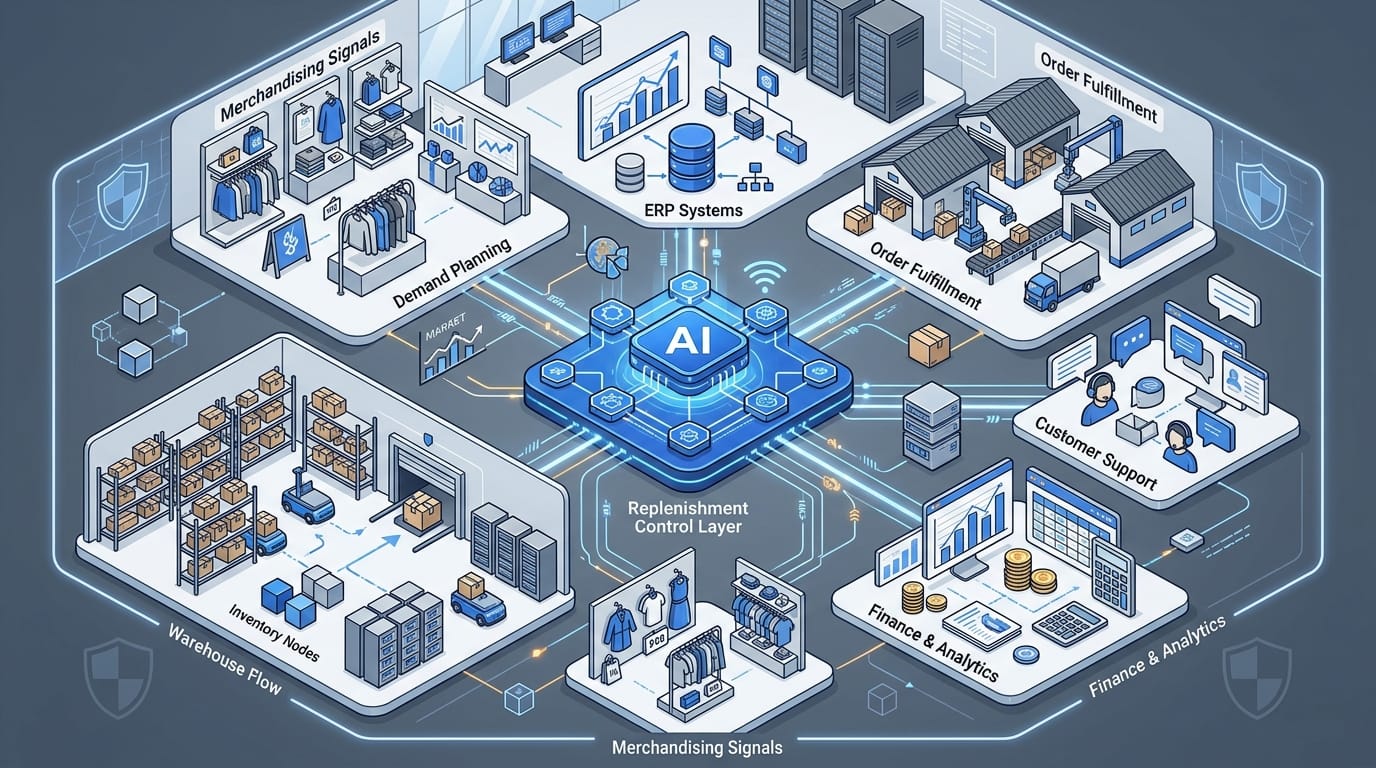
TL;DR: An AI replenishment control layer is becoming the real retail software upgrade because retailers need inventory decisions, substitutions, fulfillment priorities, and exception handling to move faster than planning suites and ERP handoffs allow. The 2026 signals all point the same way: Retail Technology Innovation Hub reported on April 14 that Iceland Foods selected invent.ai for inventory and replenishment operations, Microsoft used NRF 2026 to promote agentic AI across retail functions, the National Retail Federation's 2026 trends report kept AI at the center of retail planning, Deloitte's 2026 retail outlook kept margin pressure and operating efficiency high on the agenda, and IGD's 2026 retail trends report highlighted AI alongside cybersecurity and waste reduction.
That combination matters because it shows retail AI is leaving the slide deck stage. The serious question now is not whether retailers will use AI. It is where the replenishment logic, policy boundary, and execution control will live once AI starts touching day-to-day commercial decisions.
If your replenishment team still depends on dashboards, spreadsheets, exports, and approval chains to resolve inventory exceptions, you do not have a forecasting problem anymore. You have a workflow-architecture problem.
Why are retailers moving beyond planning-suite AI?
Because the valuable work in retail is no longer generating another forecast. It is deciding what to do when reality breaks the forecast.
Planning suites are good at structure. They can model demand, hold assortment rules, and produce forecasts, replenishment proposals, or inventory views. ERP systems are good at record keeping, controls, and transaction integrity. But the painful part of retail operations lives in the messy middle: stockouts, substitutions, regional demand spikes, delayed inbound inventory, promotion overruns, support-driven demand anomalies, channel conflicts, and the slow drip of exceptions that force humans to stitch decisions together across systems.
That is where most retailers still lose time and margin. Merchandising sees one signal. Supply chain sees another. Fulfillment sees a third. Finance notices the damage later. Customer support feels it immediately when delivery promises slip or substitutions make no sense. The software stack may be full, but the decision path is still manual.
The 2026 news cycle makes that harder to ignore. Retail Technology Innovation Hub reported on April 14, 2026 that Iceland Foods selected invent.ai for inventory and replenishment operations. Microsoft used NRF 2026 to promote agentic AI capabilities across retail functions. The National Retail Federation's 2026 trends and predictions report identified AI as a defining theme for the year. Deloitte's 2026 retail industry outlook kept margin pressure and operating efficiency high on the agenda. IGD's 2026 global retail trends report highlighted AI alongside cybersecurity and waste reduction. The pattern is clear: retailers want AI tied to live operations, margin, and control.
Direct answer: Retailers are moving beyond planning-suite AI because the important work is not just forecasting demand. It is handling cross-system replenishment and inventory exceptions in real time, which planning suites were never built to orchestrate elegantly.
What is broken in the old replenishment operating model?
The problem is not that planning systems exist. The problem is that too much judgment is trapped around them.
Take a familiar scenario. A promotion lands harder than expected in one region. Inventory looks healthy at the national level but is fragile at node level. One warehouse is overexposed, another can cover if transfers happen quickly, one supplier has already signaled inbound slippage, and customer support has started seeing delivery questions before the planners finish their first review. The commerce team wants to keep demand flowing. Operations wants to protect service levels. Finance wants to avoid margin bleed from expedites and markdowns. The planning suite contains pieces of the truth, but not the living workflow that decides what happens next.
So people compensate manually. They export reports. They compare spreadsheets. They send messages. They ask whether the forecast should be overridden, whether substitutions should be promoted, whether a marketplace listing should be throttled, whether support macros need updating, whether transfer rules still make sense, and whether the product should stay in the campaign. By the time that coordination finishes, the business has already paid for the delay.
This is why generic AI overlays often disappoint. If the model can summarize the inventory picture but cannot gather governed context from ERP, WMS, merchandising, promotions, supplier updates, support patterns, and finance thresholds, then it is just a more articulate screen. Retailers do not need one more surface that tells them a stockout might happen. They need a workflow layer that assembles the evidence, applies policy, and triggers the next approved action.
The deeper issue is commercial. Once replenishment logic sits inside a vendor-owned product boundary, the retailer starts renting operational judgment: which data is visible, which connectors are supported, how thresholds are encoded, where audit logs live, how quickly policy can change, and how expensive it becomes to adapt later. In an AI-heavy stack, those are not technical details. They shape who controls how the retail business runs.
Direct answer: The old replenishment model breaks because retail decisions require cross-system evidence, local policy, and real-time action, while planning suites and ERP flows mainly record or recommend rather than coordinate the messy judgment work around them.
What does an AI replenishment control layer for retail actually look like?
It looks less like an AI feature and more like a governed workflow engine sitting between retail systems and day-to-day operating decisions.
The first layer is connectors. Without them, nothing useful happens. A serious replenishment workflow needs governed access to planning data, ERP, warehouse systems, order flows, supplier signals, promotions, merchandising rules, support inputs, and finance metrics. This is where many demos quietly cheat. They show the model being smart after somebody else has already solved the hard systems problem. In production, connector design is the product. That is why reliable cross-system connectors matter so much: they determine whether the AI is reasoning over live retail truth or over stale fragments.
The second layer is context assembly. A replenishment agent should not dump raw tables into a model and call it intelligence. It should gather the exact evidence needed for the workflow: node-level availability, promotion lift, substitution options, transfer constraints, inbound ETA confidence, service-risk signals, margin exposure, prior exception patterns, and approval thresholds. This turns the system from a reporting layer into a decision layer.
The third layer is policy. This is where customer-controlled deployment matters. Some replenishment changes can be automated. Some can be recommended but require approval. Some substitutions are allowed only for specific categories or markets. Some channel throttles are acceptable only when service risk crosses a threshold. Some price or promotion actions must stay outside automation entirely. If those rules live only in a black-box vendor product, the retailer is still renting judgment. The policy layer has to sit in a boundary the operator controls.
The fourth layer is execution. Useful systems do not stop at advice. They re-route replenishment actions, raise transfer requests, draft supplier follow-ups, update support guidance, flag merchandising exposure, escalate channel throttles, and write approved outcomes back into the systems of record with clear auditability. That is the architecture InfraHive is built for: customer-controlled AI data processing and workflow automation running on infrastructure the customer owns, with zero ambiguity about where data moves and how actions are governed.
The fifth layer is measurement. If the system cannot connect its actions back to stockout rate, sell-through, markdown risk, expedite cost, waste, service level, and margin, then it is just faster confusion. This is why a measurement spine like MetricFlow matters. It ties workflow automation back to economics instead of vanity dashboards.
The smarter answer for a retailer with a complex existing stack is not to pretend the planning suite disappears next quarter. The smarter answer is to keep systems of record where they still earn their place and insert a customer-controlled replenishment control layer above the brittle handoff zone. That layer can run on infrastructure the retailer governs, coordinate across inventory, fulfillment, support, and finance, and replace one ugly workflow at a time.
Direct answer: An AI replenishment control layer combines governed connectors, workflow-specific context retrieval, a local policy boundary, auditable actions, and customer-controlled deployment so retail decisions can move faster without surrendering control.
How do you implement this without another endless retail transformation program?
Start with one cross-functional path where delay, manual coordination, and policy drift already cost money.
Good starting points include low-stock substitution handling, inbound-delay response, promotion oversell prevention, node-level transfer exceptions, service-risk routing for popular SKUs, or finance-heavy exception paths where stock decisions create hidden margin damage. These are the places where planning and ERP records exist, but operational judgment still lives in people.
Implementation usually has three layers. First, evidence mapping: what systems hold trustworthy state, what data is late, where node-level visibility breaks, what approvals exist, and what the business actually treats as decisive. Second, policy design: what the system may do automatically, what it may recommend with approval, and what must remain human-controlled. Third, rollout: one category, one region, one exception type, or one business unit first, with aggressive measurement of overrides, cycle time, stockout exposure, waste, service impact, and margin effect.
The forward-deployed model matters because every retail stack lies. The architecture diagram says one thing; the workflow in production says another. Somebody has to sit with planners, merchants, operators, and finance teams, map where truth actually lives, and encode policy around reality instead of around vendor claims. That is why the strongest implementations do not begin with a giant template. They begin with a painful workflow and a small team that can move from connector setup to policy design to live feedback quickly.
The objections are predictable. “Our planning environment is too customized.” Fine. That is an argument for an execution layer, not against one. “We cannot replace everything.” Good. Do not. “Our vendor already offers AI.” Also fine, but an in-suite AI feature rarely sees the full economics of decisions that cross merchandising, inventory, support, fulfillment, and finance. “We need a business case.” Then start where the current process already burns hours, markdowns, or customer trust.
The migration path is almost always hybrid. Keep the planning suite or ERP as the book of record if needed. Replace the workflow layer first. That means the retailer avoids a giant rip-and-replace program while still reclaiming the judgment work that causes the most delay. It also means the connectors, policies, and monitoring become reusable assets for the next workflow instead of one-off project debris.
Direct answer: Real implementation starts with one ugly replenishment exception, maps the messy reality first, builds governed connectors and policy controls, uses a forward-deployed builder to bridge teams, and expands through a measured hybrid rollout.
What results should retailers actually expect?
When judgment-heavy replenishment work moves into a retailer-owned AI layer, teams spend less time stitching context together manually. Exceptions are resolved faster because the system gathers the evidence, applies policy, and prepares the next step before a human intervenes. Merchants stop flying blind on node-level inventory risk. Supply-chain teams stop chasing routine escalations. Finance gets earlier visibility into the cost of inventory moves.
The second result is control. A retailer-owned workflow layer is easier to inspect, audit, and adapt than a stack of SaaS AI modules. The same connector patterns that help replenishment can support support, finance, or post-purchase exception handling. The same policy boundary can protect inventory logic and write-back rules across multiple workflows. That is where the economics improve: reusable operating capability instead of repeated subscription spend on thin AI overlays.
The third result is strategic flexibility. Once the workflow layer is customer-controlled, the business can change systems beneath it over time without restarting from zero. That is exactly why the market is becoming so interested in deployment boundaries. Whoever owns the workflow layer gains compounding power. Whoever rents it becomes easier to trap.
You can see the same pattern in customer deployment outcomes and security and deployment design. The first use case may be narrow, but the connectors, approval patterns, logging model, and control posture become reusable. One ugly workflow becomes a repeatable operating capability.
Direct answer: Expect faster exception resolution, fewer manual touches, better stock and service discipline, clearer margin visibility, and a reusable automation layer that compounds across the retail operation.
What does this mean for retail leaders in Europe and the US?
It means AI advantage will increasingly belong to the operator who owns the workflow boundary, not the operator who buys the flashiest module.
Retail leaders in both Europe and the US face the same strategic move: keep replenishment intelligence close to the systems that run the business, and keep the policy layer inside a boundary you can defend technically and commercially.
The early movers will not merely “adopt AI.” They will strip exception-heavy work out of rigid planning and ERP flows and rebuild it as controlled, inspectable workflow systems that actually fit how retail runs. That is the durable difference between adding intelligence to a dashboard and rebuilding the execution path itself.
Direct answer: In both Europe and the US, retailers that own their AI workflow boundary will modernize faster and with less lock-in risk than those waiting for planning-suite vendors to solve the problem for them.
So what should a retailer do next?
Pick one replenishment workflow where people are still acting as the integration layer between planning tools, ERP, warehouses, support systems, and reality. Rebuild that decision path first. Keep the systems of record if you need them. Just stop pretending the judgment layer belongs inside old planning software.
If you want a practical view of retailer-owned workflow AI on infrastructure you control, start at https://infrahive.ai, review deployment control and security, inspect connector coverage, and explore how this works for your stack. The strategic choice is not whether AI will enter retail operations. It is whether your team gets to own the part that matters.
Direct answer: Start with one exception workflow, own the control boundary, prove the economics, and expand from there.
Frequently Asked Questions
What is an AI replenishment control layer?
It is a retailer-owned workflow layer that connects planning, ERP, inventory, fulfillment, support, and finance systems so AI can assemble context, apply policy, and trigger auditable replenishment actions.
Does this mean replacing the planning suite entirely?
No. Most retailers keep planning tools and ERP as systems of record and replace the judgment-heavy workflow layer around them first.
Which workflows are best to start with?
Low-stock substitution, inbound-delay response, transfer exceptions, promotion oversell prevention, and service-risk routing are strong starting points because they already span multiple teams and systems.
Why does customer-controlled deployment matter?
Because the strategic asset is not only the inventory data. It is the policy logic, thresholds, approvals, and action patterns that determine how the business responds when inventory reality changes.
What is the biggest mistake in retail AI projects?
Treating the model as the product. In production, the real product is the connector boundary, policy layer, action logic, and measurement system wrapped around the model.
For anyone exploring a character design, it is worth considering how details related to cosplay accessories will affect the complete look. During a long convention day, reviewing details related to character costumes also makes comfort and movement easier to judge. To organise preparations involving details related to cosplay wigs, character costumes for outdoor photography can help narrow the options for a specific purpose. For an outfit that feels convincing, it is useful to check details related to cosplay costume sets against the wearer's own needs.