
Why Retailers Need an AI Execution Layer for Retail Before AI Search Rewires Demand
TL;DR: An AI execution layer for retail is quickly becoming more important than another AI feature inside a commerce dashboard. Adobe for Business says AI traffic is growing while retail sites still lag in AI search visibility. ESM Magazine says retail is in execution mode headin

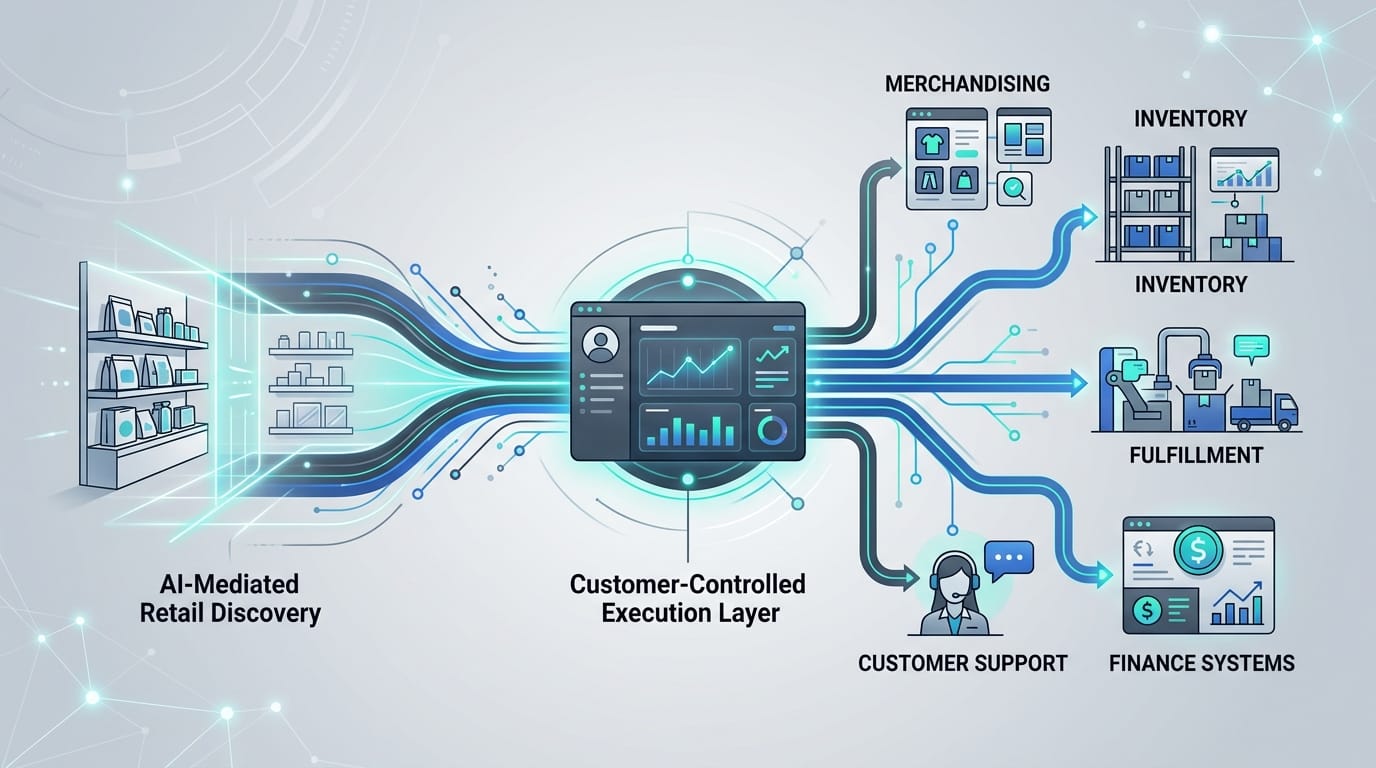
TL;DR: An AI execution layer for retail is quickly becoming more important than another AI feature inside a commerce dashboard. Adobe for Business says AI traffic is growing while retail sites still lag in AI search visibility. ESM Magazine says retail is in execution mode heading into NRF 2026 Europe. Microsoft says agentic AI can power intelligent automation for every retail function. The real issue is not whether retailers show up in AI search. It is whether they can translate new demand signals into pricing, merchandising, inventory, fulfillment, support, and finance decisions fast enough to matter.
If they cannot, AI search becomes another source of demand volatility that the stack notices too late.
The next retail moat will not be better dashboards about AI demand. It will be the execution layer that turns AI-mediated discovery into governed operational action.
Why is an AI execution layer for retail suddenly urgent?
Because discovery is changing faster than retail operations are.
Adobe's point about AI traffic growing while retail sites still lag in AI search visibility matters for one obvious reason and one less obvious reason. The obvious reason is traffic acquisition. The less obvious reason is that AI-mediated discovery changes how demand arrives. Shoppers come in with narrower intent, different comparison behavior, and different expectations about availability, delivery confidence, and product answers. That means the value of the traffic depends on how quickly the retailer can translate those signals into action.
ESM Magazine's framing that retail is in execution mode heading into NRF 2026 Europe fits this exactly. The market has had enough AI demos. Operators now care whether systems can actually make merchandising, fulfillment, and support decisions under pressure. Microsoft's message that agentic AI can power automation for every retail function sharpens the issue even further. If AI is spreading across the whole retail operating model, then the strategic question is no longer which department gets a copilot. The question is who owns the workflow boundary where those functions meet.
Direct answer: An AI execution layer for retail is urgent because AI search and agentic retail software are changing demand and operational expectations at the same time, while most retailers still lack a governed system that can act across the stack.
What is broken in the current retail stack?
The problem is not a lack of tools. It is a lack of connection between demand signals and operating decisions.
A modern retailer may already run a commerce platform, product information management, search and merchandising tools, demand planning software, an ERP, warehouse systems, customer support software, spreadsheets for exception handling, and finance workflows that explain the damage after the fact. Every one of those tools owns a slice of the truth. Almost none owns the cross-system decision that actually protects margin.
Imagine a new demand pattern appears through AI search. Certain products get more traffic, but the landing pages underperform, store availability is uneven, substitutions are unclear, and support volume rises because customers are asking pre-purchase questions that the site cannot answer cleanly. Merchandising needs to adjust ranking and content. Inventory teams need to rebalance supply assumptions. Fulfillment needs to understand promise risk. Support needs better product and availability context. Finance needs visibility into markdown, expedite, and return exposure if the retailer pushes the wrong assortment signal too hard. The systems involved can all log events. Very few can coordinate the next move.
This is where vendor-centered AI pitches get slippery. A tool inside one suite may summarize demand beautifully and still fail operationally because the real decision spans merchandising, inventory, support, fulfillment, and finance. The Register's reporting on lock-in concern around an AI clause in SAP's new API policy matters because it reminds buyers that AI value gets trapped wherever the integration boundary lives. If one vendor owns the automation boundary, the retailer risks handing over more than software spend. It hands over the logic that decides how demand is converted into revenue and service outcomes.
Europe adds pressure through compliance, data control, fragmented supply chains, and multilingual merchandising complexity. US retailers feel it through labor pressure, shipping cost volatility, and more brutal promotion economics. Different triggers. Same architectural flaw.
Direct answer: The current retail stack is broken because AI-mediated demand, merchandising, inventory, fulfillment, support, and finance decisions span multiple systems, but most retailers still have no governed layer that can assemble evidence and execute the right next action.
What does an AI execution layer for retail actually look like?
It is not another recommendation engine. It is a governed retail workflow system running across the real operating graph of the business.
Keep the systems of record that still matter. Keep the commerce platform, ERP, warehouse software, PIM, and support tools. The architectural shift is to add an execution layer that can pull signals from those systems, evaluate explicit policy, decide which actions are permitted, trigger those actions, and write outcomes back into the stack for audit and measurement.
The first requirement is connector depth. AI discovery does not help if the system sees only traffic and not the downstream operational state. A retailer needs line-level inventory, node availability, lead times, margin data, support themes, return risk, promotion windows, and supply constraints in the same decision flow. That is why deep connectors across retail systems matter. The execution layer has to understand both the demand signal and the operational cost of responding to it.
The second requirement is executable policy. Most retailers already have rules for substitutions, stock exposure, markdown thresholds, customer-service escalation, return routing, shipment upgrades, and vendor replenishment triggers. The problem is that those rules often live in tribal knowledge, macros, tickets, and disconnected workflow tools. An AI execution layer turns those rules into explicit software boundaries. If AI search drives unexpected demand into a product family with constrained stock, should the system boost substitutes, suppress paid amplification, rebalance inventory, alert support, or adjust promise messaging? Those are not model questions first. They are operating-policy questions.
The third requirement is deployment control. This is where the current market tends to hide the real tradeoff. Microsoft is pushing agentic AI across retail functions because vendors see the control surface expanding. The question for the retailer is whether that control surface lives inside the vendor's boundary or its own. HPCwire's report that Cirrascale added Google Gemini support for on-premises AI deployment matters because it shows private enterprise AI infrastructure is getting more practical. For some retailers, that matters because of data residency. For others, it matters because merchandising logic, routing policy, and margin rules are strategic assets. Either way, customer-controlled security and deployment architecture is not just a compliance detail. It is a control decision.
The fourth requirement is economic feedback. A retail AI system that cannot tie actions to margin, stock turn, support cost, fulfillment cost, and return exposure is just moving faster without steering. That is why a reporting spine such as MetricFlow matters. Retailers need to know which AI-driven demand changes produced profitable action, which created stockouts, which increased service load, and which simply moved pain from one team to another.
InfraHive's natural angle sits here. The useful question is not whether AI can improve discovery. It obviously can. The better question is how a retailer builds a customer-controlled operating layer that converts new demand into bounded action across merchandising, fulfillment, support, and finance without another suite takeover.
Direct answer: An AI execution layer for retail is a governed evidence, policy, and action system running across discovery, merchandising, inventory, fulfillment, support, and finance on infrastructure the retailer controls.
What does implementation look like in practice?
Usually eight to twelve weeks for the first production workflow, not a massive rip-and-replace project.
The wrong way to start is to say, "we need agentic retail." That means almost nothing. The right way is to identify one ugly workflow where new demand signals currently break the handoff between teams. It might be fast-moving assortment changes, low-stock product promotion, substitution handling, merchandising response to emerging search patterns, product-content escalation, or customer-service triage for high-intent categories.
Phase one is evidence mapping. Which systems hold trustworthy product availability? Where does merchandising intent live? Which support signals predict conversion friction or avoidable returns? Which finance codes capture the cost of promotions, expedites, and markdown response? Which warehouse constraints should stop the system from pushing demand toward a fragile node? Most retailers discover the same thing: the bottleneck is not insight. It is the absence of one controlled place where evidence from multiple systems can be assembled before the business commits to action.
Phase two is policy design. Define what can happen automatically, what should be recommended with approval, and what should always stay human-controlled. Good retail AI is not reckless autonomy. It is bounded autonomy. The system might automatically flag a high-visibility product family for substitute ranking if stock confidence drops. It might update support prompts when search-driven demand spikes in a category with known fit questions. It might trigger internal escalation when projected margin erosion crosses a threshold. It might hold off on pushing traffic toward a product where delivery confidence has weakened.
Phase three is rollout. Start with one region, one category, one warehouse network, or one demand exception class. Measure response time, manual handoffs, override rate, markdown leakage, support contacts, stockout exposure, and fulfillment cost. Expand only when the workflow improves operating performance without creating hidden downstream damage.
The predictable objections are familiar. "Our stack is too messy." Exactly why a cross-system execution layer matters. "Our platform already has AI." Fine, but AI inside one boundary rarely sees the full retail cost structure. "We cannot replace everything." You should not. Keep systems of record. Replace the brittle decision layer first.
Direct answer: Start with one costly cross-functional retail workflow, keep the current stack in place, and build a bounded AI process that assembles evidence, applies policy, executes allowed actions, and escalates the rest.
What results should a retailer expect?
First, less lag between a new demand signal and an operational response. Teams stop behaving like human middleware between discovery, merchandising, operations, support, and finance.
Second, fewer policy leaks. The business handles stock risk, substitute logic, support escalation, and fulfillment tradeoffs more consistently because the workflow applies explicit rules every time instead of relying on whoever notices the problem first.
Third, better visibility into the economic impact of AI-driven demand. Retailers stop treating traffic, product ranking, support load, and margin damage as separate analytics stories. They become one operating chain.
Fourth, a cleaner path to scaled automation. Once one governed workflow is live, the next one becomes cheaper to deploy because connectors, policy patterns, and measurement are already in place. That is where customer-controlled automation results start to compound: faster merchandising response, fewer inventory surprises, tighter support coordination, and better finance visibility into what AI-driven demand actually costs or earns.
Direct answer: Expect faster operational response, tighter policy consistency, fewer cross-team handoffs, and a more realistic path from AI traffic insight to measurable retail margin improvement.
What does this mean for retail over the next 24 months?
It means the strategic control point is moving away from passive retail software and toward the workflow layer that decides how the business responds to demand.
Retailers that treat AI search only as a visibility problem will improve discoverability and still lose execution. Retailers that treat it as an operating-system problem will build a stronger moat. In Europe, that intersects with control, compliance, and supply-chain complexity. In the US, it intersects with labor efficiency, conversion pressure, and contribution margin. In both markets, early movers will not win because they bought the loudest AI announcement. They will win because they owned the workflow boundary where AI could actually act.
Direct answer: The next retail edge is not having AI somewhere in the stack. It is owning the execution layer that decides how AI interacts with pricing, inventory, service, fulfillment, and cash outcomes.
So what should a retail team do next?
Pick one demand-to-action workflow that still depends on spreadsheets, ad hoc approvals, expert memory, and slow handoffs across merchandising, operations, support, and finance. Rebuild that path as a customer-controlled AI workflow on infrastructure you trust. Keep the systems that still earn their place. Stop confusing a vendor demo with operational control.
If you want to see what that architecture looks like in practice, start at https://infrahive.ai, review the deployment model, and explore how this could fit your stack. In retail, the moat is not the AI announcement. It is the workflow boundary you own.
Direct answer: Build the execution layer before AI search turns into another demand source your current stack cannot operationalize.
Frequently Asked Questions
Does an AI execution layer for retail replace the commerce platform or ERP?
No. The practical model is to keep systems of record in place and add a governed workflow layer across them so demand, inventory, support, and finance decisions stop depending on disconnected tools and manual coordination.
What retail workflow should be automated first?
Start with one cross-functional decision chain such as low-stock demand response, substitute ranking, product-content escalation, delayed fulfillment recovery, or high-intent category support triage where multiple teams already collide.
Why does customer-controlled deployment matter in retail AI?
Because the strategic asset is not only customer data. It is the retailer's operating logic: merchandising rules, stock thresholds, routing priorities, service standards, promotion controls, and margin guardrails.
How is this different from AI inside a retail suite?
An in-suite AI feature can summarize or recommend from inside one boundary. An AI execution layer can gather evidence across systems, apply policy, trigger allowed actions, and maintain an audit trail across the real workflow.
What is the biggest mistake retailers make with AI search?
The biggest mistake is treating AI search as a traffic problem only, instead of redesigning the cross-system workflow that decides how the business responds when that traffic changes demand patterns.
When choosing a first cosplay outfit, it is worth considering how details related to Halloween styling will affect the complete look. When the final look will be photographed, reviewing details related to convention planning also makes comfort and movement easier to judge. For choices related to details related to cosplay props, cosplay props for beginners offers a useful starting point for practical preparation. When planning for care after the photoshoot, it is useful to check details related to cosplay shoes against the wearer's own needs.