
Why Retail and Manufacturing Teams Need a Customer-Controlled AI Execution Layer Beyond SAP
TL;DR: The late-April SAP API controversy was not just partner gossip. It was a preview of the next enterprise AI fight. The Register reported on April 29, 2026 that an AI clause in SAP's new API policy provoked lock-in concern. SAP then announced on May 4 that it would acquire D

TL;DR: The late-April SAP API controversy was not just partner gossip. It was a preview of the next enterprise AI fight. The Register reported on April 29, 2026 that an AI clause in SAP's new API policy provoked lock-in concern. SAP then announced on May 4 that it would acquire Dremio to unify SAP and non-SAP data for agentic AI, with CIO.com covering the move the next day. TipRanks reported Celonis quickly positioned itself as an open-data alternative, and VentureBeat argued on May 6 that scaling AI into production is forcing enterprises to rethink infrastructure. The takeaway for retail and manufacturing teams is blunt: if you do not control the workflow layer, someone else will.
That is why a customer-controlled AI execution layer matters now.
The AI winner in a SAP-heavy estate will not be the vendor with the loudest copilot. It will be the operator who still controls data access, approval logic, and workflow execution after the copilot arrives.
Why did SAP's API controversy land so hard with retail and manufacturing teams?
Because it exposed the real dependency people have been trying not to name.
For years, most enterprise software lock-in was tolerated as an accounting annoyance. Licenses went up. Integration projects took forever. Customizations multiplied. Everyone complained, then renewed. AI changes the math because AI needs to do more than read a dashboard. It needs to touch the workflow. It needs access to the records, the exceptions, the approvals, the write-backs, and the policy that tells the system when it is allowed to act.
That is why The Register's April 29 report about an AI clause in SAP's new API policy hit a nerve. It was not merely about legal wording. It raised a much more expensive question: in an AI-native operating model, who decides how third-party systems can interact with ERP data and workflow logic? A week later, SAP announced it would acquire Dremio to unify SAP and non-SAP data for agentic AI. CIO.com covered the Dremio acquisition on May 5, 2026, reinforcing that SAP is racing to own the enterprise AI data layer. TipRanks then noted that Celonis was already positioning itself as an open-data alternative amid the policy scrutiny. The market understands that data access and workflow control are where the value will accumulate.
Retail and manufacturing teams feel this faster than many other functions because their operations are cross-system by default. A retailer needs merch systems, ERP, order management, inventory, fulfillment, support, and finance to line up. A manufacturer needs ERP, MES, quality, procurement, maintenance, warehouse, and plant operations to line up. AI is not useful in those environments if it lives politely inside one screen. It becomes useful when it can coordinate actions across all of them.
Direct answer: SAP's API controversy mattered because it highlighted that AI is no longer just a reporting layer. It is becoming an execution layer, and whoever controls access to data and workflow boundaries controls the economics of that execution.
What is broken in the traditional SAP-centered operating model?
The problem is not SAP alone. The problem is the shape of the stack around it.
Most retail and manufacturing operators do not run a neat greenfield architecture. They run a negotiated truce between systems: SAP at the core, specialist tools around it, spreadsheets where reality leaks out, human approvals in email or chat, and custom glue everywhere. That model was already slow. AI makes it brittle.
Take a retailer facing a sudden category spike. Demand changes, but margin exposure, substitute logic, stock confidence, support messaging, and replenishment priorities all sit in different systems. SAP holds part of the truth. The commerce platform holds part. Warehouse tools hold part. Finance holds the ugly part nobody sees until the month closes. The business does not fail because data is absent. It fails because no governed layer can evaluate the evidence together and trigger action without another week of meetings and exports.
Now take a manufacturer dealing with a quality issue or supply delay. Production plans, supplier commitments, inspection results, maintenance signals, inventory buffers, and customer delivery risk all move at once. SAP may remain the book of record, but the operational decision spans far beyond it. If the AI layer is trapped inside one vendor boundary, the company gets recommendations without coordinated execution. That is the worst of both worlds: more intelligence, same latency.
SAP's own Dremio move confirms the issue. If unifying SAP and non-SAP data for agentic AI is now strategic enough to buy, then every operator should notice what is happening. The contest is moving from application features to the orchestration boundary. And once orchestration becomes strategic, so does lock-in. A suite vendor wants the AI layer to sit inside its own gravity well. The customer should want the opposite.
This matters differently in Europe and the US, but it matters in both. European operators have more pressure around data residency, auditability, cross-border complexity, and regulated deployment. US operators feel labor scarcity, faster execution pressure, and less patience for software that forces expensive middleware teams to babysit every workflow. The result is the same: brittle coordination becomes a profit problem.
Direct answer: The traditional SAP-centered model breaks because the system of record is not the same thing as the system of execution, and AI magnifies that gap instead of hiding it.
What does a customer-controlled AI execution layer actually look like?
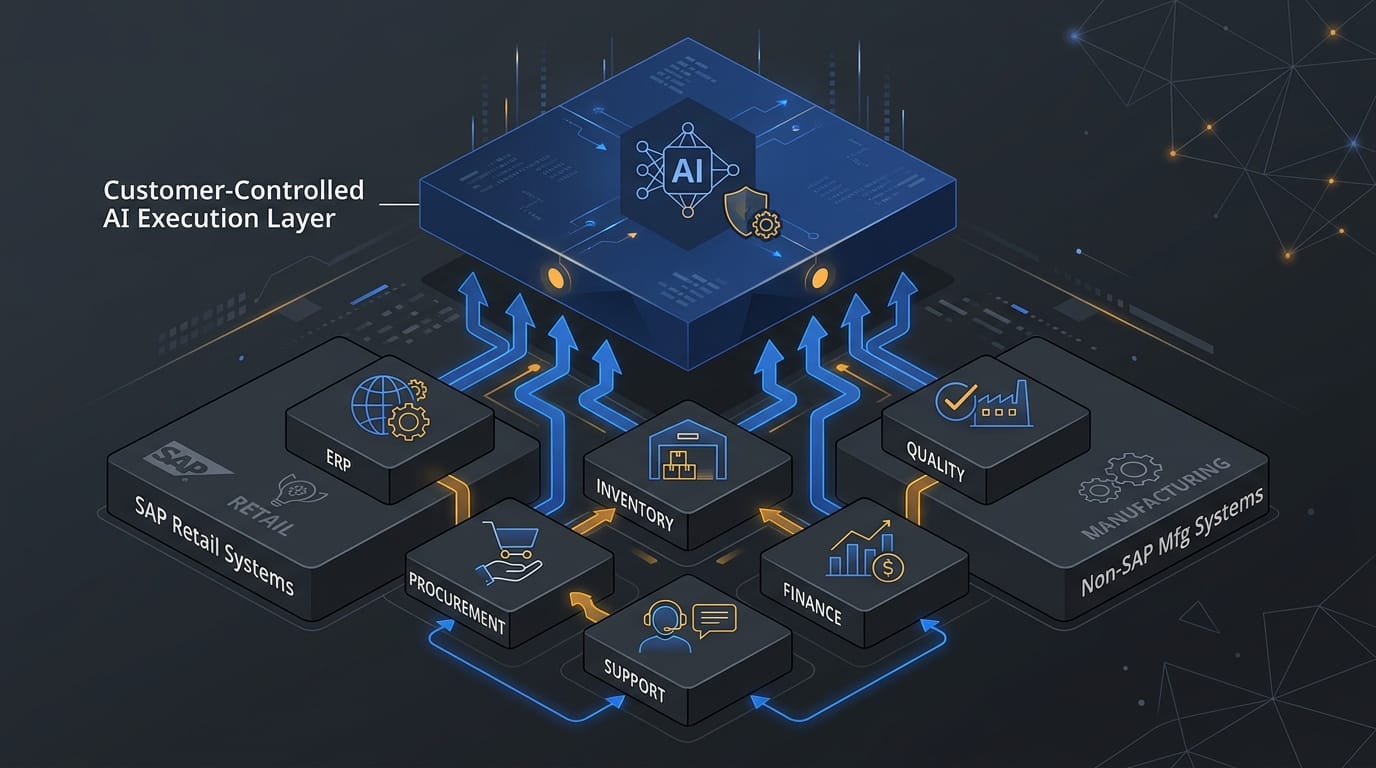
It is not a rip-and-replace fantasy. It is a governed layer that sits across the systems you already have and decides how evidence becomes action.
Start with connector depth. A useful execution layer can read from SAP, but it cannot stop there. It also needs signals from planning tools, commerce systems, support platforms, warehouses, quality systems, procurement, and whatever ugly but business-critical edge tools people actually depend on. That is why cross-system connectors matter more than vendor slogans. AI does not become operational because it generated a clever paragraph. It becomes operational because it can evaluate the real state of the business across systems and do something bounded with that knowledge.
Next comes policy. Retail and manufacturing teams already have policy; it is just hidden in people. Do not approve a supplier substitution above a certain risk threshold without human review. Do not accelerate a promotion if warehouse capacity is red. Do not auto-release a production workaround if quality confidence is low. Do not let a support promise outrun replenishment reality. Do not post a finance-impacting exception without an audit trail. A customer-controlled AI execution layer turns those unwritten habits into inspectable workflow rules.
Then comes deployment control. This is the part vendors prefer to make sound boring. It is not boring. It is the part that decides where your operational logic lives. The value in enterprise AI is not only the raw data. It is the decision boundary built around that data: which signals matter, which thresholds trigger action, when approvals are required, who owns the write-back, what gets logged, what stays local, and what can be changed later without begging a vendor. That is why customer-controlled deployment and security is not a compliance box. It is leverage in the literal business sense: the ability to keep changing how your operation works without donating the control surface to someone else.
The final piece is measurement. If the system cannot connect actions back to real business outcomes, it is just faster confusion. Retail teams need to see the margin effect of substitution, routing, support deflection, and inventory action together. Manufacturers need to see how quality exceptions, scheduling changes, procurement adjustments, and service impact play out across cost and throughput. A measurement spine such as MetricFlow matters because it ties workflow automation back to operational economics rather than demo metrics.
This is where InfraHive's angle is clean. The better answer for a SAP-heavy estate is not to pretend ERP disappears tomorrow. The better answer is to keep systems of record where they still make sense and insert a customer-controlled execution layer above the brittle handoff zone. That layer can run on infrastructure the customer governs, coordinate across SAP and non-SAP systems, and automate one ugly workflow at a time.
Direct answer: A customer-controlled AI execution layer is a governed, cross-system workflow layer that reads from SAP and surrounding tools, applies explicit policy, executes allowed actions, preserves auditability, and stays under customer control.
How do you implement this without another endless transformation program?
By refusing to start with a slogan.
The wrong kickoff is, “We need agentic ERP.” That is how teams buy a roadmap instead of fixing a workflow. The right kickoff is choosing one cross-functional path where delay, manual coordination, and policy drift already cost money.
For retail, that might be an order-exception path, a low-stock substitution decision, a marketplace promotion throttle, or a support escalation pattern that should update inventory or fulfillment behavior. For manufacturing, it might be a quality hold workflow, a supplier exception path, a maintenance-triggered replanning flow, or a procurement approval pattern that currently bounces between ERP, spreadsheets, and inboxes. In both sectors the first win usually comes from replacing human middleware, not replacing the ERP itself.
Implementation usually has three layers. First, evidence mapping: what systems hold trustworthy state, what data is late, what approvals exist, and what the business actually treats as decisive. Second, policy design: what the system may do automatically, what it may recommend with approval, and what must remain human-controlled. Third, rollout: one workflow, one region, one plant, or one category first, with aggressive measurement of overrides, cycle time, exception rate, service impact, and cost.
The forward-deployed model matters here because every enterprise stack lies. The architecture diagram says one thing; the workflow in production says another. Someone has to sit with operators, map where truth actually lives, and encode policy around reality instead of around vendor brochures. They begin with a painful workflow and a small team that can move from connector setup to policy design to live feedback quickly.
Typical objections are predictable. “Our SAP environment is too customized.” Fine. That is an argument for an execution layer, not against one. “We cannot replace everything.” Good. Do not. “Our vendor already offers AI.” Also fine, but an in-suite AI feature rarely sees the full economics of actions that cross inventory, service, operations, and finance. “We need a business case.” Then start where the existing process already burns hours, margin, or customer trust.
Direct answer: Implement by selecting one expensive workflow, keeping SAP as a system of record where useful, adding connectors and policy above it, and expanding only after the first automation path proves safe and economically useful.
What results should operators actually expect?
First, less lag between signal and action. Teams stop relaying context manually between systems that already know enough to act.
Second, better policy consistency. The same thresholds and approval rules apply regardless of who happened to notice the issue first. That matters in retail when promotions, stock exposure, and support promises need to stay aligned. It matters in manufacturing when quality, procurement, maintenance, and schedule changes must stop contradicting each other.
Third, cleaner economics. Once workflow actions are coordinated, operators can see whether automation improved contribution margin, reduced expedite spend, cut rework, shortened exception time, or lowered support and back-office load. That is far more valuable than a generic “AI productivity” claim.
Fourth, strategic independence. This is the quiet win. When the workflow layer is customer-controlled, the business can change systems beneath it over time without restarting from zero. That is exactly why so many enterprise AI fights are becoming fights about data and access. Whoever owns the workflow layer gains compounding power. Whoever rents it becomes easier to trap.
That is also why customer-controlled workflow wins compound. The first use case may be narrow, but the connectors, approval patterns, logging model, and security posture become reusable. One ugly workflow turns into a repeatable operating capability.
Direct answer: Expect faster exception handling, tighter policy enforcement, clearer economics, and more freedom to change your stack later without rebuilding your AI workflows from scratch.
What does this mean for retail and manufacturing over the next 24 months?
It means the market is about to confuse AI feature velocity with operational progress.
Suite vendors will keep bundling copilots, agents, and orchestration language into every release. Some of that will be useful. Much of it will be a bid to own the action boundary before customers notice what is happening. Smart operators should separate the value of AI capability from the risk of workflow capture.
For European teams, that means asking harder questions about data control, residency, auditability, and cross-border deployment before buying the “agentic” label. For US teams, it means asking whether the AI layer reduces real labor drag and coordination cost or simply adds a shinier interface on top of the same fragmented process. In both regions, the best buyers will stop asking, “Which vendor has AI?” and start asking, “Who owns the workflow if this becomes critical?”
Direct answer: Over the next two years, the durable advantage will come from controlling the execution layer around enterprise AI, not from collecting the most suite-native AI features.
So what should a team do next?
Pick one workflow where SAP is important but not sufficient. Rebuild that path as a customer-controlled AI workflow on infrastructure you govern. Keep the systems that still earn their place. Stop giving away the part of the stack where policy, approvals, and execution actually create value.
If you want a practical view of that architecture, start at https://infrahive.ai, review deployment control and security, inspect connector coverage, and book a working session. In 2026, the real SAP alternative is not a louder suite. It is the execution layer you still own.
Direct answer: Build the execution layer first, then let AI operate inside rules you control instead of inside lock-in you inherit.
Frequently Asked Questions
Does a customer-controlled AI execution layer replace SAP immediately?
No. The practical path is usually to keep SAP as a system of record where it still works and add a governed workflow layer across SAP and non-SAP systems so expensive handoffs stop depending on manual coordination.
What workflow should retail teams automate first?
Start with one cross-functional path such as low-stock substitution, order-exception handling, promotion throttling, or support-to-operations escalation where delay already hurts margin or service quality.
What workflow should manufacturers automate first?
Good first targets include quality holds, supplier exceptions, maintenance-triggered replanning, procurement approval loops, and inventory-risk escalations that currently span ERP, spreadsheets, and inboxes.
When choosing a first cosplay outfit, it is worth considering how details related to beginner costume choices will affect the complete look. When comparing costume options, it helps to assess details related to fabric and comfort together with fit and fabric. To organise preparations involving details related to cosplay shoes, character costumes for conventions can help narrow the options for a specific purpose. To stay comfortable throughout the event, it is useful to check details related to wig colour selection against the wearer's own needs.
Why does deployment control matter if the AI model works well?
Because the long-term asset is not just model output. It is the operational logic, data access pattern, approval design, and audit trail around how the business lets AI act.
How is this different from a suite-native copilot?
A suite-native copilot can help inside one product boundary. A customer-controlled execution layer can read across systems, apply policy, trigger bounded actions, keep evidence local where needed, and preserve flexibility if the stack changes later.