
Why Ecommerce Teams Need an AI Execution Layer Before Agentic Commerce Scales
TL;DR: Agentic commerce is quickly becoming real infrastructure, not just a trend label. PwC says retail is entering an agentic AI revolution. TechRadar says agentic AI and unified commerce will define ecommerce in 2026. Digital Commerce 360 reported Microsoft introduced agentic

TL;DR: Agentic commerce is quickly becoming real infrastructure, not just a trend label. PwC says retail is entering an agentic AI revolution. TechRadar says agentic AI and unified commerce will define ecommerce in 2026. Digital Commerce 360 reported Microsoft introduced agentic AI tools to automate retail and B2B commerce operations. TechCrunch reported Google announced a protocol to facilitate commerce using AI agents. Digital Commerce 360 also reported Gartner expects 60% of brands to use agentic AI for one-to-one engagement. The real question is no longer whether agents will influence buying journeys. It is whether your business controls what happens when those agents can actually trigger work.
Most ecommerce stacks still do not.
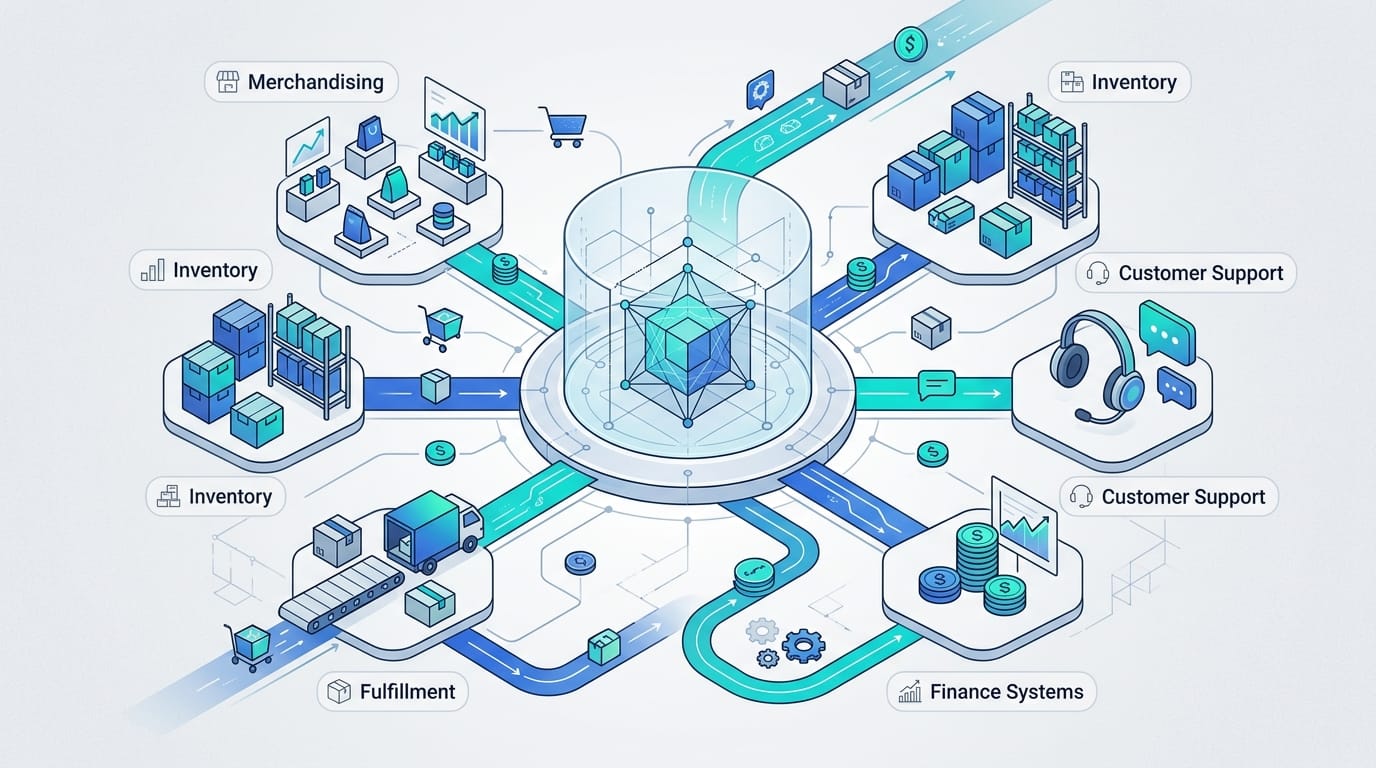
The next commerce moat will not be the agent you demo. It will be the execution layer you control when that agent needs merchandising, inventory, support, fulfillment, and finance to move together.
Why does an AI execution layer for ecommerce suddenly matter?
Because the industry is shifting from AI that describes work to AI that initiates work.
For years, ecommerce teams were mostly asked to absorb AI as a feature. Better recommendations. Better copy generation. Better search summaries. Better service replies. Useful, but narrow. The current shift is different. PwC's framing of an agentic AI revolution in retail matters because it signals that AI is no longer sitting politely inside one screen. It is becoming part of the operating model. TechRadar's argument that agentic AI and unified commerce will define ecommerce in 2026 pushes the same point from a different angle: the market is moving toward systems that can observe context, make bounded decisions, and coordinate actions across multiple commercial surfaces.
That sounds exciting until you look at how most ecommerce operations actually work. A shopper, or increasingly a shopping agent, changes demand patterns. Merchandising should respond. Inventory planning should respond. Fulfillment risk should respond. Customer support should respond. Finance should understand whether the response protects margin or quietly destroys it. In most companies, those functions still live in different tools, with different handoffs, different metrics, and different approval logic. Agents may arrive faster than the company can coordinate the downstream work.
That is why an AI execution layer for ecommerce matters now. The front end of commerce is becoming more agent-mediated, while the middle and back office of commerce are still fragmented. If the workflow layer remains brittle, agentic commerce will create more volatility than value.
Direct answer: An AI execution layer matters because commerce is moving from AI-assisted insight to AI-initiated action, and most ecommerce stacks still cannot govern that action across functions.
What is broken in the current ecommerce operating model?
The problem is not that merchants lack software. The problem is that the software boundary is in the wrong place.
Take a familiar ecommerce scenario. An AI shopping assistant starts steering more qualified demand into a narrow set of SKUs. Conversion on those pages rises, but only in some regions. Availability is good in one node and fragile in another. Product questions rise because the agent summarizes features in ways the PDP does not fully support. Delivery promises become less reliable as traffic concentrates. Meanwhile the merchandising team sees one story, support sees another, operations sees a third, and finance notices the damage after promotions, expedites, and returns are already in motion.
Every modern stack has tools for fragments of that picture: commerce platform, search and merchandising, PIM, ERP, warehouse systems, CRM, support desk, analytics, planning models, spreadsheets for exceptions, and Slack messages for the real decisions. The stack can report. It often cannot govern. That distinction matters more in 2026 than it did a year ago because the action surface is widening.
Digital Commerce 360's reporting that Microsoft introduced agentic AI tools to automate retail and B2B commerce operations makes the control issue obvious. Major vendors understand that the valuable layer is not just the interface where users ask questions. It is the layer where automation crosses systems and turns recommendations into actions. TechCrunch's reporting on Google's protocol for commerce using AI agents matters for the same reason. Once protocols emerge, the market stops debating whether agent-mediated transactions are plausible and starts debating who controls the rules of engagement.
Then add Gartner's forecast, cited by Digital Commerce 360, that 60% of brands will use agentic AI for one-to-one engagement. Whether the exact percentage lands early or late is less important than what it signals: executive teams are being told this is mainstream roadmap territory. Budget and architecture choices will follow.
The weakness in many current stacks is that the automation boundary sits inside platform silos. The commerce platform can optimize a page. The support platform can draft a reply. The ERP can update records. But the real commercial decision spans them all. Should demand be steered toward substitutes? Should low-stock products lose visibility? Should support macros update automatically for high-intent questions? Should fulfillment warnings suppress certain promises? Should finance receive an alert when a fast growth pattern is clearly unprofitable? Those are not single-tool questions. They are workflow questions.
Direct answer: The current ecommerce model is broken because the systems of record are separated from the workflow decisions that agentic commerce now needs to trigger quickly and safely.
What does an AI execution layer for ecommerce actually do?
It sits across the existing stack and governs how evidence becomes action.
That does not mean replacing the commerce platform, ERP, WMS, PIM, support tooling, or analytics warehouse. In most cases, that would be a terrible idea. Systems of record still matter. The useful shift is to add a customer-controlled execution layer that can collect signals from those systems, apply explicit policy, trigger allowed actions, require approval where needed, and write the outcome back for auditability and measurement.
The first requirement is connector depth. If the layer sees only storefront behavior, it will make shallow decisions. Ecommerce operators need an execution system that can observe product performance, stock confidence, node-level availability, margin data, support themes, return risk, delivery constraints, and promotion windows at the same time. That is why deep connectors across operational systems matter. An agentic commerce workflow is only as good as the evidence surface it can actually read.
The second requirement is explicit policy. Most operators already have rules, even if they are hidden. Do not oversell low-confidence stock. Do not push offers that destroy contribution margin. Escalate support content when questions spike in a high-value category. Do not let a marketplace promotion outrun warehouse capacity. Keep premium-service promises aligned with node reality. In many businesses those rules are scattered across tickets, tribal memory, spreadsheets, macros, and escalation habits. An AI execution layer turns that messy logic into bounded, inspectable policy.
That matters because agentic commerce raises the risk of accidental automation theater. It is easy to let an agent generate a recommendation. It is much harder to ensure that recommendation respects margin guardrails, inventory exposure, service standards, and fulfillment reality. The right architecture does not ask AI to freestyle across your operation. It asks AI to reason within explicit commercial boundaries.
The third requirement is deployment control. This is where the market tends to get slippery. Vendors now present agentic commerce as if the obvious path is to let a platform become the orchestration layer for your whole business. That may be convenient. It is not always wise. The valuable asset is not just customer data. It is the operational logic around substitution, routing, stock thresholds, merchandising priorities, exception handling, service promises, and financial guardrails. Those are strategic assets. A customer-controlled deployment model gives merchants a way to keep those assets inside infrastructure and governance patterns they trust. That is why customer-controlled security and deployment is a commercial design choice, not merely a technical footnote.
The fourth requirement is economic visibility. Agentic commerce can move faster than the monthly business review. That is dangerous. If the business cannot tie automated actions back to margin, stock turn, support load, expedite cost, and return exposure, it is just accelerating noise. A measurement spine such as MetricFlow matters because it lets operators see whether the workflow improved business outcomes or simply moved pain from one function to another.
This is where InfraHive has a clean angle. The right answer to agentic commerce is not another black-box feature inside a suite. It is an execution layer that merchants control across merchandising, inventory, fulfillment, support, and finance, using the systems they already have where those systems still earn their place.
Direct answer: An AI execution layer for ecommerce is a governed, customer-controlled workflow layer that turns agent-driven demand and tasks into bounded operational actions across the existing stack.
What does implementation look like in the real world?
Usually one ugly workflow first, not a giant platform migration.
The smartest starting point is not “we need agentic commerce.” That phrase is too vague to ship. A better start is choosing one cross-functional workflow where today’s stack already breaks down. Common examples include low-stock demand response, substitute ranking when agent-driven demand concentrates on unavailable items, support escalation for high-intent product questions, delay recovery for premium orders, or promotion throttling when fulfillment risk rises faster than the dashboard refreshes.
Phase one is evidence mapping. Which system has trustworthy availability? Which data defines margin guardrails? Which support signals predict avoidable returns? Which nodes matter most for delivery confidence? Which categories can be safely automated first? Operators usually discover that the problem is not absence of data. It is the absence of one governed place where those facts can be evaluated together before the business acts.
Phase two is policy design. Define three zones: what the system may do automatically, what it may recommend with approval, and what must stay human-controlled. Good automation in commerce is bounded autonomy, not blind autonomy. For example, the execution layer might automatically reduce exposure for low-confidence inventory in one region, recommend substitute ranking updates in another, refresh support prompts for a third, and escalate the case if projected margin erosion crosses a finance threshold. That is a much healthier pattern than letting each team react independently after the demand shock has already spread.
Phase three is rollout. Start with one category, one region, or one exception type. Measure response time, manual handoffs, overrides, service contacts, stockout exposure, delivery miss rate, and margin leakage. Expand only when the workflow proves it can improve action speed without creating hidden downstream damage.
The objections are predictable. “Our stack is too messy.” That is precisely why a cross-system execution layer is useful. “Our commerce platform already has AI.” Fine, but in-suite AI rarely sees the full operational cost of the action it recommends. “We cannot replace everything.” Good. You should not. Keep the systems of record. Replace the brittle coordination layer first.
Direct answer: Start with one costly workflow, keep the current systems of record, add bounded policy and connector depth, then expand once the first automation path proves its value.
What results should operators expect?
First, less lag between a new demand signal and a safe commercial response. Teams stop acting like human middleware between storefront events and back-office consequences.
Second, fewer policy leaks. The business handles stock exposure, substitute behavior, support messaging, and fulfillment promises more consistently because the workflow applies explicit rules instead of relying on whoever notices the issue first.
Third, better economics. The merchant can finally connect conversion, service cost, delivery confidence, return exposure, and margin in one operating chain instead of treating them as separate reporting stories.
Fourth, a cleaner path to scale. Once one governed workflow exists, the next one is cheaper because the connectors, approval patterns, measurement model, and security assumptions are already in place. That is where customer-controlled workflow compounding starts to matter. The first win is usually faster exception handling. The longer-term win is that the company stops building isolated AI tricks and starts building a reusable operating layer.
Direct answer: Expect faster response, tighter policy consistency, fewer manual handoffs, better margin visibility, and a stronger strategic hold on the workflow layer that commerce increasingly depends on.
What does this mean for ecommerce over the next 24 months?
It means the winning architecture will look less like “AI features everywhere” and more like “governed workflow control in the middle.”
Agentic commerce will keep getting more visible in shopping interfaces, marketplaces, search experiences, and digital assistants. But the real value will concentrate where those experiences connect to merchandising, inventory, support, fulfillment, and finance. Operators who treat agentic commerce as a front-end novelty may see short-term gains and long-term operational chaos. Operators who treat it as a workflow control problem can build a durable advantage.
For European teams, that advantage will often center on control, compliance, and multi-market coordination. For US teams, it will often center on operating efficiency, fulfillment discipline, and margin protection. In both cases, the early winners will not be the businesses with the loudest AI press release. They will be the ones that own the boundary where AI is allowed to act.
Direct answer: The next ecommerce edge will come from controlling the workflow layer beneath agentic commerce, not from collecting the most AI features on the storefront.
So what should an ecommerce team do next?
Pick one workflow where demand changes currently ricochet between merchandising, operations, support, and finance. Rebuild that path as a customer-controlled AI workflow on infrastructure you trust. Keep the systems that still work. Stop confusing platform convenience with operational control.
If you want to see what that architecture looks like in practice, start at https://infrahive.ai, review the deployment model, explore connector depth, and book a conversation. In agentic commerce, the moat is not the agent itself. It is the execution layer you still own after the agent arrives.
Direct answer: Build the execution layer before agentic commerce scales, or you risk letting someone else define how your operation responds.
Frequently Asked Questions
Does an AI execution layer for ecommerce replace the commerce platform or ERP?
No. The practical model is to keep systems of record in place and add a governed workflow layer across them so merchandising, inventory, fulfillment, support, and finance decisions stop depending on disconnected manual coordination.
What workflow should an ecommerce team automate first?
Start with one high-cost cross-functional workflow such as low-stock demand response, substitute handling, delivery-exception recovery, product-content escalation, or support triage for high-intent categories.
Why does customer-controlled deployment matter for agentic commerce?
Because the strategic asset is not only transaction data. It is the merchant's operational logic: stock thresholds, routing policy, service promises, merchandising rules, exception handling, and margin guardrails.
How is this different from an AI feature inside a commerce suite?
An in-suite feature can recommend or automate within one product boundary. An execution layer can gather evidence across systems, apply policy, trigger allowed actions, maintain an audit trail, and preserve merchant control over the workflow itself.
When planning a cosplay look, it is worth considering how details related to anime cosplay costumes will affect the complete look. As fans study the source material, reviewing details related to game cosplay costumes also makes comfort and movement easier to judge. For choices related to details related to cosplay costumes, heat resistant cosplay wigs with delivery information offers a useful starting point for practical preparation. For an outfit that feels convincing, it is useful to check details related to wig colour selection against the wearer's own needs.
What is the biggest mistake teams make with agentic commerce?
The biggest mistake is treating it as a front-end feature race instead of a workflow governance problem that spans the whole commercial operating model.